Solar Panel Installation in Queens
Queens contains almost every housing type New York City has, and the solar answer changes with each one. It also contains the only part of the city not served by Con Edison.
On this page 8 sections
- 01Solar panel installation in Queens depends on which Queens you are in
- 02Detached and semi-detached homes are the straightforward case
- 03Attached rowhouses share a roof plane and a lot of constraints
- 04Which route each Queens housing type takes
- 05Co-ops and condos need a board, not an installer
- 06Part of the Rockaways is not Con Edison territory
- 07What the paperwork and the incentives look like now
- 08Frequently asked questions
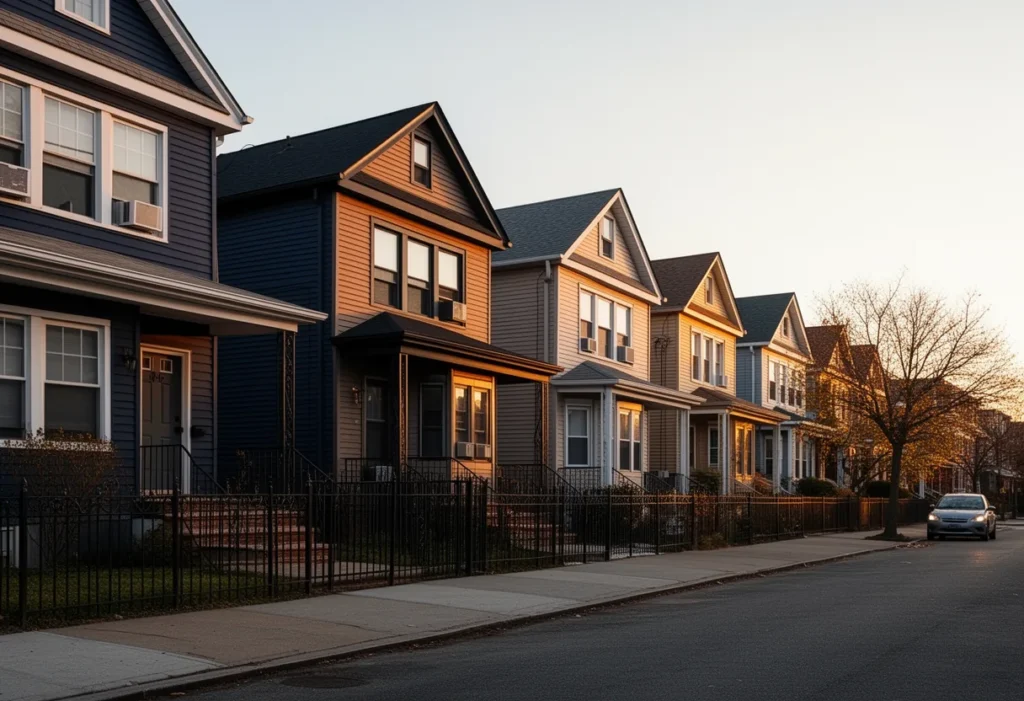
Solar panel installation in Queens has no single answer, because Queens has no single kind of building. A detached house in Bayside, an attached rowhouse in Ridgewood and a co-op in Forest Hills sit in the same borough and take three different routes.
The borough also contains the only substantial part of New York City that is not served by Con Edison, which quietly changes the interconnection and billing side for the households affected. Working out which category a property falls into is the first useful step.
Solar panel installation in Queens depends on which Queens you are in
Eastern and north-eastern Queens is dominated by detached and semi-detached houses with pitched roofs, moderate lot sizes and mature trees. This is the closest the borough comes to a conventional suburban installation.
Western and central Queens carries more attached rowhouses and small apartment buildings, usually with flat roofs, parapets and shared party walls. Roof area per household is smaller and the design work is more constrained.
Across the borough there is a large stock of co-ops and condominiums, particularly in Forest Hills, Rego Park, Jackson Heights and Kew Gardens, where the roof is a common element and no individual owner controls it.
Detached and semi-detached homes are the straightforward case
Where a homeowner controls a pitched roof, the process resembles any suburban installation with city paperwork attached. Panels are attached through the roof covering into the rafters using flashed penetrations, and the array follows the roof orientation rather than a chosen tilt.
Semi-detached houses add one recurring question: whether the roof plane is genuinely divided at the property line and whether any part of the proposed array crosses it. That should be resolved from the survey rather than assumed, because it becomes difficult to correct later.
Tree shading is the usual limiting factor in the eastern neighbourhoods, and a shading model taken on a bare winter canopy will overstate summer production.
Confirm where the array stops at a party wall
On semi-detached and attached houses, ask the installer to mark the property line on the array layout drawing. An array that oversails a neighbour’s roof plane, even slightly, creates a problem at sale and can complicate any future roof work on either side.
Attached rowhouses share a roof plane and a lot of constraints
Attached rows in Queens typically have small flat roofs behind a parapet, with a stair bulkhead, plumbing vents and air conditioning equipment already competing for space. New York City’s fire-code setbacks and access pathways then remove more of what is left.
The result is usually a small ballasted array producing partial rather than full offset. That can still be worthwhile at Con Edison rates, but a proposal claiming full offset on a narrow attached roof deserves a careful look at the layout drawing.
Roof structure also matters more here. Ballasted racking adds distributed weight, and older rowhouse roofs sometimes need a structural review before a design is finalised.
Which route each Queens housing type takes
| Housing type | Who controls the roof | Usual route |
|---|---|---|
| Detached house | The homeowner | Rooftop system, purchase or lease |
| Semi-detached house | The homeowner, up to the party line | Rooftop system with a surveyed boundary |
| Attached rowhouse | The homeowner | Small ballasted flat-roof array |
| Two to four family, owner occupied | The owner, meters may be separate | System serving the owner’s meter |
| Co-op or condo | The board, as a common element | Building project, or community solar |
| Rental apartment | The landlord | Community solar subscription |
Co-ops and condos need a board, not an installer
In a co-op or condominium the roof is a common element. An individual shareholder or unit owner cannot commission an installation on it, regardless of how the electricity would be used.
A building-scale project is possible, but it is a governance exercise: the board has to agree the project, the financing structure, how the output is credited and what happens to the roof warranty. Where the building is master metered, solar offsets the building’s own load directly. Where units are individually metered, the crediting arrangement is more involved and depends on how the project is structured with the utility.
For residents who cannot wait on a board, a community solar subscription delivers bill credits without any equipment. Both paths are set out in the guide to solar for NYC apartments and co-ops.
Part of the Rockaways is not Con Edison territory
Most of Queens is served by Con Edison, but electricity service on the Rockaway peninsula is provided by PSEG Long Island. That matters because the utility is the counterparty for interconnection, metering, permission to operate and bill credits.
Rates, application forms, incentive administration and the queue for meter exchanges all differ between the two. An installer that works mainly in Con Edison territory is not automatically familiar with the other process.
Check which utility serves the address
Do not assume Con Edison across Queens. Look at a recent electricity bill and confirm the supplier before comparing quotes, then ask each installer how many systems it has interconnected with that specific utility. Verify current interconnection terms and any per-kilowatt charge with the utility itself.
What the paperwork and the incentives look like now
Whichever part of Queens a property is in, the installation is filed with the New York City Department of Buildings, with a separate electrical filing by a licensed master electrician, and it is subject to the city’s rooftop clearance rules. Designated landmarks and historic districts, including parts of Jackson Heights and Sunnyside Gardens, trigger Landmarks Preservation Commission review first.
On incentives, the federal residential clean energy credit under section 25D ended for expenditures made after 31 December 2025, so a homeowner buying a system now claims nothing on their federal return. An expenditure counts as made when the original installation is completed, so a system finished in December 2025 but switched on in January 2026 still falls under the old rules. Systems whose installation was completed in 2025 were covered by the old rules and unused credit from that year can generally be carried forward. A separate business credit still applies to the company that owns a leased or PPA system, which is why some third-party offers still price in a federal incentive the homeowner never claims.
What remains for an owner is the New York State credit for solar energy system equipment claimed on Form IT-255 and the NYC property-tax abatement filed through the Department of Buildings and taken in four annual instalments. NYSERDA’s per-watt NY-Sun incentive, which used to come off the contract through the installer, is not available to homes at present, as described in the guide to the NY-Sun incentive programme. As of September 2026 NYSERDA has no open NY-Sun block for homes in any utility territory; check NYSERDA’s NY-Sun dashboard for a new one. How exported energy is credited afterwards is covered in the explainer on net metering in New York, and the selection questions worth asking before signing are in the guide to choosing a solar installer in New York.
Frequently asked questions
Can I install solar on an attached house in Queens?
Usually yes, but on a smaller scale than a detached house allows. After fire-code setbacks, access pathways, bulkheads and rooftop equipment, the usable area on an attached roof is often modest. Ask for the array layout drawing with the property line marked, and treat a promise of full bill offset with caution.
Which utility handles interconnection in Queens?
Con Edison serves most of the borough, but the Rockaway peninsula is served by PSEG Long Island. The utility is your counterparty for the interconnection application, metering and permission to operate, so the difference is practical rather than cosmetic. Check a recent bill and confirm before comparing quotes.
I own a co-op unit in Forest Hills. Can I get solar?
Not on your own initiative, because the roof is a common element controlled by the board. You can propose a building-wide project, which the board would have to approve along with financing and how output is credited. In the meantime a community solar subscription gives you bill credits without any equipment or board approval.
Is there still a federal tax credit for a Queens homeowner buying solar?
No. The section 25D residential credit ended for expenditures made after 31 December 2025, so a purchase today produces no federal credit. A separate business-side credit still applies to companies that own leased or PPA systems, which is why some third-party offers continue to reflect a federal incentive in their pricing. The New York State credit and the city abatement are unaffected by that change.
Confirm figures with the administrators
NY-Sun block status, the state credit cap, the city abatement percentage and utility charges all change over time. Verify current numbers with NYSERDA, the New York State Department of Taxation and Finance, the NYC Department of Buildings, and Con Edison or PSEG Long Island as applicable. This site is independent and not affiliated with any of them.
NY Solar Incentives
Independent New York solar research. We summarise NYSERDA, NY-Sun and federal programme rules from published sources and state plainly when a figure is an estimate. We are not a government agency and do not sell equipment.
Run the arithmetic on your own system
Check the dated program table and your arrangement before counting an incentive. Standard residential NY-Sun blocks are closed; Long Island Affordable Solar has a conditional income-verification route. The NY credit depends on qualified costs and tax liability, while the NYC abatement reduces future property-tax bills. The estimator keeps those timings separate.