Solar Panel Installation NYC: the New York incentives that still pay for it in 2026
For a new 2026 installation, the former federal residential credit is unavailable. New York's purchase credit can be 25% of qualified costs, up to $5,000, if the state conditions are met; its use depends on your tax liability. NYC also has a separate property-tax abatement. The standard residential NY-Sun blocks are closed, while Long Island Affordable Solar has a conditional income-verification route. Check the dated program table, then separate your installation price from any later tax benefit.
Independent consumer resource. Not a government agency, and not affiliated with NYSERDA, ConEd or PSEG Long Island.
- 1
NYSERDA NY-Sun rebateStandard residential blocks are closed in all three regions. Long Island Affordable Solar income-verification intake accepts applications, but funding and an individual award are unconfirmed. See the regional status and official sources.
- 2
NY State tax credit25% of system cost, capped at $5,000, claimed on Form IT-255.
- 3
NYC property tax abatementReduces the building's property tax over four years (Class 1, 2 & 4).
- 4
RPTL §487 exemptionThe value solar adds can be exempt from property tax for 15 years if you file Form RP-487 with your assessor by the taxable status date, unless your locality has opted out.
- 5
Net meteringPower the array sends to the grid is credited on your electric bill.
Sun altitudes are solar noon over New York City (latitude 40.7° N); light entering the windows is drawn at the same angle. Diagrammatic, not to scale.
The 2026 solar incentive stack for New York homeowners
What each program pays, where you claim it, and who runs it. For eligibility rules, how to claim each one on your taxes and the common mistakes, see the full incentives breakdown.
Official sources checked . This is a dated source check, not a live funding or award confirmation.
| Program and status | Main eligibility and timing | Next step and official sources |
|---|---|---|
| Federal residential §25DNo new credit for a new 2026 installation | The expenditure timing test generally uses completed installation, with separate rules for an original-use structure. Valid older carryforwards need their own review. | Check the IRS timing guidance and final instructions for the year being filed. |
| NY solar equipment tax creditConditional tax benefit, not an invoice rebate | Qualifying purchase: 25% of eligible costs, up to $5,000; NY principal residence, utility connection and other IT-255 conditions. Not refundable; unused credit may carry into the next five tax years. Lease/PPA methods are separate and qualifying contracts require at least ten years. | Confirm qualified costs, tax liability and contract route with your preparer. |
| Standard residential NY-Sun — Con EdisonClosed for new standard-block applications | The official residential block chart gives a closed date of May 29, 2025. A closed block is different from an older project with a reserved award. | Do not deduct a new standard-block award without written program confirmation. |
| Standard residential NY-Sun — UpstateClosed for new standard-block applications | The official residential block chart gives a closed date of December 17, 2025. A closed block is different from an older project with a reserved award. | Do not deduct a new standard-block award without written program confirmation. |
| Standard residential NY-Sun — Long IslandClosed for new standard-block applications | The official residential block chart gives a closed date of April 17, 2016. A closed block is different from an older project with a reserved award. | Do not deduct a new standard-block award without written program confirmation. |
| Affordable Solar — Con Edison / UpstateAffordable blocks closed | Con Edison closed October 15, 2025; Upstate closed March 9, 2026. Income eligibility alone does not reopen those blocks. | Use the regional chart and contractor documentation. |
| Affordable Solar — PSEG Long IslandIncome-verification intake accepts applications; funding and award unconfirmed | Income under 80% of AMI or 80% of SMI, whichever is higher, with household-size and location rules. NYSERDA advertises a conditional total rate of $0.40/W; this is not an extra payment on top of an ordinary residential block. | Verify income and work with a participating contractor. Confirm available funding, submitted project status and your written award before deducting anything. |
| NYC solar property-tax abatementConditional future property-tax reduction | Qualifying class 1, 2 or 4 property, system placed in service on or after January 1, 2024 and before January 1, 2035. Each of four years: smallest of 7.5% of qualified expenditure, eligible annual property tax, or $62,500. Incompatible benefits and other conditions apply; unused annual amount does not carry forward. | Use the DOB application process; check March 15 before the property-tax year beginning July 1. The overall statutory last-application boundary does not extend the 2034 placed-in-service window. |
| RPTL §487 added-value exemptionConditional property-assessment treatment | Up to 15 years for the added assessed value attributable to qualifying equipment; not an exemption of the entire home or all property tax. Local opt-outs/PILOT and the before-January-1-2030 construction condition matter. | Confirm the assessor deadline and file RP-487. NYC has its own published January 5 filing guidance. |
| Residential solar sales-tax exemptionState exemption; local rate depends on location | Qualifying equipment/installation is exempt from 4% state tax and the 3/8% MCTD tax where applicable. Local exemption depends on adoption; NYC has adopted it. Publication 718-S retrieved for this check is dated March 2022. | Check the official local-rate list. Do not subtract a second discount if the quoted invoice already applies the exemption. |
| Community solar subscriptionUtility bill credits under contract | Renters can participate without buying rooftop equipment. The project must serve the same electric utility territory. Subscription charges, monetary versus kWh credit rules, terms and cancellation determine net savings. | Compare credit value minus charges using the actual disclosure; a subscription alone does not establish rooftop-purchase tax-credit eligibility. |
| Statewide Solar for AllUtility-specific no-fee bill-credit route | Energy Affordability Program enrollment and applicable disadvantaged-community rules depend on the utility. New National Grid electric EAP entrants from December 1, 2025 require the DAC condition; documented older participants have separate grandfathering. EEAP is not blanket SFA eligibility. | Check the electric utility EAP and SFA rules. This program may coexist with ordinary community solar under the utility rules. |
| Earlier NY Pilot Solar for AllSeparate limited application route | Current route: Central Hudson, or NYSEG customers in Chenango, Delaware, Otsego or Sullivan counties; under 80% SMI, own electric account, at least 1,000 kWh annual usage and other eligibility conditions. | Check the Pilot application and existing solar-bill-credit exclusion; do not apply that exclusion to all Statewide SFA participants. |
| Federal EPA Solar for AllCurrent NY application reopening and disbursement unconfirmed | The August 2025 termination was vacated by federal court rulings in September 2026. That legal development does not by itself verify an open New York intake or an individual funded award. | Check a current NY administrator application notice before assuming funding or enrollment. |
Source versions: final 2025 IT-255 instructions; NY-Sun Manual April 2026, version 22; linked sales-tax Publication 718-S dated March 2022. A source-check date describes this table, not a professional review of every article. Research and correction method.
Separate installation cost from a possible tax credit
An illustrative purchase calculation, not an eligibility decision or an installer quote. The starting values are examples, not a survey of market prices. Your entries stay in this browser.
Installation and tax are separate
Confirm the residence and utility conditions before treating the potential credit as usable.
- Quoted installation price before grants or rebates
- $20,100
- Confirmed upfront grant or rebate
- −$0
- Quoted price after confirmed award
- $20,100
- Assumed qualified cost for the NY credit
- $20,100
- Potential NY credit, if eligible (25%, up to $5,000)
- $5,000
- Credit usable this year
- Not determined
- Unused credit for the next five tax years
- Not determined
- Cost if the full NY credit is eventually used
- $15,100
- New federal residential §25D credit for a 2026 installation
- $0
NYC's separate property-tax abatement can reduce a qualifying property's bill over four years. Each annual amount is the smallest of 7.5% of qualifying expenditure, that year's eligible property tax, and $62,500. Unused annual abatement does not carry forward. It is excluded from the calculation above; confirm property class, incompatible benefits and the DOB application. NYC rules and a capped example.
The NY credit is not refundable and does not lower the installer's invoice. Carryforward is subject to the next-five-tax-years limit and future available tax liability. The tool subtracts confirmed non-taxable grant funding and entered excluded costs from the assumed NY basis. It does not model loan payments, credit ordering, lease/PPA formulas, prior carryovers, or an additional sales-tax discount. Method, conditions and official IT-255 sources.
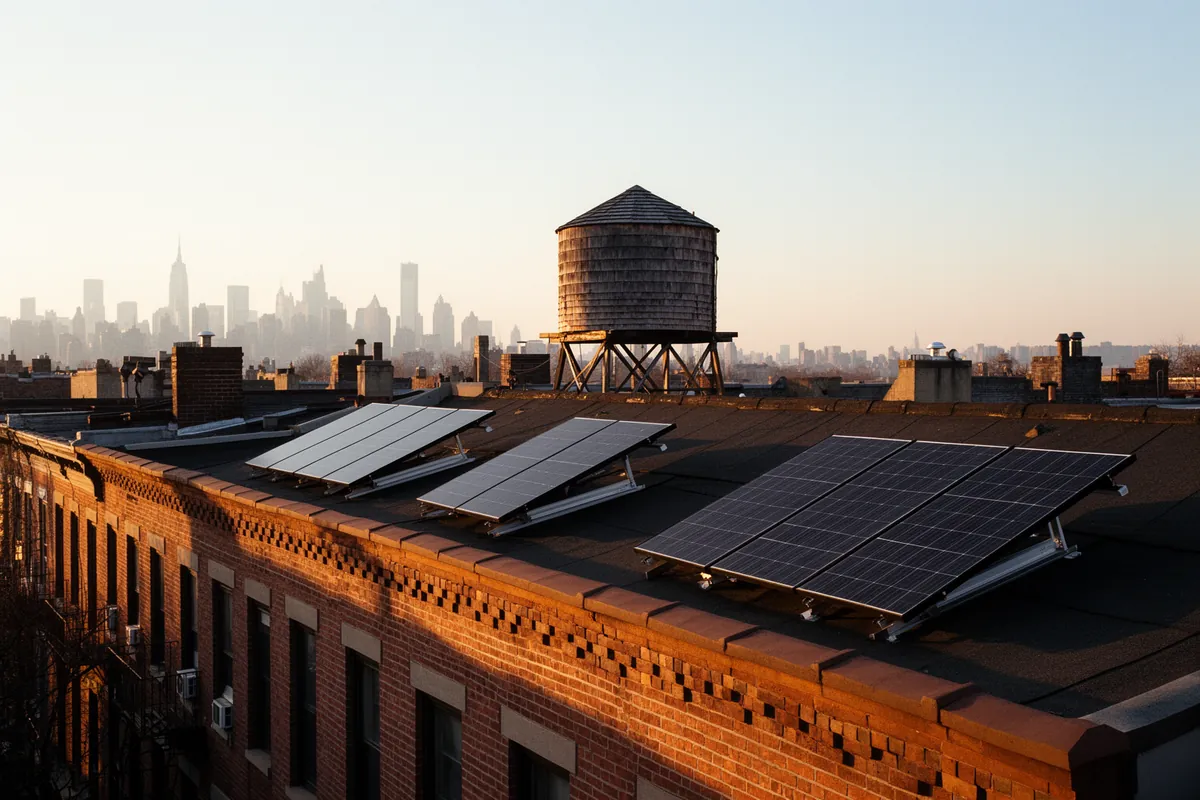
Solar panel installation in NYC adds city paperwork
People assume it's complicated, and in the five boroughs it does add steps a suburban install doesn't have. An experienced local installer handles them, but it helps to know what they are.
- Department of Buildings permitsThe installer files with the NYC DOB before any work starts.
- Utility interconnectionConEd or PSEG handles the paperwork to connect the system to the grid.
- Landmarks, where it appliesSome buildings also need Landmarks Preservation Commission approval.
What happens when you go solar in NYC, week by week
The physical installation takes a day or two. From the first site visit to switching the system on typically runs 8 to 12 weeks, and most of that is permitting.
Read the full installation guide, by borough, roof type and timeline
Does solar pay for your home? Compare the actual assumptions
A lower electricity bill is different from a tax credit or an installation grant. Compare quoted equipment and installation costs, financing charges, modeled annual production, the utility's export-credit rules, maintenance, roof work and the terms for selling or ending the arrangement.
For illustration only, assume a qualifying purchased system costs $20,100, receives no grant, and has no excluded costs. Its potential NY credit is $5,000. The installation invoice is still $20,100. If only $1,500 of NY tax liability is available for this credit this year, $1,500 can be used and $3,500 remains for the next five tax years, subject to their rules. The cost after eventually using all $5,000 would be $15,100; that result is conditional.
NYC's abatement is a separate, capped reduction in future property-tax bills. Sales-tax relief may already be built into the quote; do not subtract it again. Ordinary NY-Sun blocks are closed. Long Island Affordable Solar needs its own income and award confirmation.
Read the complete incentive guide for official rules and compare a purchase, a lease, a PPA and community solar using the actual contract terms.
Start with the rule that applies to you
These core guides separate eligibility, program availability and the timing of a benefit. Source checks are shown beside the rules.
New York solar guides by topic
Latest guides
- Round Trip Efficiency Battery Ratings and Where the Loss Goes
- Lithium Iron Phosphate Safety and What the Cell Actually Does
- Your Solar Is Producing Less Than the Estimate. Why?
- Reading Enphase Enlighten Without Guessing
- Reading Your SolarEdge Monitoring App Like an Owner
- Is an Extended Warranty Worth It on a Heat Pump or Solar…
- Ice Storm Power Outage: Why Rooftop Solar Shuts Down Too
- Solar Permits in Brooklyn Landmark Districts: What Changes
- NYSERDA Solar Projects: How the Programs Actually Work
- Orange & Rockland Solar Rebate: What Actually Exists
- National Grid CBC Charge: 97 Cents a Kilowatt a Month
- Solar Panel Cost in Camillus, NY: Fixed Costs and Choices
- Solar Panel Cost in Batavia, NY: How to Read the Quote
- What Solar Panels Cost in Glens Falls, NY
- What Solar Panels Cost in Geneva, NY
- PSEG Long Island Battery Storage: What It Really Buys
Browse by topic
- Solar in the Hudson Valley and Westchester 71
- Solar by Region 60
- Utilities and Net Metering 57
- Solar on Long Island 55
- Solar in Upstate New York 48
- Equipment and Technology 28
- Solar Incentives 26
- Batteries and Home Storage 26
- Installation and Permits 20
- Maintenance and Repair 19
- Solar and Your Property 17
- Solar in Central New York 17
Frequently asked questions about solar in NYC
How much does solar panel installation cost in NYC after all incentives?
Use an actual quote and separate the invoice from later tax benefits. In a hypothetical eligible $20,100 purchase with no grant or excluded cost, the potential NY credit is $5,000; the invoice remains $20,100. With $1,500 of available NY tax liability, $1,500 is usable this year and $3,500 carries into the next five tax years under the rules. A new 2026 installation gets no new federal residential §25D credit. The NYC abatement affects future property-tax bills. Standard residential NY-Sun blocks are closed; Long Island Affordable Solar requires separate income, funding and award confirmation. See the source-backed guide.
Are there free solar panels in New York, including for seniors?
No New York program gives rooftop panels away. Offers advertised as free are a lease, a power purchase agreement, a zero-down loan or a community solar subscription, and none of them depends on age. Only community solar costs nothing to join, and it installs nothing at your home. Low-income households enrolled in their utility’s Energy Assistance Program may get the Statewide Solar for All bill credit at no cost, under each utility’s rules. What each “free” offer really costs.
Do I need to replace my roof before installing solar panels?
Have the roof condition, remaining service life, structure, proposed mounting system and warranty terms assessed for your project. There is no universal 15-year threshold that decides eligibility. Removing and reinstalling an array for later roof work can add cost; ask for that cost and the roof assessment in the proposal.
How long does the whole process take from start to finish?
The schedule depends on the roof, design, permits, utility interconnection, equipment and any required electrical work. Ask the installer for the milestones and dependencies for your actual project. Physical panel installation is only one stage; it does not by itself establish permission to operate or incentive eligibility.
Will my solar panels work during a power outage?
A standard grid-connected array generally does not supply your home during an outage. Backup needs an appropriately designed system, compatible equipment, isolation and circuit protection. A battery or transfer switch alone does not prove that those conditions are met. Confirm the exact equipment with a qualified electrician, and check any current storage incentive separately. Why rooftop solar shuts down in an outage.
Can renters or apartment dwellers go solar?
Community solar is often a practical option because it can provide bill credits without installing equipment on your building. Confirm the electric utility territory, contract charges and cancellation terms. A renter who actually purchases qualifying equipment for a New York principal residence may have different NY tax-credit facts; renting alone is not a blanket tax exclusion. Compare community-solar routes.
Will solar panels increase my property taxes?
RPTL §487 can exempt the added assessed value attributable to a qualifying solar system for 15 years. It does not freeze every property tax or exempt the full home value. File Form RP-487, confirm your assessor's deadline, and check local opt-outs or a payment-in-lieu-of-taxes requirement. Construction must meet the statute's before-January-1-2030 condition. Official NY assessment guidance.
Start with the arithmetic, then talk to installers
Run the estimate on your own system size, read your borough's guide, and walk into every quote knowing which incentives it should include.