Solar Panels in Brooklyn: Roofs, Rules and Returns
Brooklyn has no shortage of sunlight. What it has a shortage of is unobstructed, unlandmarked, structurally simple roof area that a single owner controls.
On this page 7 sections
- 01Solar panels in Brooklyn compete with everything else on the roof
- 02Landmark districts cover a large share of the borough
- 03What kind of Brooklyn building you have decides the route
- 04Most Brooklyn residents cannot put panels on their own roof
- 05Con Edison territory sets the bill arithmetic
- 06What actually determines the return in Brooklyn
- 07Frequently asked questions
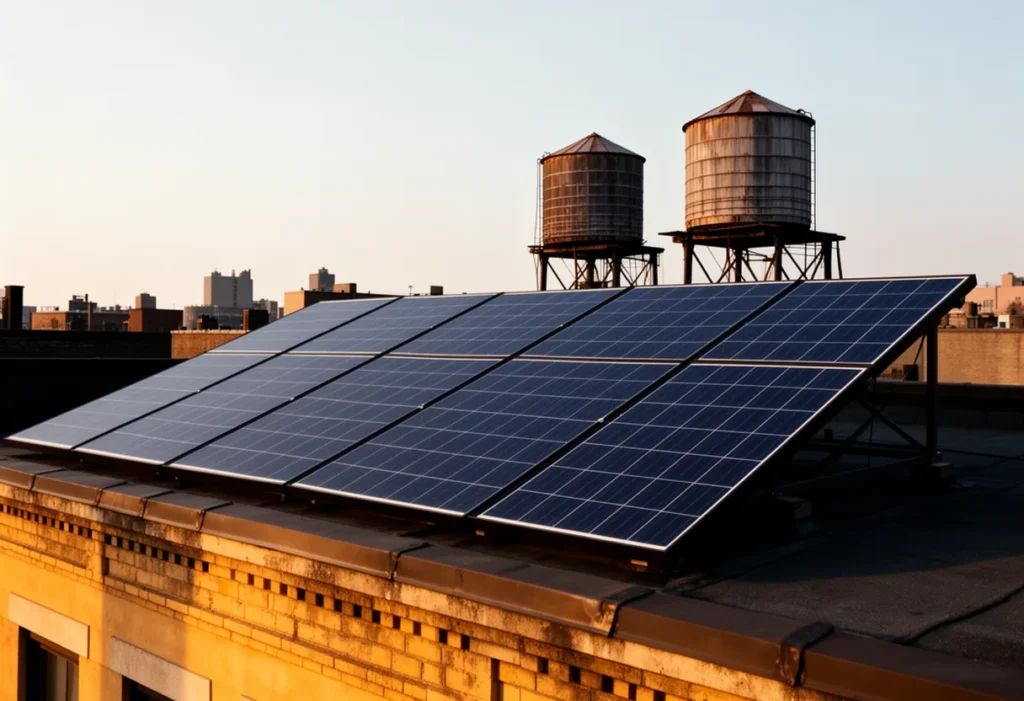
Solar panels in Brooklyn are limited by geometry and ownership far more than by sunlight. The borough receives roughly the same solar resource as the rest of the region, and the constraint is almost never the sun.
The constraint is a roof that is small, flat, often overlooked by a taller neighbour, frequently inside a historic district, and in a great many buildings not controlled by the person who wants the panels. Everything specific about Brooklyn solar follows from those four facts.
Solar panels in Brooklyn compete with everything else on the roof
A typical Brooklyn rowhouse roof is flat, narrow and already occupied. Stair bulkheads, skylights, plumbing vents, chimneys, air conditioning condensers and in some buildings a water tank all take space, and each one casts a moving shadow across the day.
Fire-code clearances then remove more area. New York City requires clear perimeter setbacks and access pathways around rooftop arrays so firefighters can reach and ventilate the roof, and on a narrow lot those requirements can consume a large share of the deck.
The practical result is that a Brooklyn rowhouse often supports a modest array rather than a large one. That is not a reason to skip solar, but it does mean the system may offset part of a bill rather than all of it, and any proposal promising full offset on a small rowhouse roof deserves scrutiny.
Check the neighbours’ development rights
Shading from an adjacent building is permanent and unappealable. Before committing, look at whether neighbouring lots are built out to their allowable height, because a new storey next door can shade an array for the rest of its life. A local architect or a zoning search can answer this in an afternoon.
Landmark districts cover a large share of the borough
Brooklyn Heights, Park Slope, Fort Greene, Clinton Hill, Cobble Hill, Boerum Hill and several other neighbourhoods contain designated historic districts. Where a building sits in one, the Landmarks Preservation Commission reviews the installation before the Department of Buildings will permit it.
The Commission’s concern is visibility from public streets rather than energy output. Flat-roofed Brooklyn rowhouses are often well suited to approval because a parapet can conceal a low-tilt array, but the required setback from the street-facing edge takes further area away.
Landmark status is a matter of public record and should be checked before design work begins, not after. It affects both the schedule and the achievable system size.
What kind of Brooklyn building you have decides the route
| Building type | Typical roof | Usual solar route |
|---|---|---|
| Detached or semi-detached house | Pitched or mixed, moderate area | Standard rooftop purchase or lease |
| Rowhouse, single owner | Small flat roof, several obstructions | Small ballasted array, often partial offset |
| Two to four family, owner occupied | Flat roof shared with tenant meters | Rooftop system serving the owner’s meter |
| Co-op or condo | Roof is a common element | Board-led building project, or community solar |
| Rental apartment | Not controlled by the resident | Community solar subscription |
| Warehouse or mixed-use with large roof | Large flat membrane roof | Commercial-scale or community solar host |
Most Brooklyn residents cannot put panels on their own roof
A large proportion of the borough lives in co-ops, condos and rental buildings where the roof is either a common element or the landlord’s property. No amount of interest in solar changes that, and it is the single most common reason a Brooklyn enquiry does not end in an installation.
The alternative is a community solar subscription, where you take a share of an off-site array and receive bill credits on your Con Edison account without owning equipment or touching the building. The mechanics, including what the contract should say about cancellation, are covered in the guide to community solar in Brooklyn.
For co-op and condo owners there is a middle path, in which the board develops a rooftop system for the building. That is a governance project as much as an engineering one, and it is discussed in the article on solar for NYC apartments and co-ops.
Con Edison territory sets the bill arithmetic
Brooklyn is Con Edison territory, and Con Edison’s rates are among the higher ones in the state. That cuts both ways for solar economics.
High electricity prices mean each kilowatt-hour a system produces displaces a more expensive unit, which shortens payback compared with a lower-cost service territory. At the same time, NY-Sun incentive levels are administered by region, and the Con Edison region has its own megawatt block sequence that steps down independently of upstate.
Bill credits for exported energy follow New York’s net metering rules, with a separate per-kilowatt charge applied to systems interconnected after the phase-in date. Con Edison is the authority on the current charge and on the metering arrangement for your specific service class.
The federal credit no longer applies to purchases
The federal residential clean energy credit under section 25D ended for expenditures made after 31 December 2025. An expenditure counts as made when the original installation is completed, so a system finished in December 2025 but switched on in January 2026 still falls under the old rules. A Brooklyn homeowner buying a system now claims nothing federally. Any quote still showing a 30 percent federal deduction for an owned system is out of date, and that is worth raising directly with the company.
What actually determines the return in Brooklyn
Four variables do most of the work: usable roof area after clearances, shading from surrounding buildings, the price you pay per installed watt, and the rate you were paying Con Edison beforehand. Everything else is secondary.
On the incentive side, what remains for an owner is the New York State credit for solar energy system equipment, a percentage of qualified expenditure subject to a statutory cap and claimed on Form IT-255, plus the New York City property-tax abatement taken in four annual instalments. The abatement is applied for through the Department of Buildings, and the filing steps are set out in the guide to applying for the NYC solar tax abatement.
Because Brooklyn arrays are often small, fixed costs such as permitting, scaffolding, roof access and electrical work spread across fewer watts. That raises the cost per watt relative to a large suburban roof, and it is the main reason Brooklyn pricing looks different from statewide averages. Local price patterns are discussed further in the note on solar panel cost in Brooklyn.
Frequently asked questions
Is a Brooklyn rowhouse roof big enough for solar?
Often yes, but for a smaller system than a suburban roof would take. After fire-code setbacks, access pathways, bulkheads and mechanical equipment, the usable rectangle on a rowhouse is frequently a fraction of the total roof. Expect partial rather than full offset of your electricity use, and ask for the modelled annual production figure in writing.
Can I install solar if my Brooklyn building is in a historic district?
Usually, subject to Landmarks Preservation Commission review, which focuses on whether the array is visible from public streets. Flat roofs with parapets are often approved because a low-tilt array can be concealed, though a setback from the street-facing edge is typical. Check the building’s landmark status before design work starts, since it affects both the timeline and the system size.
What can I do if I rent or live in a co-op?
Community solar is the practical route, because it requires no equipment and no roof rights. You subscribe to a share of an off-site array and receive credits on your Con Edison bill. Co-op and condo owners can also raise a building-wide rooftop project with the board, though that is a longer governance process.
Does Brooklyn get enough sun for solar to be worth it?
The solar resource in Brooklyn is comparable to the wider region and is not the limiting factor. What limits output is local shading from adjacent buildings and rooftop structures, plus the reduced array size that fire-code clearances impose. A modelled shading analysis for your specific roof is far more informative than any borough-level figure.
Programme figures change
NY-Sun block rates, the state credit cap, the city abatement percentage and Con Edison’s charges are all revised periodically. Confirm current values with NYSERDA, the New York State Department of Taxation and Finance, the NYC Department of Buildings and Con Edison before making a decision. This site is independent and not affiliated with any of them.
NY Solar Incentives
Independent New York solar research. We summarise NYSERDA, NY-Sun and federal programme rules from published sources and state plainly when a figure is an estimate. We are not a government agency and do not sell equipment.
Run the arithmetic on your own system
Check the dated program table and your arrangement before counting an incentive. Standard residential NY-Sun blocks are closed; Long Island Affordable Solar has a conditional income-verification route. The NY credit depends on qualified costs and tax liability, while the NYC abatement reduces future property-tax bills. The estimator keeps those timings separate.