Solar Permits in Brooklyn Landmark Districts: What Changes
A rooftop in a designated historic district in Brooklyn goes through an extra review most New York installs never see. Here is what that review actually covers.
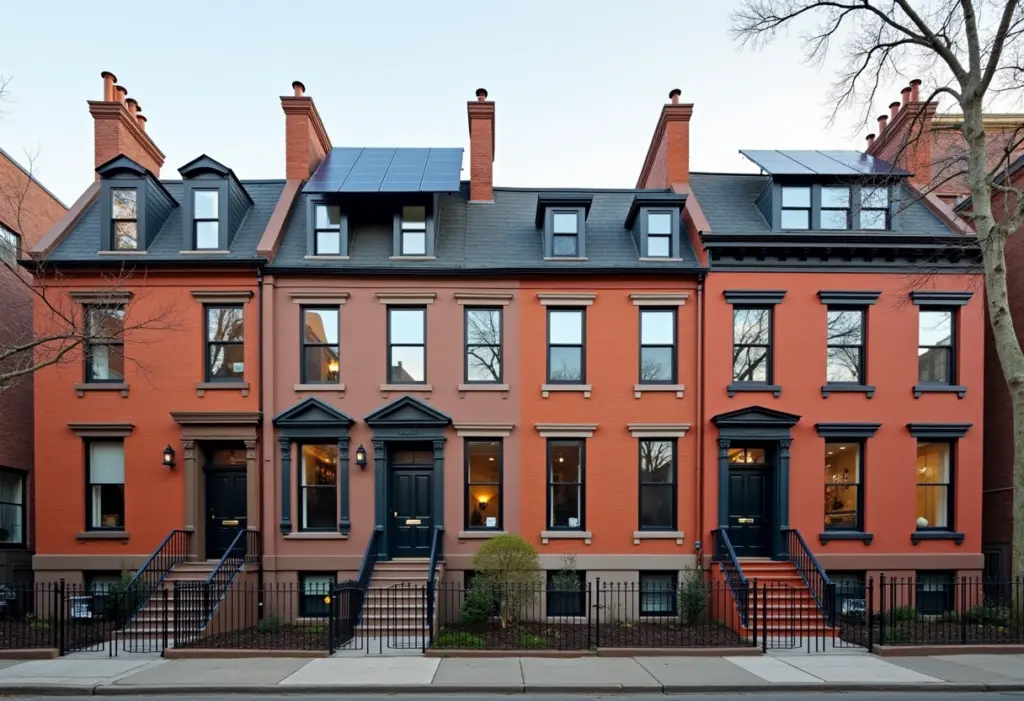
Brooklyn has more designated historic and landmark districts than any other borough in New York City, covering large stretches of neighborhoods like Park Slope, Brooklyn Heights, Fort Greene, Clinton Hill and Bedford-Stuyvesant. A rooftop solar installation inside one of these districts goes through an extra layer of review that a house a few blocks outside the boundary line does not, and that review — not the underlying electrical permit — is usually what determines how long the project actually takes.
The extra step is Landmarks Preservation Commission review
Outside a historic district, a solar installation in New York City is generally reviewed by the Department of Buildings under standard electrical and structural permit rules. Inside a designated historic district, the same project also needs a sign-off from the Landmarks Preservation Commission (LPC) before the Department of Buildings permit can move forward. The LPC review is about visibility and appearance from the public street, not about the electrical work itself.
For most rooftop solar in a low-rise historic district, LPC review happens at the staff level rather than requiring a public hearing, provided the installation meets the agency’s existing solar guidelines. A project that follows those guidelines closely can often be approved administratively; one that does not may be pushed to a fuller review process, which adds real time.
Confirm your address is actually inside the district
Historic district boundaries in Brooklyn are drawn block by block and do not always follow intuitive lines. Confirm your specific address against the LPC’s own designated-district maps before assuming either that you need this review or that you do not.
What the visibility rules generally look for
LPC’s published solar guidance for historic districts focuses on whether panels and their mounting hardware are visible from the street. In practice, that tends to mean panels are more straightforward to approve when placed on rear-facing roof slopes, set back from the front roofline, or otherwise screened from view at street level, and more likely to require closer review when they would sit on a front-facing slope or a mansard visible from the sidewalk. Racking height, wiring conduit routing, and how the array interacts with existing rooftop features like chimneys and bulkheads are also part of what staff look at.
None of this is a blanket prohibition on visible panels — it is a review process, and outcomes depend on the specific roof geometry and the specific block. An installer with recent experience in a particular historic district will generally have a clearer sense of what has been approved nearby than a general contractor working there for the first time.
Typical rowhouse and brownstone roof constraints
Separate from the landmark review, Brooklyn’s brownstone and rowhouse building stock brings its own physical constraints that shape what a system can look like regardless of district status: shared party walls, limited roof area compared to a detached suburban home, existing rooftop mechanicals, and roofs that are flat or low-slope rather than pitched. A system on this kind of roof is often sized and laid out differently than a suburban install with a wide-open south-facing roof plane, simply because there is less usable area and more competing equipment already up there.
| Factor | Non-landmarked Brooklyn address | Designated historic district |
|---|---|---|
| Primary reviewing agency | Department of Buildings | Landmarks Preservation Commission, then Department of Buildings |
| Typical review focus | Structural and electrical compliance | Street-level visibility, plus structural and electrical compliance |
| Preferred panel placement | Best solar exposure, generally unrestricted | Often steered toward rear or set-back roof areas |
| Added timeline | Standard permit timeline | Additional LPC review step before DOB sign-off |
What this means for timeline and cost
The extra LPC step adds review time before construction can begin — how much depends on whether the project qualifies for staff-level approval or needs a fuller hearing, and on the commission’s current caseload. It does not necessarily change the underlying cost of the panels and equipment, though a layout constrained to a smaller rear roof section, or one requiring additional screening or non-standard racking, can affect system size and therefore price. An installer quoting a Brooklyn historic-district project should be able to say upfront whether they expect staff-level or full review and roughly how that has played out on recent jobs nearby.
Ask for the LPC guidance sheet directly
The Landmarks Preservation Commission publishes its own solar panel guidelines. Reading that document, or asking your installer to walk through it against your specific roof, is more useful than relying on a general description of the process.
How this fits the rest of a Brooklyn solar decision
Landmark review is one factor among several that shape a Brooklyn solar project, alongside roof condition, utility interconnection with Con Edison, and financing choice. For the cost side of the decision, see what typically drives solar panel cost in Brooklyn, and for the general process across the borough, the overview on solar panels in Brooklyn: roofs, rules and returns covers ground this article does not. If your building falls outside a historic district but you are still weighing a citywide view of permitting, the NYC-wide guide to permits and process is the broader reference point.
Frequently asked questions
Do all Brooklyn solar installs need Landmarks Preservation Commission review?
No. Only properties inside a designated historic or landmark district need this additional review. Most of Brooklyn is not inside such a district, though many well-known neighborhoods are.
Does landmark status mean solar panels are not allowed?
No. The Landmarks Preservation Commission has published guidance specifically for approving solar installations in historic districts. The review affects placement and visibility, not whether solar is permitted at all.
How much longer does landmark review typically add?
It varies by whether the project qualifies for staff-level approval or needs a fuller hearing, and by the commission’s current caseload. An installer with recent local experience can usually give a realistic estimate for your specific block.
Can I find out if my Brooklyn address is in a historic district before contacting an installer?
Yes. The Landmarks Preservation Commission publishes designated-district maps that you can check against your address directly, before starting the quoting process.
Figures and rules change
Landmarks Preservation Commission guidelines and review procedures are set and updated by the commission itself. Confirm current requirements directly with LPC or a Brooklyn installer experienced with your specific district before assuming a fixed timeline.
NY Solar Incentives
Independent New York solar research. We summarise NYSERDA, NY-Sun and federal programme rules from published sources and state plainly when a figure is an estimate. We are not a government agency and do not sell equipment.
Run the arithmetic on your own system
Check the dated program table and your arrangement before counting an incentive. Standard residential NY-Sun blocks are closed; Long Island Affordable Solar has a conditional income-verification route. The NY credit depends on qualified costs and tax liability, while the NYC abatement reduces future property-tax bills. The estimator keeps those timings separate.