Community Solar for Orange & Rockland Customers
Community solar puts credits from an off-site array onto your Orange and Rockland bill. You own nothing, you need no roof, and you pay no capacity charge.
On this page 7 sections
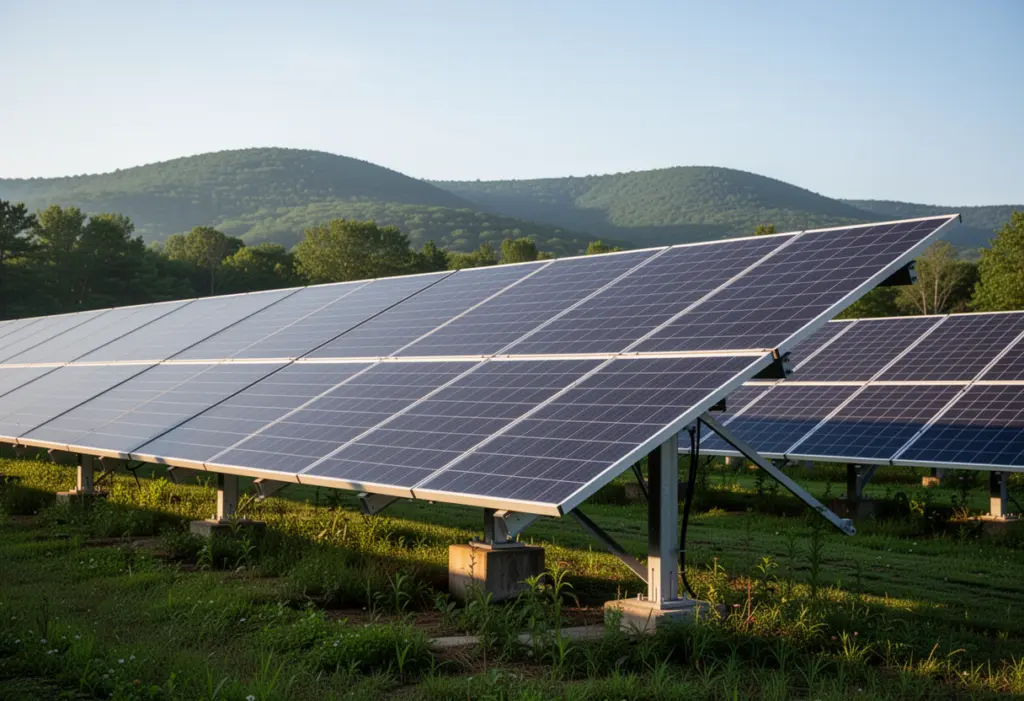
Community solar is a subscription to a share of an off-site array. The array exports to the grid, your share of that output becomes a credit, and the credit lands on your Orange & Rockland bill. You own no equipment, you need no roof, and no one comes to your house.
That last point is the whole appeal for a large part of Rockland County: renters, condominium and co-op residents, anyone under a mature tree canopy, anyone whose roof has five years left in it, and anyone who simply does not want a twenty-year decision attached to a building they may sell.
The capacity charge difference is real money
Rooftop owners pay the Customer Benefit Contribution monthly on the DC size of their array — $1.00 per kW-month on O&R for 2026. A 12 kW roof therefore pays $12.00 a month, $144 a year, forever, regardless of what the weather did.
Community solar subscribers pay no capacity charge at all. The charge does not apply to front-of-the-meter projects, and community solar is one. It is not a huge sum, but it is a genuine structural difference between the two routes and it almost never appears in a comparison a salesperson prepares.
What you give up
Be clear-eyed about this. A subscription is a discount on electricity, not an asset.
- No state tax credit. New York’s 25 percent credit on Form IT-255 requires solar energy system equipment installed and used at your principal residence. A community array is not at your residence. A ten-year purchase agreement for power from equipment you do not own can qualify where the equipment is at your home; a community solar subscription is a different arrangement. If someone tells you your subscription earns you IT-255, get that in writing and take it to your accountant.
- No property value. There is nothing attached to the house to sell.
- No resilience. A subscription does nothing in an outage. Neither does an ordinary grid-tied roof array, but people assume differently about both.
The five things to read in the contract
- The cancellation terms and the notice period. This is the single most important clause. How many days notice, is there a fee, and what happens to credits already banked.
- Whether the discount is guaranteed or indicative. A guaranteed percentage off the value of the credits is a different product from a projection.
- What happens when you move. Within the same utility territory a subscription can usually transfer. Moving from O&R territory into Central Hudson territory — entirely possible inside Orange or Sullivan County — may end it.
- How the billing works. Some arrangements consolidate onto one bill, others send a separate invoice from the subscription company alongside your O&R bill. Two bills is not a problem, but not expecting two bills is.
- Allocation. How your share is sized against your consumption, and what happens if you use much less than expected.
A Rockland-specific point about supply contracts
If you already buy your supply from an energy services company rather than from O&R, check how the subscription interacts with that agreement before you sign either. The two arrangements are independent and can both be live at once, which makes the arithmetic on your actual savings harder to see than a marketing page suggests.
If your utility is not Orange & Rockland
Read the name on your bill. Central Hudson serves parts of Orange and Sullivan counties too, and a community solar project has to be in the same utility territory as the subscriber for the credits to arrive. A municipal electric department customer is outside the Public Service Commission’s community distributed generation framework entirely, and should ask that utility what, if anything, it offers.
2026 incentives, and the one that stopped mattering
Community solar is the route where the collapse of the federal residential credit changes nothing for you, because you were never the taxpayer claiming it. Section 25D ended for expenditures made after 31 December 2025; a subscriber never made an expenditure on equipment in the first place. The commercial owner of the array claims what survives on the business side, which is part of why subscription pricing exists at all. Your own economics are simply the discount in the contract, the absence of the capacity charge, and the flexibility to leave. Check the current terms directly with the subscription provider and confirm your utility from your bill — programmes and providers change.
Frequently Asked Questions
Do community solar subscribers pay the CBC?
No. The Customer Benefit Contribution does not apply to front-of-the-meter projects such as community solar. A rooftop owner on O&R pays $1.00 per kW-month of DC size in 2026; a subscriber pays none of it.
Can I claim the New York state solar credit on a community solar subscription?
Generally no. Form IT-255 requires solar energy system equipment installed and used at your principal residence, and a community array is off site. If anyone claims otherwise, get it in writing and ask your accountant.
What happens to my subscription if I move?
Within the same utility territory it can usually transfer. Moving out of Orange & Rockland territory into another utility's area may end it, so read the transfer and cancellation clauses before signing.
Does community solar work for renters?
Yes. There is no equipment at your home, so no landlord permission and no roof are needed. It is the main route to solar savings for renters and for co-op and condominium residents.
This article is general information, not tax, legal or financial advice. Incentive amounts, eligibility rules and deadlines change and depend on your utility, your tax situation and your property. Confirm current terms with NYSERDA, your utility and a qualified tax professional before making a decision.
NY Solar Incentives
Independent New York solar research. We summarise NYSERDA, NY-Sun and federal programme rules from published sources and state plainly when a figure is an estimate. We are not a government agency and do not sell equipment.
Run the arithmetic on your own system
Check the dated program table and your arrangement before counting an incentive. Standard residential NY-Sun blocks are closed; Long Island Affordable Solar has a conditional income-verification route. The NY credit depends on qualified costs and tax liability, while the NYC abatement reduces future property-tax bills. The estimator keeps those timings separate.