Form IT-255: Filling Out the New York Solar Credit
Form IT-255 is short, but almost every problem with it happens before the arithmetic — in whether you qualify, which of three arrangements you're in, and which line on Schedule A or B the number actually belongs on.
On this page 9 sections
- 01Qualifying, in order
- 02The arithmetic, and where the three routes diverge
- 03How to fill out Form IT-255, line by line
- 04What the credit can and cannot do for you
- 05The mistakes that get returns adjusted
- 06Where to get the form, and how to file it
- 07Before you file
- 08The rest of the 2026 position
- 09Frequently Asked Questions
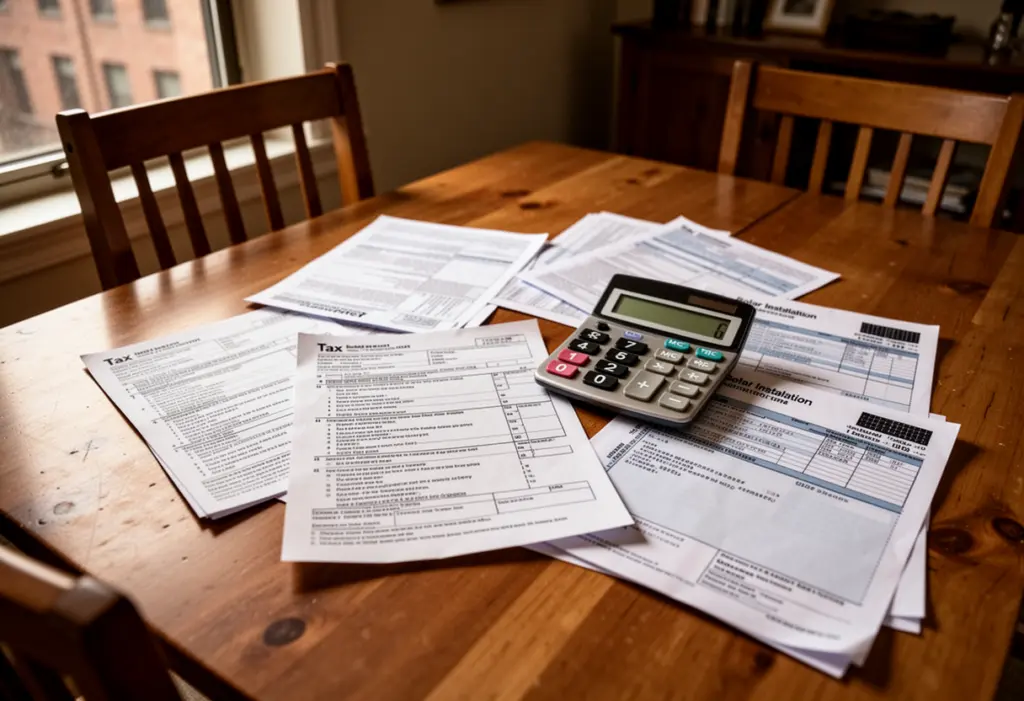
Form IT-255, the Claim for solar energy system equipment credit, is how a New York taxpayer claims 25% of qualified solar expenditure, capped at $5,000. It is filed with Form IT-201 or IT-203. The form itself is short — one page, two schedules. Almost everything that goes wrong with it goes wrong before the arithmetic: in whether you qualify at all, in which of three arrangements you’re actually in, and in which line the resulting number belongs on.
Qualifying, in order
The property must be your principal residence in New York State — the home where you and your family live most of the time. Not a seasonal cottage, not a second home, not a rental you own. It can be a house you own or rent, a mobile home, a cooperative apartment, or a condominium. This is the single most common reason a claim fails, and it is not negotiable by argument.
The system must be net metered. If the equipment produces electricity, you must enter a net energy metering contract with your electric corporation, or comply with its net metering schedule, before the credit applies — and the completed system must be connected to that utility’s transmission and distribution facility. Confirm this with your utility before you sign a contract, not after.
Then the arrangement. Three qualify, and only three:
- You purchased the equipment.
- You lease it under an agreement of at least ten years.
- You have a written agreement of at least ten years to buy the power generated by equipment you do not own — a power purchase agreement.
The ten-year minimum applies to the lease as well as the power purchase agreement. Some summaries attach it only to the PPA, which is looser than the operative law. Written the loose way, that summary tells a homeowner a seven-year lease qualifies. It does not. Check the term on the face of your own contract before you fill in anything.
If you’re a tenant-shareholder in a cooperative housing corporation or a condominium owner, you don’t calculate your own expenditure — the co-op board or condo association allocates a share of the building’s qualified cost to each unit and is required to provide you that figure. And if you moved between two principal residences in New York during the year, the credit and the paperwork are separate for each one: you file a distinct IT-255 for each residence, covering only the costs incurred while it was your principal residence.
The arithmetic, and where the three routes diverge
If you purchased, the credit is 25% of the qualified expenditure, capped at $5,000. On a system whose qualified expenditure runs to $20,000 the cap has not bitten yet; above that, every additional dollar of system cost earns nothing more from this credit. That’s worth knowing before you upsize an array. Qualified expenditure covers materials, on-site labor, assembly, original installation, and the architectural, engineering and design work tied directly to the system — not any part paid for with a nontaxable federal, state or local grant, and not interest or finance charges.
If you lease, the credit is 25% of the total contracted lease payments (all years combined), capped at $5,000 — but what you can actually claim in a given year is limited to the lease payments you made that year. A flat 25%-of-this-year’s-payment describes the power purchase agreement mechanic rather than the lease one.
If you have a power purchase agreement, it’s 25% of that year’s payments to the equipment owner, again subject to the $5,000 lifetime cap on the agreement.
Two ceilings apply to both third-party routes. The $5,000 is a lifetime ceiling for that agreement, not an annual allowance — which is why the form has you track, year over year, how much of it you’ve already used. And on an agreement running longer than fifteen years, no credit is allowed after the fifteenth year, even if you never reached $5,000.
The three routes side by side, since the credit base and the annual limit are not the same thing:
| Arrangement | Credit is 25% of | What limits a single year’s claim | Lifetime/term cap |
|---|---|---|---|
| Purchase | Total qualified expenditure | Nothing beyond the $5,000 cap itself — the whole 25% is available the year the system is placed in service | $5,000, no time limit on using it |
| Lease (10+ years) | Total contracted lease payments over the full term | The lease payments actually made that year | $5,000 per lease; no credit after year 15 |
| Power purchase agreement (10+ years) | That year’s payments to the equipment owner | That year’s PPA payments | $5,000 per agreement; no credit after year 15 |
How to fill out Form IT-255, line by line
The form has two schedules. Schedule A works out the credit itself; Schedule B applies it against your actual tax and figures out what carries forward.
Schedule A starts with a table matched to your arrangement — purchase, power purchase agreement, or lease — each with its own columns for the date the equipment was placed in service and your qualified expenditure or payments. From that table:
- Line 1 — current year credit. A purchase enters the expenditure column figure straight (25% of cost, capped at $5,000). A power purchase agreement enters the lesser of that 25% figure or the amount still available under the $5,000 lifetime cap. A lease enters the lesser of the current year’s 25%-of-payments figure or what’s left under the lifetime cap, based on payments actually made so far.
- Line 2 — the carryover credit from last year’s IT-255, line 10 (below), if you have one.
- Line 3 — lines 1 and 2 added together. This is the total credit available this year.
If you occupied the residence with someone other than a spouse filing jointly — an unmarried co-owner, an adult child, a parent — the credit is prorated between you by each person’s share of the cost or payments, and each of you files a separate IT-255 plus a statement showing who paid what. A married couple filing one joint return does not prorate.
Schedule B applies that credit against what you actually owe:
- Line 4 — tax due before credits: the tax figure from IT-201 (plus any IT-201-ATT amount) or IT-203 (plus any IT-203-ATT amount), depending on which return you file.
- Line 5 — any other credits you’re applying before this one. New York has a required order: the household credit first, then credits that can’t be carried over or refunded, then limited-duration carryover credits, then unlimited-duration carryover credits, then refundable credits. The solar credit falls in the carryover group, so several other credits typically get applied ahead of it.
- Line 6 — line 4 minus line 5.
- Line 7 — the smaller of line 3 or line 6. This is what you actually use this year, and it’s the figure that flows onto IT-201-ATT, line 5, or IT-203-ATT, line 6.
- Line 8 — line 3 minus line 7: the unused portion.
- Line 9 — any of line 8 that has expired. The carryforward window is five years; anything that ages out goes here.
- Line 10 — line 8 minus line 9: what actually carries into next year’s line 2.
What the credit can and cannot do for you
The credit is not refundable. It reduces New York State tax you actually owe, and it cannot turn into a payment to you. If your state liability is small, you won’t use the full amount this year. What you don’t use carries forward for up to five years, which is generous but finite — and it’s why a household with modest state liability shouldn’t build a financing plan around receiving $5,000 quickly.
Timing matters too. The state credit turns on when the equipment is placed in service — correct language here, even though it’s the wrong test for the repealed federal credit. A project that finishes near the end of December can land in one tax year or the next depending on when the final steps complete. Ask your preparer rather than assuming.
The mistakes that get returns adjusted
- Claiming on a property that isn’t the principal residence.
- Claiming without a net metering contract or compliance in place for a system that produces electricity.
- Claiming on a lease shorter than ten years.
- Claiming the full $5,000 again in a later year on the same lease or PPA, ignoring the lifetime ceiling that line 2 and the carryover tracking exist to enforce.
- Applying credits out of the required order on line 5, which changes what actually clears on line 7.
- Claiming more than the state tax liability supports, instead of carrying the balance forward on line 10.
- Including a repealed federal 30% figure somewhere in the working. Section 25D was terminated for expenditures made after December 31, 2025, with an expenditure treated as made when the original installation is completed, so it has no place in a 2026 calculation for a buyer.
- Guessing at what’s inside qualified expenditure. Take the itemized invoice to your preparer and let them allocate equipment, labor and incidental charges.
Where to get the form, and how to file it
IT-255 and its instructions, IT-255-I, come from the New York State Department of Taxation and Finance — do not use a copy attached to a contractor’s sales packet, since these forms are revised. Most filers never touch a paper form at all: IT-255 is supported by the Department’s e-file program and by the commercial software approved for New York returns, and it transmits alongside IT-201 or IT-203 as part of the same electronic return. If you file on paper, IT-255 is attached to that same return, not mailed separately.
Whichever way you file, the underlying records don’t change: the signed contract, the itemized invoice, proof of payment, and evidence of the in-service date. Keep them past the year you file, since a multi-year lease or PPA claim depends on the same documents to substantiate line 2’s carryover each year that follows — see what to keep, and for how long for the full list.
Before you file
Read the current IT-255-I instructions for the year you’re filing — they carry the line-by-line detail above and they’re revised periodically. Have the signed contract, the itemized invoice, proof of payment, and evidence of the in-service date in front of you. For a lease or PPA, have the contract page showing the term length and your record of what you claimed in prior years for that same agreement. Co-op and condo owners need the allocation letter from the board or association.
The rest of the 2026 position
IT-255 is the centre of the New York picture but not all of it. NY-Sun was applied by your contractor as a price reduction, so it never appeared on your return, and the income-qualified Affordable Solar rate worked the same way. As of September 2026 NYSERDA has no open NY-Sun block for homes in any utility territory; check NYSERDA’s NY-Sun dashboard for a new one. The state sales tax exemption means no state sales tax is added at purchase. RPTL 487 exempts 15 years of added value from property tax where the municipality, county and school district have each not opted out, and is filed with your assessor, not with your return.
One number that no credit touches: the Customer Benefit Contribution, charged monthly on DC capacity for systems interconnected on or after January 1, 2022. A 7 kW array in NYSEG territory pays 7 x $1.19, about $8.33 a month or $100 a year. Confirm the current rules at tax.ny.gov before filing, since these programmes are revised.
Frequently Asked Questions
Who can claim the credit on Form IT-255?
A taxpayer whose principal residence in New York State has the qualifying, net-metered solar equipment. A seasonal home, second home or rental property does not qualify, and that is the most common reason a claim fails.
Does a solar lease qualify for the New York credit?
Only if the lease runs at least ten years. The ten-year minimum applies to a lease as well as to a power purchase agreement, even though some summaries attach it only to the PPA.
Which lines on Form IT-255 actually carry the credit amount?
Schedule A, line 1, is the current-year credit; line 3 adds any carryover to give the total available. Schedule B, line 7, is the amount that actually offsets your tax this year, and line 10 is what carries into next year.
What if my state tax bill is smaller than the credit?
The credit is not refundable, so it only offsets tax you owe. Unused amounts carry forward for up to five years on line 10, which means a household with modest state liability should not plan on receiving $5,000 quickly.
Can I claim $5,000 every year on a leased system?
No. For a lease or PPA the $5,000 is a lifetime ceiling for that agreement, and Schedule A requires you to subtract what you claimed in earlier years. No credit is allowed after the fifteenth year of a longer agreement.
Can Form IT-255 be filed electronically?
Yes. IT-255 is supported by New York's e-file program and by approved commercial tax software, and it transmits with IT-201 or IT-203 as part of the same electronic return. Filed on paper, it attaches to that same return rather than being mailed on its own.
What records do I need to keep after filing?
The signed contract, the itemized invoice, proof of payment, and evidence of the in-service date. For a lease or PPA, keep them for as long as you carry a balance forward, since each year's line 2 depends on the same documentation.
NY Solar Incentives
Independent New York solar research. We summarise NYSERDA, NY-Sun and federal programme rules from published sources and state plainly when a figure is an estimate. We are not a government agency and do not sell equipment.
Run the arithmetic on your own system
Check the dated program table and your arrangement before counting an incentive. Standard residential NY-Sun blocks are closed; Long Island Affordable Solar has a conditional income-verification route. The NY credit depends on qualified costs and tax liability, while the NYC abatement reduces future property-tax bills. The estimator keeps those timings separate.