Value Stack VDER vs Net Metering in New York, Compared
The Value Stack and net metering are not two options a homeowner chooses between. Which one applies is decided by what kind of project you are building.
On this page 8 sections
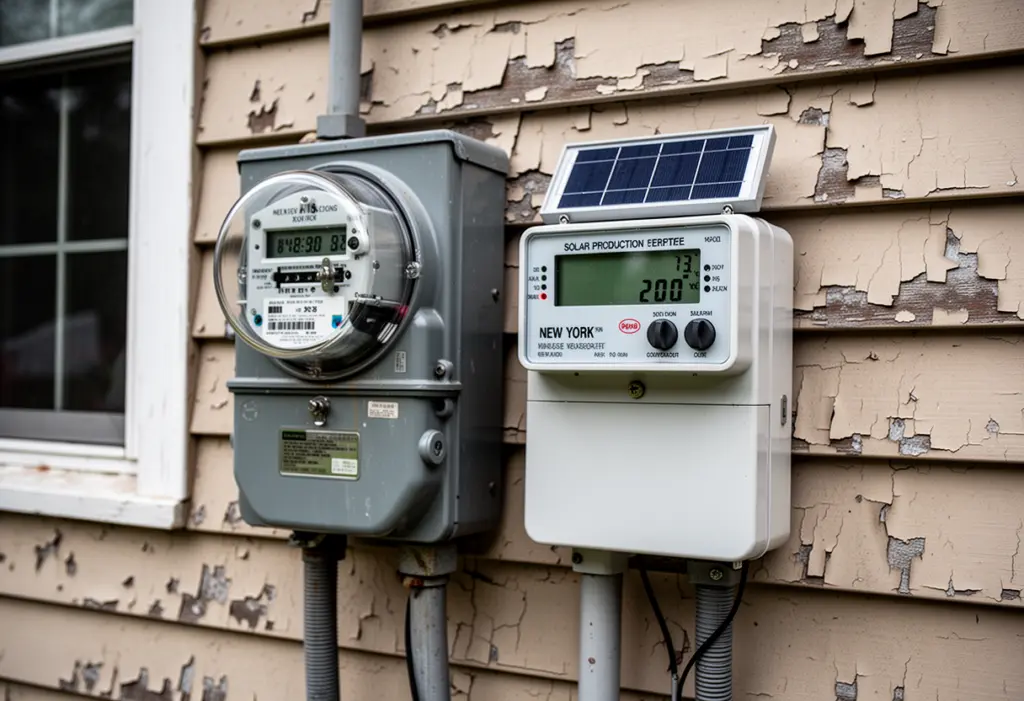
If you are putting panels on the roof of a New York house, you are almost certainly on Phase One net metering and not on the Value Stack. That is the short answer, and it matters because the two are frequently presented as a choice when in practice the project type decides it.
What Phase One net metering does
Exported kilowatt-hours are credited at the full retail rate, the same rate you pay to buy a kilowatt-hour. A system interconnected today holds that structure for 20 years from interconnection. It is simple by design: one rate, one meter, and an annual cycle in which summer surplus offsets winter consumption. Most residential rooftop customers in New York are on it and will remain on it.
What the Value Stack is for
The Value Stack, usually called VDER, was built for community distributed generation and for larger and commercial projects, not for mass-market residential rooftops. Instead of one retail rate it values an exported kilowatt-hour through a set of separately calculated components, and those components vary by time and by location on the distribution system. That is a reasonable way to pay a developer who can shift or site generation in response to it, and a poor fit for a household that exports whenever the sun is out.
The practical consequence for a homeowner is that if a salesperson offers to put your rooftop project on the Value Stack, you should ask why, in writing, and what it does to the value of your exports against full retail-rate crediting.
The one place the difference is published as a number
The Customer Benefit Contribution is charged per kW of DC capacity per month on systems interconnected on or after 1 January 2022, and it is set separately for net-metered PV and for Value Stack PV. The 2026 residential rates make the gap plain:
- Central Hudson: $1.67 net metered against $0.84 Value Stack
- Con Edison: $1.29 against $0.65
- RG&E: $1.31 against $0.65
- NYSEG: $1.19 against $0.60
- Orange & Rockland: $1.00 against $0.50
- National Grid: $0.97 against $0.49
- LIPA and PSEG Long Island: $1.13 net metered, with no Value Stack figure, because mass-market LIPA projects cannot opt into it
A lower monthly charge is not by itself an argument for the Value Stack, because the charge is a small number beside what the export crediting mechanism is worth over twenty years. On a 9 kW array the difference between the Con Edison net-metered and Value Stack rates is 9 x $0.64 = $5.76 a month, about $69 a year. Set that against the export value of everything the array sends to the grid before treating it as a saving. The rates are recalculated annually and are not locked in at interconnection.
Two details that get misquoted
- Three utilities charge small commercial less than residential on the net-metered schedule: RG&E at $0.96 against $1.31, NYSEG at $1.14 against $1.19, and Orange & Rockland at $0.88 against $1.00. It is three, not two, and it is worth knowing if your project sits on a small commercial account.
- Community solar subscribers pay no Customer Benefit Contribution at all. Community projects sit on the Value Stack side of this divide, but the subscriber does not own capacity and is not billed for any.
Who is outside both systems
Customers of a municipal electric utility are outside Public Service Commission jurisdiction altogether: no PSC net metering, no Value Stack, no Customer Benefit Contribution and no state interconnection process. If your bill comes from Massena Electric Department, the Jamestown Board of Public Utilities, Plattsburgh Municipal Lighting Department, Sherrill Power and Light or one of the roughly fifty other municipal systems in New York, the terms for exported power are set by that utility and you have to ask it directly. Confirm from the name printed on your own bill rather than from a map, because service territories do not follow county lines.
The questions worth asking before you sign
- Which crediting mechanism will my system be enrolled in, named on the contract?
- What is the interconnection date the 20-year net metering term runs from, and how will I be told it?
- What DC size will the Customer Benefit Contribution be billed on, and at which rate?
- If the proposal assumes anything other than full retail-rate crediting, what is the assumption and where does the number come from?
Where the incentives sit in all this
The crediting mechanism does not change the tax picture, and the tax picture in 2026 starts with a removal: the 30% federal residential credit under section 25D was terminated for expenditures made after 31 December 2025, an expenditure being treated as made when the original installation is completed. What remains is a state affair. New York’s 25% credit capped at $5,000 on Form IT-255 applies to a principal residence in the state, is limited by your actual state tax liability and carries forward up to five years. NY-Sun, which arrived as a contractor-applied price reduction whose per-watt level stepped down as each regional megawatt block filled, is not available to homes at present. As of September 2026 NYSERDA has no open NY-Sun block for homes in any utility territory; check NYSERDA’s NY-Sun dashboard for a new one. The residential sales tax exemption covers the equipment and its installation from the state share of sales tax, and from the local share only where the county or city has opted in. And RPTL 487 exempts the added value for 15 years, but only where your municipality, your county and your school district have each not opted out, with no separate school check in New York City, Buffalo, Rochester, Syracuse or Yonkers because those districts are fiscally dependent. Construction must be complete before 1 January 2030. Verify the current position with NYSERDA and the Department of Taxation and Finance, since these terms are revised.
Frequently Asked Questions
Is my rooftop system on net metering or the Value Stack?
A mass-market residential rooftop is almost always on Phase One net metering, which credits exports at the full retail rate for 20 years from interconnection. The Value Stack was built for community distributed generation and larger or commercial projects.
Does the Value Stack pay more?
It pays differently. It values an export through separate components that vary by time and location, which suits a developer that can site or shift generation. A household exporting whenever the sun shines has no way to respond to those signals.
Why is the monthly charge lower on the Value Stack?
The Customer Benefit Contribution is set separately for the two schedules. For 2026 the residential Value Stack rates are roughly half the net metered ones, but that difference is small beside the export crediting itself.
Do community solar subscribers pay this charge?
No. Community solar subscribers pay no Customer Benefit Contribution at all, because the charge falls on owned generating capacity rather than on a subscription.
This article is general information, not tax, legal or financial advice. Incentive amounts, eligibility rules and deadlines change and depend on your utility, your tax situation and your property. Confirm current terms with NYSERDA, your utility and a qualified tax professional before making a decision.
NY Solar Incentives
Independent New York solar research. We summarise NYSERDA, NY-Sun and federal programme rules from published sources and state plainly when a figure is an estimate. We are not a government agency and do not sell equipment.
Run the arithmetic on your own system
Check the dated program table and your arrangement before counting an incentive. Standard residential NY-Sun blocks are closed; Long Island Affordable Solar has a conditional income-verification route. The NY credit depends on qualified costs and tax liability, while the NYC abatement reduces future property-tax bills. The estimator keeps those timings separate.