EV Charging and Solar Panels in New York
An electric car changes solar sizing more than almost anything else a household adds, and the federal tax credit that used to offset the charger itself expired mid-2026.
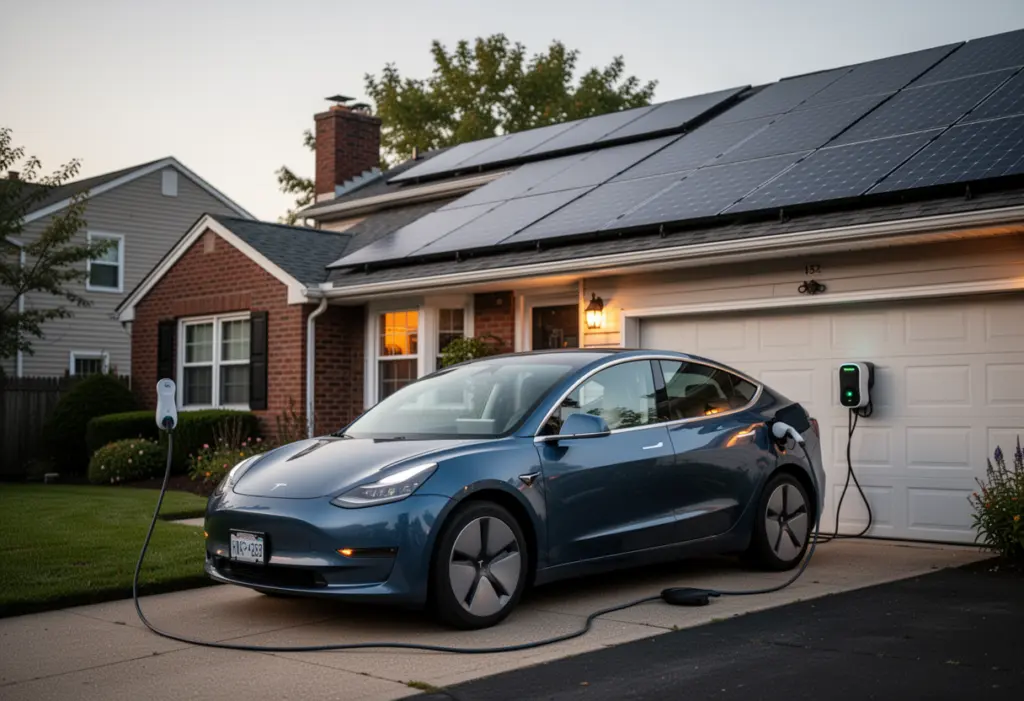
An electric car is the largest single change most households ever make to their electricity consumption — bigger than a heat pump, far bigger than any appliance. If a car is in your plans, it belongs in the solar conversation before the system is designed rather than after.
How much extra electricity a car actually uses
The honest way to think about it is annual mileage divided by efficiency. A typical electric car uses somewhere in the region of a quarter to a third of a kilowatt-hour per mile in mixed driving, more in a New York winter when heating the cabin and warming the battery both draw power.
So a household driving 12,000 miles a year is adding a substantial fraction of its existing annual consumption — for many New York homes, something like a third to a half again on top of what the house used before. That is not a rounding error in a solar design. It is a different system.
The number to work from is your own: your annual mileage, and the car’s real winter efficiency rather than its brochure figure.
Why order matters
Solar systems are sized against annual consumption. If you size against a household that does not yet have a car, you will be undersized the moment it arrives, and the credit balance that was supposed to carry you through February will not.
Three sensible sequences:
- Car already owned: use twelve months of actual usage that includes it. Simplest and most accurate.
- Car planned within a year or two: tell the installer, and have the system sized for the combined load. Ask to see the two production and consumption models side by side.
- Car uncertain: size for the house, but ask what expanding the array later would involve — roof space left, inverter headroom, and whether the utility treats an expansion as a new interconnection application.
That last question has a New York-specific consequence. The Customer Benefit Contribution applies to systems interconnected on or after 1 January 2022, and NYSERDA’s guidance treats later expansions of a pre-2022 system as still exempt. For a post-2022 system, an expansion increases DC size and therefore increases the monthly charge. It is a small number, but it belongs in the comparison between building bigger now and expanding later.
Charging at the right time
Under Phase One net metering, exports are credited at the full retail rate whenever they occur, so a kilowatt-hour exported at noon and one imported at midnight net out one for one. On a flat rate, then, when you charge does not change the arithmetic. Charge overnight if it suits you; the annual net is what counts.
Two situations change that:
- A time-of-use rate. If you are on one, overnight charging is cheaper and daytime charging is expensive, and the calculation is entirely different.
- A home battery. With storage, charging the car from the battery in the evening rather than from the grid becomes possible — though whether it is worthwhile depends on the battery’s capacity relative to the car’s appetite, which is usually the limiting factor. A car battery is far larger than a typical home battery.
The electrical work
A Level 2 charger and a solar system both connect to your main panel, and in older New York housing that panel is frequently the constraint. A 100-amp service in a pre-war house may not comfortably take both without an upgrade, and a service upgrade is a real cost with its own utility coordination.
If you are doing both, do the electrical assessment once and for both. It is markedly cheaper than discovering the constraint twice, and the panel work is easier to schedule while an electrician is already on site.
The federal charger tax credit has expired
Through June 30, 2026, a homeowner installing a qualifying Level 2 charger could claim the federal Alternative Fuel Vehicle Refueling Property Credit: 30% of the cost of the charger and its installation, up to $1,000 per charging port, filed on Form 8911 for the year the charger was placed in service. That credit’s eligibility window closed on June 30, 2026. A charger installed after that date does not qualify, and there is no extension currently scheduled. Anyone whose charger went into service before the deadline should still confirm eligibility and claim it for that tax year; anyone pricing a charger now should budget it without that 30% offset, because it no longer applies.
New York does not have a state-level rebate or tax credit that fills that gap for a single-family home. NYSERDA’s Charge Ready NY 2.0 program pays a per-port rebate toward Level 2 charging, but only at workplaces, multifamily buildings and public parking facilities — not at a homeowner’s own garage. Utility “make-ready” programs work the same way, subsidizing the electrical infrastructure for fleet, multifamily and public charging sites rather than a single detached home. The practical result is that a home charger installed today is an out-of-pocket electrical project in New York, with no dedicated incentive attached to it, even though the solar system next to it may still qualify for the state tax credit, the sales tax exemption and net metering.
Practical points
- Have the charger and the solar assessed together, even if you install them months apart.
- Ask whether your service panel has capacity for both, and what an upgrade would cost.
- Get the solar sized against consumption that includes the car, not the house as it is today.
- Ask what roof space and inverter headroom remain for a future expansion.
- Confirm what rate you are on. Net metering on a flat rate makes charging time irrelevant; a time-of-use rate makes it central.
- Price the charger itself without assuming a tax credit — the federal credit that used to offset it expired June 30, 2026, and New York has no state program that replaces it for a single home.
Does the car make solar pay faster?
Usually yes, in the sense that matters. A larger system spreads the fixed costs of the project — the permit, the interconnection, the labour, the trip — across more kilowatts, so the cost per watt of a bigger array is generally lower. And the electricity the car displaces is petrol you would otherwise have bought, which is a larger saving per unit than the electricity the house displaces.
The caveat is honest sizing. A system built for a car that never arrives is a system that overproduces into a credit balance you cannot fully use, and net metering banks credit rather than paying it out.
Frequently Asked Questions
How much bigger does my solar system need to be for an electric car?
Work from your own annual mileage and the car's real winter efficiency, typically around a quarter to a third of a kilowatt-hour per mile, more in cold weather. For many New York households a car adds something like a third to a half again on top of existing consumption.
Should I charge my EV during the day to use my solar directly?
Under flat-rate net metering it makes no difference: exports are credited at the full retail rate whenever they happen, so the annual net is what counts. It matters if you are on a time-of-use rate or have a home battery.
Can my electrical panel handle both solar and an EV charger?
In older New York housing this is often the binding constraint. A 100-amp service may not comfortably take both. Have the assessment done once for both, because discovering the limit twice costs more.
Is the federal tax credit for a home EV charger still available?
No. It applied only to chargers placed in service through June 30, 2026, at 30% of the cost up to $1,000 per port. A charger installed after that date does not qualify, and New York has no state-level rebate that replaces it for a single-family home.
NY Solar Incentives
Independent New York solar research. We summarise NYSERDA, NY-Sun and federal programme rules from published sources and state plainly when a figure is an estimate. We are not a government agency and do not sell equipment.
Run the arithmetic on your own system
Check the dated program table and your arrangement before counting an incentive. Standard residential NY-Sun blocks are closed; Long Island Affordable Solar has a conditional income-verification route. The NY credit depends on qualified costs and tax liability, while the NYC abatement reduces future property-tax bills. The estimator keeps those timings separate.