How the New York Solar Sales Tax Exemption Works
This is the incentive you never file for. It happens inside the price, which is exactly why so many homeowners cannot tell whether they received it.
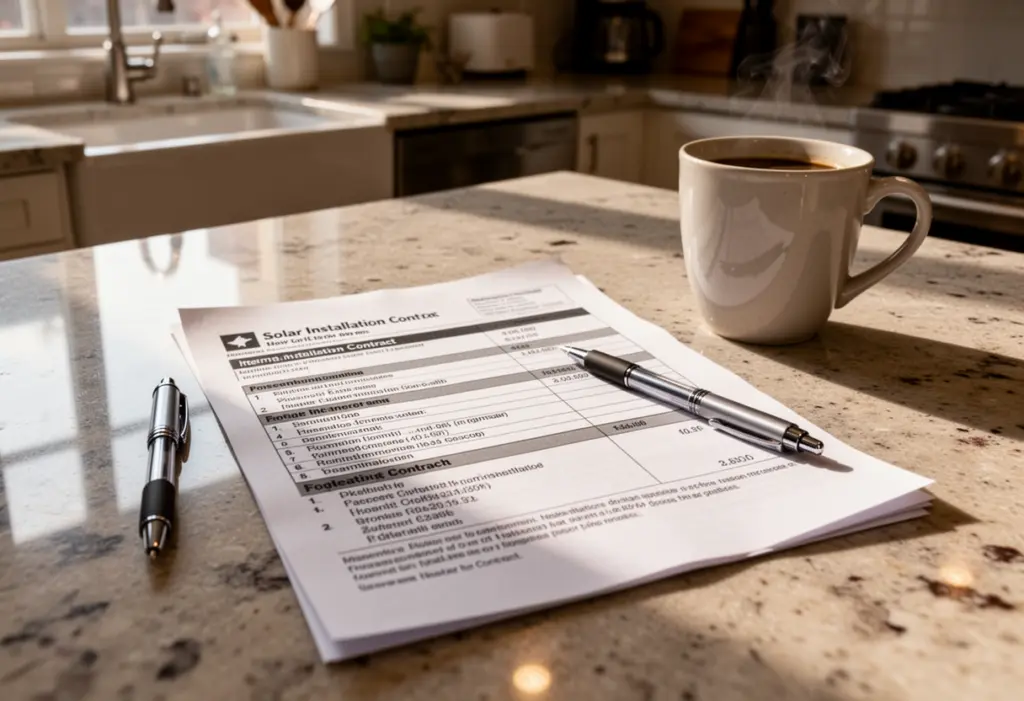
New York exempts the sale and installation of residential solar energy systems equipment from state sales tax. Unlike the credit on Form IT-255, this is not something you claim after the fact — it happens at the point of sale, as tax that is simply not added to your invoice. That is convenient and it is also why most homeowners cannot tell whether they got it. The way to find out is to read the contract, not the tax code.
Two layers, and only one is statewide
New York sales tax is not a single rate. There is a state share and a local share, and they are decided by different bodies. The state share is exempt for qualifying residential solar equipment across New York. The local share is a separate election: counties and cities may each choose to exempt their own portion, and not all of them have.
The practical consequence is that two households buying identical systems in different counties can pay different amounts of sales tax on the same hardware. There is no statewide answer to what you will save, only an answer for your address. Ask your contractor which local jurisdiction applies to the installation site and whether that jurisdiction has elected the exemption, and ask them to show you the result on the contract.
What to look for on the paperwork
- Is sales tax a separate line at all? If it is not, ask whether tax was charged and simply folded into a lump price, or whether the exemption was applied. Those are different answers and only one of them is good.
- Is state sales tax charged on the installation labour? It should not be. The exemption covers both the retail sale and the installation of residential solar energy systems equipment, so a contract that adds state sales tax to the solar labour line is one you should ask about.
- What documentation is the contractor using? Sellers apply exemptions through specific certification paperwork. Ask which document they are relying on for your job and keep a copy with your closing file.
- What about the parts that are not the solar array? Batteries, a service panel upgrade, a new roof, an EV charger or a carport structure are not automatically inside the same treatment. Ask item by item rather than assuming the whole invoice is exempt.
Why this matters more than its size suggests
The exemption is not the largest incentive in New York. Its value is that the exempt tax is never added to what you pay, with no filing, no liability test and no waiting for a tax year to close. Compare that with the state credit, which is capped, non-refundable and limited by the tax you owe, or with NY-Sun, which used to arrive as a contractor-applied price reduction and currently offers homes nothing. As of September 2026 NYSERDA has no open NY-Sun block for homes in any utility territory; check NYSERDA’s NY-Sun dashboard for a new one.
There is also a knock-on worth understanding. Your credit on Form IT-255 is calculated from qualified expenditure — what you actually spent. Sales tax you did not have to pay is money you did not spend, so it is not sitting inside the credit base either. That is not a loss; it simply means the two incentives do not stack on the same dollar. Ask your preparer to work from the itemised invoice rather than from a headline system price.
Situations where the question changes shape
Leases and power purchase agreements. You are not buying equipment, so the sales tax treatment of the hardware is not yours. What you should ask instead is how tax is treated on your monthly payments, and get that answer in writing before you sign a ten year or longer agreement.
Community solar. A subscriber buys no equipment at all. There is nothing to exempt, and equally there is no Customer Benefit Contribution, because that charge does not reach community solar subscribers. The comparison between a rooftop purchase and a subscription is not only about savings per kilowatt-hour; it is about which set of charges and exemptions you enter at all.
Municipal electric utility customers. Sales tax rules follow the county and city, not the utility, so the exemption question is unchanged if a village electric department serves you. What does change is everything on the utility side: municipal utilities sit outside Public Service Commission jurisdiction, so there is no PSC net metering, no Customer Benefit Contribution and no state interconnection process. Confirm the utility name printed on your own bill.
The rest of the 2026 picture
Start from the correction that changes every calculation: the 30% federal residential credit no longer exists. Section 25D was terminated for expenditures made after 31 December 2025, with an expenditure treated as made when the original installation is completed. Nothing on your contract should reference it.
What remains alongside the sales tax exemption is New York’s 25% credit capped at $5,000 on Form IT-255 for a principal residence, and RPTL 487, a 15-year property tax exemption on the added value where the municipality, county and school district have each not opted out, for systems constructed before 1 January 2030. NY-Sun and its income-qualified Affordable Solar rate are not among them for now: no residential block is open in any utility territory. Running against them is the capacity charge: a 6 kW array in RG&E territory pays 6 x $1.31, about $7.86 a month or $94 a year, on DC size regardless of output. Local sales tax elections and incentive rules both change, so confirm yours with the contractor, the county and tax.ny.gov before signing.
Frequently Asked Questions
Do I pay sales tax on solar panels in New York?
The state share is exempt for qualifying residential solar equipment. The local share is a separate election by counties and cities, so what you pay depends on the jurisdiction where the system is installed.
Do I have to file anything to get the exemption?
No. It is applied at the point of sale by the seller, using their exemption documentation. That is why you should check the contract to confirm it was applied rather than assuming.
Does the exemption cover a battery or a panel upgrade?
Not automatically. Batteries, service upgrades, roofing and structures are not necessarily treated the same way as the solar equipment. Ask your contractor item by item and keep the answer with your contract.
Does it reduce my New York solar credit?
The credit is 25% of what you actually spent, so tax you never paid is not part of the base. The two do not stack on the same dollar. Have your preparer work from the itemised invoice.
This article is general information, not tax, legal or financial advice. Incentive amounts, eligibility rules and deadlines change and depend on your utility, your tax situation and your property. Confirm current terms with NYSERDA, your utility and a qualified tax professional before making a decision.
NY Solar Incentives
Independent New York solar research. We summarise NYSERDA, NY-Sun and federal programme rules from published sources and state plainly when a figure is an estimate. We are not a government agency and do not sell equipment.
Run the arithmetic on your own system
Check the dated program table and your arrangement before counting an incentive. Standard residential NY-Sun blocks are closed; Long Island Affordable Solar has a conditional income-verification route. The NY credit depends on qualified costs and tax liability, while the NYC abatement reduces future property-tax bills. The estimator keeps those timings separate.