What a 10 kW Solar System Costs in New York in 2026
The useful question about a 10 kW system in New York is not the headline price but which four things moved it, and where the state credit stops rewarding a bigger number.
On this page 8 sections
- 01The four things that actually move the price
- 02The dealer fee inside a low-rate loan
- 03The arithmetic that matters most on a 10 kW quote
- 04What is not in the 2026 arithmetic
- 05The running cost nobody quotes
- 06Is 10 kW even the right size
- 072026 incentives on a system this size
- 08Frequently Asked Questions
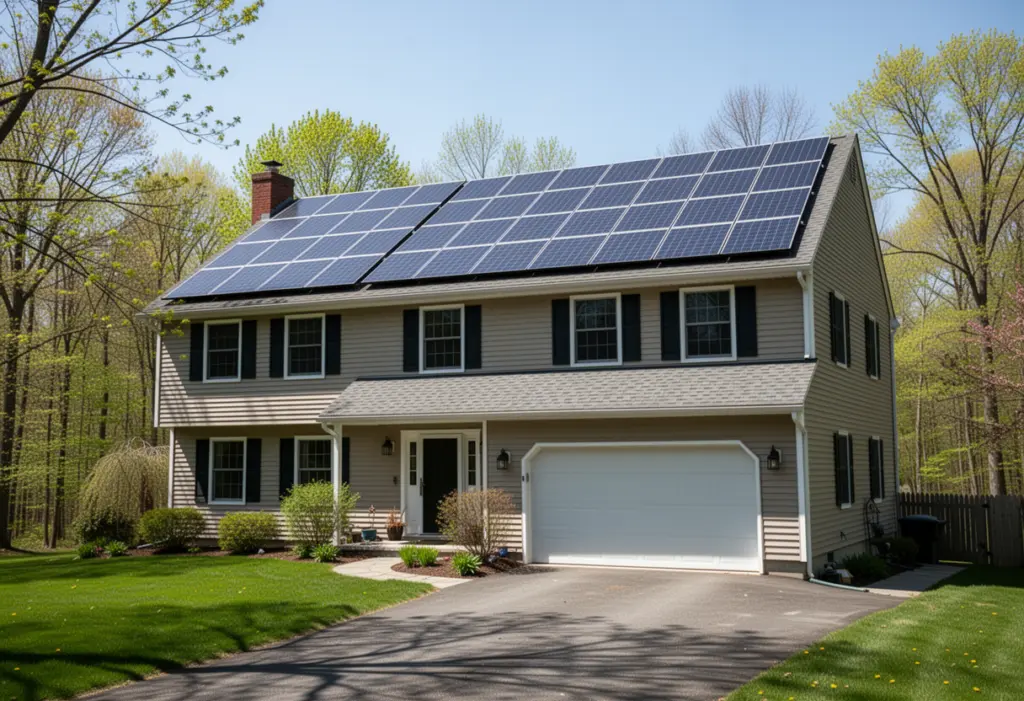
A 10 kW array is a large residential system in New York — the size a household with an electric vehicle, a heat pump or a genuinely big house ends up at. Anyone quoting you a single national average price for one is guessing, and the guess is not useful, because the spread between two honest quotes on the same street comes from things that have nothing to do with the panels.
So this page does the more useful thing: what moves the number, and what the number does after you have paid it.
The four things that actually move the price
- The roof. Pitch, orientation, obstructions, and material. A simple south-facing asphalt plane is the cheap case. Slate, standing seam, tile, a cut-up roof with three dormers, or a layout that forces the array onto two or three separate planes all cost more in labour and hardware than in equipment. A roof near the end of its life is worse than any of these, because the real decision is a re-roof.
- The electrical work. A 10 kW array is a substantial back-feed. On a 100 amp service — common in older New York housing stock — that frequently means a service upgrade, which is a real, separately priced job. Distance from the array to the panel, conduit routing, and whether the meter is on the far side of the house all show up in the price.
- Equipment tier. Module efficiency, inverter architecture, and whether the design uses microinverters or optimisers. On a shaded or multi-plane roof this is a performance decision, not a luxury one.
- The sales channel. The largest single variable in many quotes, and the one nobody itemises.
The dealer fee inside a low-rate loan
A solar loan advertised at a very low interest rate is not cheap money. The lender takes a dealer fee, and that fee is built into the system price rather than shown as a finance charge. The homeowner sees an attractive rate and a higher price and never connects the two.
The check is simple and you should insist on it: ask for the cash price and the financed price side by side, for the same system. If the numbers differ, the gap is the fee. Then decide whether you want to borrow that way, having actually seen it. A contractor who will not produce both numbers has told you something.
The arithmetic that matters most on a 10 kW quote
New York’s credit is 25 percent of qualified expenditure, capped at $5,000, on Form IT-255, for a principal residence. Twenty-five percent of $20,000 is exactly $5,000.
So on any 10 kW system priced above $20,000, the state credit stops growing. Every additional dollar of system price beyond that point is one hundred percent yours. On a smaller system the credit softens each incremental upgrade by a quarter; at this size it does not. That single fact should change how you evaluate an upsell — a $3,000 equipment upgrade on a 6 kW system effectively costs $2,250, and the same upgrade on a $26,000 10 kW system costs the whole $3,000.
Two further limits: the credit is not refundable, though unused credit carries forward up to five years, and it is bounded by your actual New York State tax liability. A proposal that simply subtracts $5,000 has assumed a tax position it knows nothing about.
What is not in the 2026 arithmetic
The 30 percent federal residential credit is gone. Section 25D was terminated for expenditures made after 31 December 2025, and an expenditure is treated as made when the original installation is completed. On a 10 kW system that line was worth thousands, so a 2026 proposal that still shows it does not overstate the benefit slightly — it misstates the net cost of the entire project. Treat it as grounds to re-price everything, and to ask what else in the document is out of date.
The running cost nobody quotes
The Customer Benefit Contribution is billed monthly on DC size, so a 10 kW array pays the same charge in every month of its life:
- National Grid, $0.97 per kW-month: $9.70 a month, $116.40 a year.
- Con Edison, $1.29: $12.90 a month, $154.80 a year.
- Central Hudson, $1.67: $16.70 a month, $200.40 a year.
Same house, same equipment, same installer — the only variable is the utility name on the bill. The rates are recalculated annually and apply to systems interconnected on or after 1 January 2022. Community solar subscribers pay none of it, which is one reason the two routes are not comparable on price alone.
Is 10 kW even the right size
Size to evidenced consumption, not to available roof. Ask for modelled annual production in kilowatt-hours against your last twelve months of actual usage, printed side by side. An oversized array banks net metering credits you never consume and still pays the capacity charge on every unused kilowatt of capacity. If the household plans an EV or a heat pump, model the future load explicitly rather than adding a comfortable margin.
2026 incentives on a system this size
The two that do most work at 10 kW are the state sales tax exemption on residential solar energy systems equipment, which means no state sales tax is added at purchase, with localities separately electing whether to exempt their own share, and RPTL 487, a fifteen-year property tax exemption on the added value — significant on a large system, and requiring that the municipality, the county and the school district have each not opted out, and that the system is constructed before 1 January 2030. In New York City, Buffalo, Rochester, Syracuse and Yonkers the school district is fiscally dependent and levies no separate property tax, so there is no separate school check in those five. NY-Sun is not in the 2026 arithmetic: as of September 2026 NYSERDA has no open NY-Sun block for homes in any utility territory; check NYSERDA’s NY-Sun dashboard for a new one. All of these change; check NYSERDA and the state tax department at source before you sign.
Frequently Asked Questions
What drives the price of a 10 kW solar system in New York?
Roof complexity and material, the electrical work including any service upgrade on a 100 amp panel, equipment tier, and the sales channel. The last of those is often the largest variable and the least itemised.
Why does the New York state credit stop helping above a certain price?
Because it is 25% capped at $5,000, and 25% of $20,000 is exactly $5,000. On a 10 kW system priced above that, every extra dollar of system price is entirely yours.
Can I still claim 30% federally on a 10 kW system?
No. Section 25D ended for expenditures made after 31 December 2025, with the expenditure treated as made when the original installation is completed. A 2026 quote showing that line misstates your net cost.
What does a 10 kW array cost to run each month?
The Customer Benefit Contribution on DC size: $9.70 a month on National Grid, $12.90 on Con Edison and $16.70 on Central Hudson for 2026. That is $116.40 to $200.40 a year on identical equipment.
This article is general information, not tax, legal or financial advice. Incentive amounts, eligibility rules and deadlines change and depend on your utility, your tax situation and your property. Confirm current terms with NYSERDA, your utility and a qualified tax professional before making a decision.
NY Solar Incentives
Independent New York solar research. We summarise NYSERDA, NY-Sun and federal programme rules from published sources and state plainly when a figure is an estimate. We are not a government agency and do not sell equipment.
Run the arithmetic on your own system
Check the dated program table and your arrangement before counting an incentive. Standard residential NY-Sun blocks are closed; Long Island Affordable Solar has a conditional income-verification route. The NY credit depends on qualified costs and tax liability, while the NYC abatement reduces future property-tax bills. The estimator keeps those timings separate.