Community Solar for National Grid Customers in New York
For a National Grid customer who cannot use their own roof, a subscription delivers credits without equipment, permits or a capacity charge.
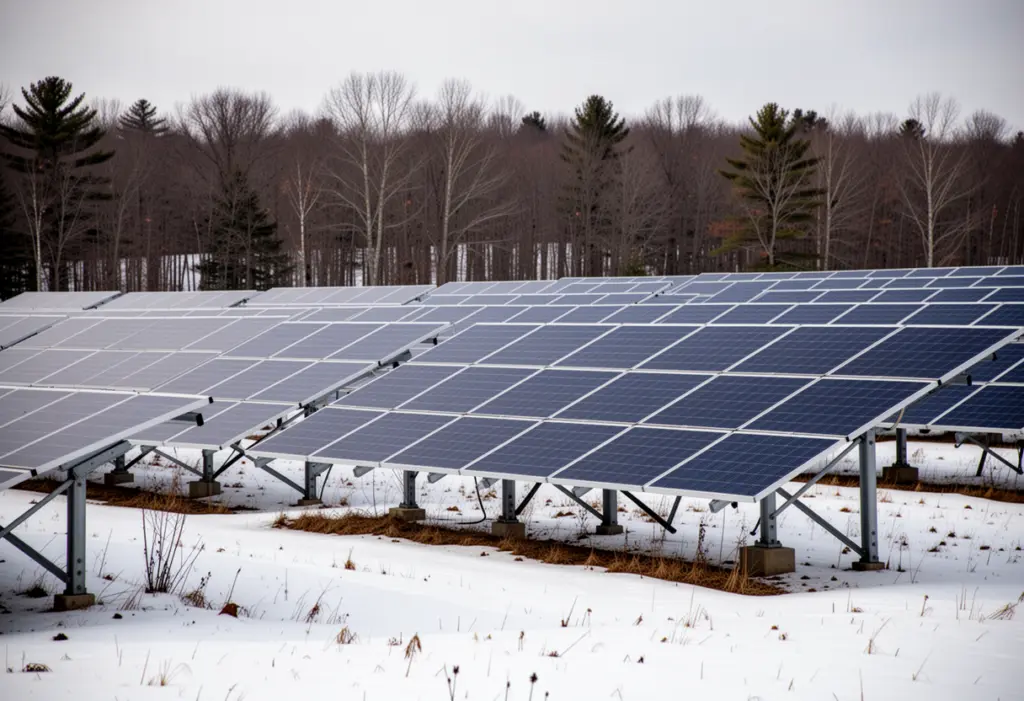
Community solar is the answer for a National Grid customer whose own roof will not work — because it is shaded, because it is rented, because it faces the wrong way, or because it needs replacing before anything is screwed to it. You subscribe to a share of an off-site array, that array produces credits, and the credits land on your National Grid bill. No equipment, no permit, no roof penetration and no interconnection application.
How the credit arrives
The project connects to the distribution system, not to your house. Its output is converted into bill credits and allocated among subscribers by share, then applied against what you owe. Your meter is unchanged and your consumption is unchanged; the amount due after the credit is what moves.
Your saving is the difference between the value of the credit allocated to you and what you pay the subscription operator for it. That difference is the whole commercial case, so make them show it. Ask whether the stated discount is measured against the credit value or against your total bill — those are different claims — and ask for a worked example using a month of your own consumption rather than an annual percentage.
Two costs a subscriber never carries
The Customer Benefit Contribution is the obvious one. It applies to net metered systems behind your meter, not to front-of-the-meter projects, so subscribers pay none of it. National Grid’s 2026 residential rate is $0.97 per kW-month, so a household that would otherwise have installed 8 kW on the roof is not paying $7.76 a month, roughly $93 a year, on capacity.
The second is the property tax question. RPTL 487 exempts the added value of an installed system for 15 years, but only for construction before 1 January 2030, and only where the municipality, the county and the school district have each declined to opt out — and many have opted out somewhere in that chain. A subscriber never has to work through it, because nothing has been added to the assessed value of their property.
The credit a subscription does not unlock
This one causes real confusion, so it is worth stating flatly. New York’s 25% solar energy system equipment credit on Form IT-255 requires qualified equipment installed and used at your principal residence. It reaches purchases, and it reaches leases and power purchase agreements of ten years or more for equipment serving that home. A community solar subscription is not equipment at your house, and nobody should be selling you a subscription on the strength of that $5,000 credit. If you are told otherwise, ask them to identify the line on the form, and confirm your own position with a tax preparer.
Why it fits a lot of National Grid territory
The older neighbourhoods of Buffalo, Syracuse, Utica, Schenectady and Troy carry a great deal of rented and two-family housing, and those two facts stop rooftop projects for reasons that have nothing to do with sunlight. A tenant cannot authorise work on a roof they do not own. A two-family house may run separate meters, so only one account would receive credits and the other resident receives nothing. And a house with a roof at the end of its life needs a re-roof before an array, which is a different budget in a different year. A subscription attaches to the electricity account instead of the building, and steps around all of it.
Shade is the other reason. Mature street canopy across upstate cities and heavy tree cover on rural lots takes a serious bite out of a southern horizon, and an honest on-site shade assessment sometimes ends a rooftop conversation outright. That is the point at which a subscription becomes the only route to any solar benefit at all.
What to read before you sign
- Term and exit. How long, what notice, and is there a charge for leaving early?
- Moving. Within National Grid territory a subscription can usually follow you. Moving into a different utility’s territory is a different conversation, and upstate boundaries are not tidy.
- Allocation. Is your share fixed, or does it track production? What happens in a poor production year?
- Surplus. If credits accumulate faster than you consume across a good summer, what becomes of the balance?
- Billing route. One consolidated bill, or a utility bill plus a separate subscription invoice? Two documents is the arrangement people most often misread as being charged twice.
One thing to check first
Confirm National Grid is genuinely your utility, from the name printed on your own bill. Municipal electric utilities operate inside that footprint at Solvay and Skaneateles in Onondaga County, Akron and Springville in Erie, Green Island in Albany County, Sherrill in Oneida and Massena in St. Lawrence, among others. Municipal customers are outside Public Service Commission jurisdiction, so the state community solar framework does not reach them and any local equivalent has to be asked for directly.
The 2026 position
Community solar is the one route where the end of the federal 30% residential credit changes nothing for the household, because a subscriber never claimed it in the first place. The business-side credit survives and belongs to whoever owns the project, which is part of why third-party arrangements can still price in an incentive the subscriber never sees. Your side of the deal is the discount, the term and the exit — read those three carefully, ask for a sample bill showing exactly where the credit appears, and verify the operator against NYSERDA’s current programme information rather than against its own marketing. Terms and project availability change through the year, so check the live position before signing.
Frequently Asked Questions
Do National Grid community solar subscribers pay the capacity charge?
No. The Customer Benefit Contribution applies to net metered systems behind your meter, not to front-of-the-meter projects. At National Grid's 2026 rate of $0.97 per kW-month that avoids about $93 a year on the equivalent of an 8 kW rooftop array.
Can I claim the New York 25% credit through a subscription?
It is not built for that. Form IT-255 requires qualified solar equipment installed and used at your principal residence, reaching purchases and leases or PPAs of ten years or more for equipment serving that home. Confirm your position with a tax preparer.
Is community solar suitable for a two-family house?
Often, yes. Where the building has separate meters a rooftop array credits only one account, leaving the other resident with nothing. A subscription attaches to each electricity account instead, so each household can subscribe on its own terms.
What if I move house?
Within National Grid territory a subscription can usually transfer to the new address. Moving into another utility's territory is a different matter, and upstate service boundaries do not follow county lines cleanly, so check before you commit to a move date.
This article is general information, not tax, legal or financial advice. Incentive amounts, eligibility rules and deadlines change and depend on your utility, your tax situation and your property. Confirm current terms with NYSERDA, your utility and a qualified tax professional before making a decision.
NY Solar Incentives
Independent New York solar research. We summarise NYSERDA, NY-Sun and federal programme rules from published sources and state plainly when a figure is an estimate. We are not a government agency and do not sell equipment.
Run the arithmetic on your own system
Check the dated program table and your arrangement before counting an incentive. Standard residential NY-Sun blocks are closed; Long Island Affordable Solar has a conditional income-verification route. The NY credit depends on qualified costs and tax liability, while the NYC abatement reduces future property-tax bills. The estimator keeps those timings separate.