Solar Battery Warranty: What It Actually Covers
A battery warranty is at least three documents written by three companies, and the clause that ends cover early is usually the one about throughput rather than the one about years.
On this page 8 sections
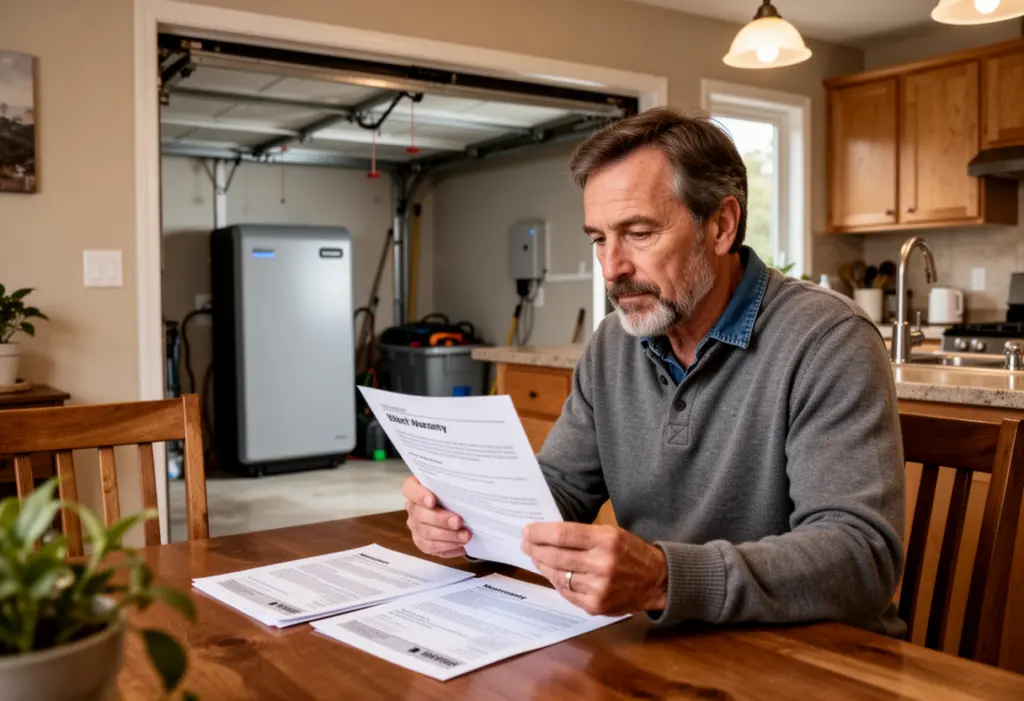
A solar battery warranty is not one document. It is at least three, written by different companies, running for different lengths of time, and the one that most often decides whether a failure costs you anything is the least discussed of the three.
Three warranties, three companies
- The battery manufacturer warranty covers the cells and the enclosure against defect, and against losing capacity faster than promised.
- The inverter or gateway warranty is frequently a separate document from a separate manufacturer with a shorter term. In many failures the part that stops working is not the battery.
- The installer workmanship warranty covers the work itself: the mounting, the conduit, the subpanel, and the roof penetrations where solar went on at the same time. This is the one that depends on a company still trading in year eight.
The capacity clause, and the words whichever comes first
A battery warranty typically promises that the unit will still deliver some percentage of its original usable capacity after a stated number of years. Read the sentence to the end. It almost always continues with a second limit, expressed either as total energy throughput in megawatt-hours or as a cycle count, and cover ends at whichever limit arrives first.
That matters more in New York than it would elsewhere, for a specific reason. Under Phase One net metering exports are credited at the full retail rate, so there is no financial reason to cycle a battery every day for self consumption. A household that cycles daily anyway burns through a throughput allowance years earlier than a household holding the battery for outages. Ask what the throughput cap is, and ask what operating mode the installer intends to leave the system in when they drive away.
Exclusions worth reading before you sign
- Temperature range. Operating outside the stated range can void cover. An unconditioned garage in the North Country is a genuine question, not a formality.
- Water. A basement installation in a flood plain, or an outdoor unit mounted below a known high water line, is an exclusion waiting to be invoked.
- Unapproved operation or service. Running the system in a mode the manufacturer has not certified, or having it serviced by an uncertified party, commonly ends cover outright.
- Exceeding the continuous power rating. Repeatedly starting a load larger than the unit is rated for is both a performance problem and a warranty one.
Labour is usually the gap
A manufacturer warranty typically replaces hardware. It does not usually pay the electrician who removes the failed unit, the permit for the replacement, or lifting equipment where access is awkward. Ask in writing who pays labour and shipping in year six. Some installers sell extended labour cover, and whether that is worth buying depends almost entirely on how likely the company is to still be there.
What happens when you sell the house
Most warranties transfer to a buyer, but on conditions: a limited number of transfers, a registration window measured in days after closing, and sometimes a fee. A buyer or their attorney will ask for the documents. Keep the commissioning report, the serial numbers, the permit sign off and the interconnection paperwork together from the day of installation, because reassembling that file years later is far harder than filing it at the time.
The question behind all of them
A workmanship warranty is a promise from a company, not from a product. Ask how long the installer has traded under its current name, who services this equipment in your county if they are not available, and whether the manufacturer maintains a certified service network in New York. A twenty five year promise from a business two years old is a different asset from the same words on a manufacturer letterhead, and the difference only becomes visible when you need it.
The 2026 backdrop
Warranty terms are not set by incentive policy, but the arithmetic around a replacement is. The federal residential credit under section 25D was terminated for expenditures made after 31 December 2025, measured by when the original installation is completed, so replacement hardware bought in 2026 carries no federal credit for a homeowner. New York State keeps the 25% credit capped at $5,000 on Form IT-255 for solar energy system equipment at a principal residence, and RPTL 487 exempts the added value of a solar energy system from property tax for 15 years where the municipality, the county and the school district have each not opted out, provided construction happens before 1 January 2030. Incentive programmes and their conditions change; verify the current position with NYSERDA and the New York State Department of Taxation and Finance rather than from a warranty brochure.
Frequently Asked Questions
How long does a solar battery warranty last?
Typically a stated number of years combined with a throughput or cycle limit, with cover ending at whichever arrives first. The years figure on its own does not tell you when the warranty expires.
What does capacity retention mean?
A promise that the battery will still deliver a stated percentage of its original usable capacity at the end of the warranty term, rather than a promise that it will perform as new throughout.
Does the warranty cover the electrician?
Usually not. Manufacturer cover generally replaces hardware only, leaving labour, permits and access equipment to you unless the installer sells separate labour cover on top.
Does the warranty transfer when I sell the house?
Most do, but on conditions such as a limited number of transfers, a registration window after closing and sometimes a fee. Keep the commissioning report and serial numbers filed from day one.
This article is general information, not tax, legal or financial advice. Incentive amounts, eligibility rules and deadlines change and depend on your utility, your tax situation and your property. Confirm current terms with NYSERDA, your utility and a qualified tax professional before making a decision.
NY Solar Incentives
Independent New York solar research. We summarise NYSERDA, NY-Sun and federal programme rules from published sources and state plainly when a figure is an estimate. We are not a government agency and do not sell equipment.
Run the arithmetic on your own system
Check the dated program table and your arrangement before counting an incentive. Standard residential NY-Sun blocks are closed; Long Island Affordable Solar has a conditional income-verification route. The NY credit depends on qualified costs and tax liability, while the NYC abatement reduces future property-tax bills. The estimator keeps those timings separate.