What Drives the Cost of Home Battery Storage in New York
Most of what you pay for on a home battery quote is not the battery. Knowing which parts move with the hardware and which move with your house is what makes two quotes comparable.
On this page 8 sections
- 01Usable capacity is not the number on the box
- 02Energy and power are two different specifications
- 03The electrical work is where quotes actually diverge
- 04Permits, inspection and who files them
- 05The financing line most people read last
- 06The charge that does not move
- 07What 2026 incentives do and do not reach
- 08Frequently Asked Questions
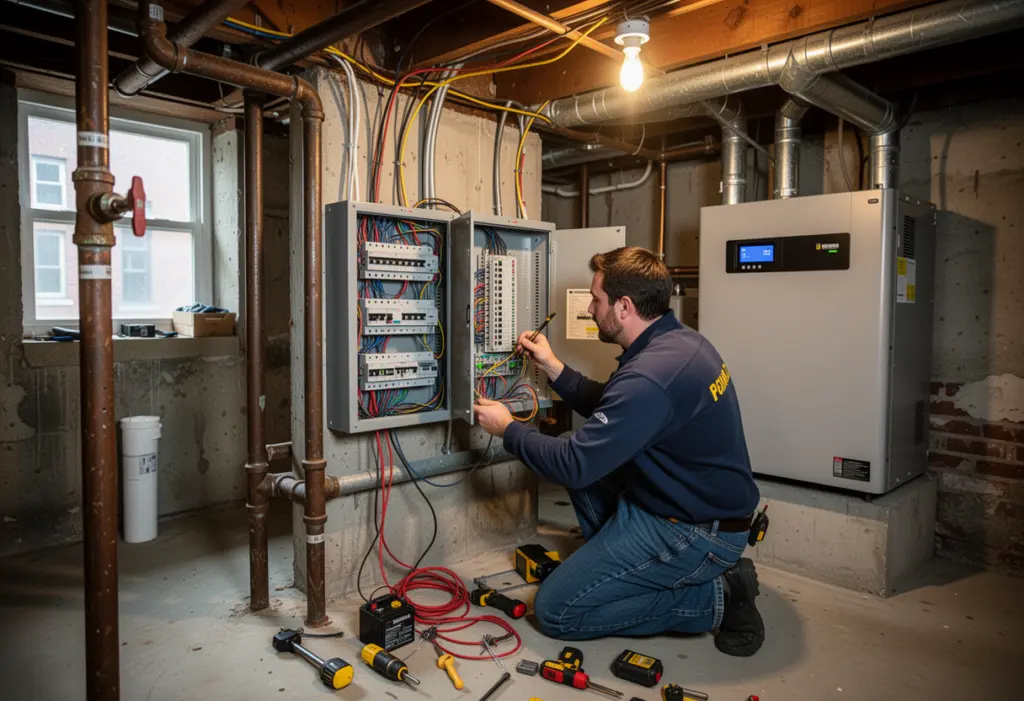
Most of what you are paying for on a home battery quote in New York is not the battery. Once you know which parts of the number move with the hardware and which move with your particular house, two quotes that looked incomparable usually turn out to be quotes for two different jobs.
Usable capacity is not the number on the box
Batteries are marketed on nameplate kilowatt-hours and delivered on usable kilowatt-hours, and the two are not the same, because no chemistry is discharged to zero. Ask for usable kWh in writing and compare quotes on that figure alone. A proposal that gives you only a nameplate number is not a proposal you can compare against another.
Energy and power are two different specifications
Kilowatt-hours tell you how long the battery runs your loads. Kilowatts of continuous output tell you what it can run at all. A unit with plenty of stored energy can still fail to start a deep well pump, a septic pump or a central air compressor, because motors draw a large surge on start up. Write the list of what must run, find the largest motor on it, and ask what surge the proposed configuration supports. This is the most common mismatch in residential backup, and it is discovered in the first outage rather than in the quote.
The electrical work is where quotes actually diverge
- A critical load subpanel. Backing up selected circuits means moving those circuits into a new subpanel. That is labour, and the further the panel sits from the battery the more of it there is.
- Service capacity. A great deal of New York housing stock still runs a 100 amp service. Add storage, a solar breaker and perhaps an EV charger and the panel is frequently the binding constraint. A service upgrade should be priced before you compare batteries, not discovered between them.
- Where the battery goes. Indoor, garage and outdoor rated units have different temperature ranges. An unconditioned garage through a Watertown or Plattsburgh winter is a real specification question, not a detail. In a flood plain, a basement location raises a separate one.
- Conduit distance. Every metre between the battery, the main panel and the meter is material and labour, and a difficult route costs more than a long easy one.
Permits, inspection and who files them
Storage installations need a building and electrical permit and an inspection, and in New York the authority having jurisdiction may be your town, your village or your city. Inside an incorporated village it is usually the village rather than the surrounding town. The NYS Unified Solar Permit standardises residential and small commercial solar permitting for systems of 25 kW DC and under and has been adopted by more than 300 authorities having jurisdiction, but it does not apply in the five boroughs, where the Department of Buildings runs its own process. Ask who files, what the fees are, and whether they sit inside the quoted price or outside it.
The financing line most people read last
A low advertised interest rate on a solar or storage loan usually carries a dealer fee inside the system price. It is not free money. It is money moved from the rate into the principal. Ask for the cash price and the financed price side by side, and compare the totals rather than the monthly payments.
The charge that does not move
The Customer Benefit Contribution is billed on the DC size of the solar array, in kilowatts, every month, on systems interconnected on or after 1 January 2022. Storage does not add to it. On a 10 kW array the 2026 residential arithmetic is 10 x $1.19 = $11.90 a month on NYSEG, about $143 a year, and 10 x $1.67 = $16.70 a month on Central Hudson, about $200 a year. The rates are recalculated annually and are not locked in at interconnection.
If your electricity comes from a municipal utility such as the Village of Skaneateles, Sherrill Power and Light or Bath Electric, Gas and Water Systems, there is no Customer Benefit Contribution and no state interconnection process, because municipal utilities are outside Public Service Commission jurisdiction. Check the utility named on your own bill rather than assuming from your county.
What 2026 incentives do and do not reach
The federal residential credit under section 25D no longer exists for anything whose original installation is completed after 31 December 2025, so no part of a 2026 battery quote should carry a 30% federal line. New York keeps its 25% credit capped at $5,000 on Form IT-255 for solar energy system equipment at a principal residence, limited by your actual New York tax liability and carried forward up to five years if unused; whether storage costs sit inside that definition is a question for the form instructions and your preparer. Do not expect a NY-Sun reduction on the proposal either: as of September 2026 NYSERDA has no open NY-Sun block for homes in any utility territory, and the income-qualified Affordable Solar blocks have closed as well. Check NYSERDA’s NY-Sun dashboard for a new one, and if one opens, ask for the reduction as its own line.
Frequently Asked Questions
What actually drives the cost of a home battery in New York?
Usable capacity and continuous power on the hardware side, and on the house side the critical load subpanel, any service upgrade, where the unit is mounted, conduit distance, and permits and inspection.
How many kilowatt-hours do I need?
Work backwards from the circuits you want running and for how long, then check the continuous power rating against the largest motor on that list, such as a well pump or an air conditioning compressor.
Does a low interest solar loan cost less overall?
Not usually. A low advertised rate typically carries a dealer fee inside the system price. Ask for the cash price and the financed price side by side and compare totals rather than monthly payments.
Is there still a 30% federal credit on a battery?
No. Section 25D was terminated for expenditures made after 31 December 2025, with an expenditure treated as made when the original installation is completed. A 2026 quote showing 30% federal is wrong.
This article is general information, not tax, legal or financial advice. Incentive amounts, eligibility rules and deadlines change and depend on your utility, your tax situation and your property. Confirm current terms with NYSERDA, your utility and a qualified tax professional before making a decision.
NY Solar Incentives
Independent New York solar research. We summarise NYSERDA, NY-Sun and federal programme rules from published sources and state plainly when a figure is an estimate. We are not a government agency and do not sell equipment.
Run the arithmetic on your own system
Check the dated program table and your arrangement before counting an incentive. Standard residential NY-Sun blocks are closed; Long Island Affordable Solar has a conditional income-verification route. The NY credit depends on qualified costs and tax liability, while the NYC abatement reduces future property-tax bills. The estimator keeps those timings separate.