What Solar Costs in Mount Vernon, NY: Roof, Meter, Permit
Mount Vernon shares a border with the Bronx, and almost every rule that governs a solar project changes at that line. The city is in Westchester, so New York City permitting and the city abatement do not reach it.
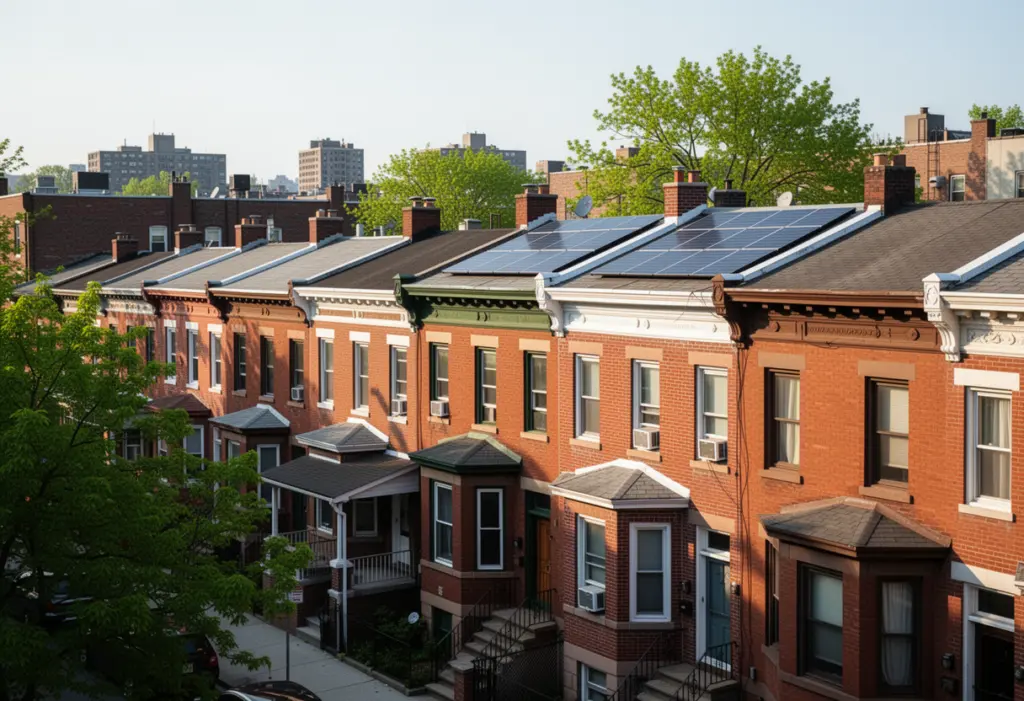
Mount Vernon shares a border with the Bronx, and almost every rule that governs a solar project changes at that line. The city is in Westchester County, so New York City’s Department of Buildings, its solar filing process and its four-year property tax abatement do not reach here. The permit comes from the City of Mount Vernon, and the utility is Con Edison, which serves most of New York City and Westchester County.
The roof usually sets the size, not the budget
Lots here are small and the housing is dense, with attached and semi-attached buildings and a great many flat or low-slope roofs behind parapets. That changes the engineering before it changes the price:
- Ballasted or penetrating racking. A flat roof can often be ballasted rather than penetrated, which avoids new holes but adds weight the structure has to carry. Ask which is proposed and whether a structural check was done.
- Fire service access and setbacks. Clear pathways and perimeter setbacks take usable area off a small roof, and they are decided by code, not by preference. This is why a roof that looks big enough for twelve modules takes eight.
- Roof condition and membrane age. On a flat roof the membrane, not the shingle, is the clock. Installing over a membrane near the end of its life means removing and reinstalling the array later.
- Adjacent buildings. Shade from a neighbouring roofline behaves differently from tree shade — it is hard-edged and seasonal by sun angle. Ask for module-level analysis and how the inverter design handles partial shading.
The meter question on a two-family house
Much of the housing across the 10550, 10552 and 10553 areas is two-family. If the building carries two utility accounts, an array net-meters against one of them, and which one is a decision made before installation rather than a setting adjusted afterwards. Establish which meter the system serves, whose bill receives the credits, and what that means if part of the house is rented. Getting this wrong produces a system that lowers a tenant’s bill while the owner pays for it.
The charges and what they come to
The Customer Benefit Contribution is billed monthly on DC system size for systems interconnected on or after 1 January 2022, regardless of production. At Con Edison’s 2026 residential rate of $1.29 per kW-month, a 5 kW array — a realistic size for a small city roof after setbacks — is $6.45 a month, about $77 a year. An 8 kW array on the same rate is $10.32 a month, roughly $124 a year. Rates are recalculated annually and are not locked in at interconnection.
Older Mount Vernon housing also often carries a 100 amp service, and a service upgrade can be the largest single item in a quote here. Ask for the existing amp rating and whether an upgrade is included or excluded from the price you were shown.
Property tax: three checks, and Mount Vernon is not Yonkers
RPTL 487 exempts the added value of a solar system from property tax for fifteen years where each taxing body has not opted out. In Mount Vernon that is three separate checks: Westchester County, the City of Mount Vernon and the Mount Vernon City School District. This is worth spelling out because five New York city school districts — New York City, Buffalo, Rochester, Syracuse and Yonkers — are fiscally dependent and levy no separate property tax, so in those places there is no school check to make. Mount Vernon borders one of them and is not one of them. The system must be constructed before 1 January 2030 to qualify.
What you can claim in 2026
The New York solar energy system equipment credit is 25 percent of qualified expenditure capped at $5,000, on Form IT-255, for equipment installed and used at your principal residence in the state. On a roof-limited city array the cap rarely binds, which makes the credit closer to a straight quarter off the qualified cost than it is on a large suburban system. It is not refundable, so it is limited by your New York liability and carries forward up to five years.
As of September 2026 NYSERDA has no open NY-Sun block for homes in any utility territory; check NYSERDA’s NY-Sun dashboard for a new one. The income-qualified Affordable Solar incentive has closed as well: in Con Edison territory it ran from 30 May to 15 October 2025. If a block for homes reopens, NY-Sun is applied by the contractor as a reduction on the price, so ask to see it identified on the contract. The state sales tax exemption covers residential solar equipment, with the local share elected separately. Phase One net metering credits exports at the full retail rate and holds for twenty years from interconnection.
The 30 percent federal residential credit is gone — section 25D was terminated for expenditures made after 31 December 2025, and an expenditure is treated as made when the original installation is completed. A Mount Vernon proposal in 2026 that still shows a federal line, or that offers the New York City abatement, is describing a different city and a different year. Verify the current position at tax.ny.gov and nyserda.ny.gov, and confirm the utility from the name on your own bill.
Frequently Asked Questions
Do New York City solar rules apply in Mount Vernon?
No. Mount Vernon is in Westchester County, so the city's own building department issues the permit and the New York City property tax abatement is not available there.
Which utility serves Mount Vernon?
Con Edison, which covers Westchester County as well as most of New York City. Confirm it from the utility name printed on your own bill before relying on any rate arithmetic.
How does a two-family house handle solar net metering?
An array net-meters against one utility account, so decide before installation which meter it serves and whose bill receives the credits. On a rented unit that decision determines who benefits.
Does Mount Vernon need a school district check for RPTL 487?
Yes. Unlike New York City, Buffalo, Rochester, Syracuse and Yonkers, whose school districts levy no separate property tax, Mount Vernon City School District is a separate check alongside the county and the city.
This article is general information, not tax, legal or financial advice. Incentive amounts, eligibility rules and deadlines change and depend on your utility, your tax situation and your property. Confirm current terms with NYSERDA, your utility and a qualified tax professional before making a decision.
NY Solar Incentives
Independent New York solar research. We summarise NYSERDA, NY-Sun and federal programme rules from published sources and state plainly when a figure is an estimate. We are not a government agency and do not sell equipment.
Run the arithmetic on your own system
Check the dated program table and your arrangement before counting an incentive. Standard residential NY-Sun blocks are closed; Long Island Affordable Solar has a conditional income-verification route. The NY credit depends on qualified costs and tax liability, while the NYC abatement reduces future property-tax bills. The estimator keeps those timings separate.