Battery Storage and Net Metering in New York: How They Interact
Phase One net metering credits your exports at the full retail rate, which removes the gap a battery would otherwise capture. That makes storage in New York a resilience purchase rather than an economic one.
On this page 7 sections
- 01Why the arbitrage argument does not work in New York
- 02What the battery genuinely changes
- 03The monthly charge a battery does not change
- 04Questions to put to the installer before you sign
- 05If your utility is municipal, none of the above governs you
- 06Where the 2026 incentives leave storage
- 07Frequently Asked Questions
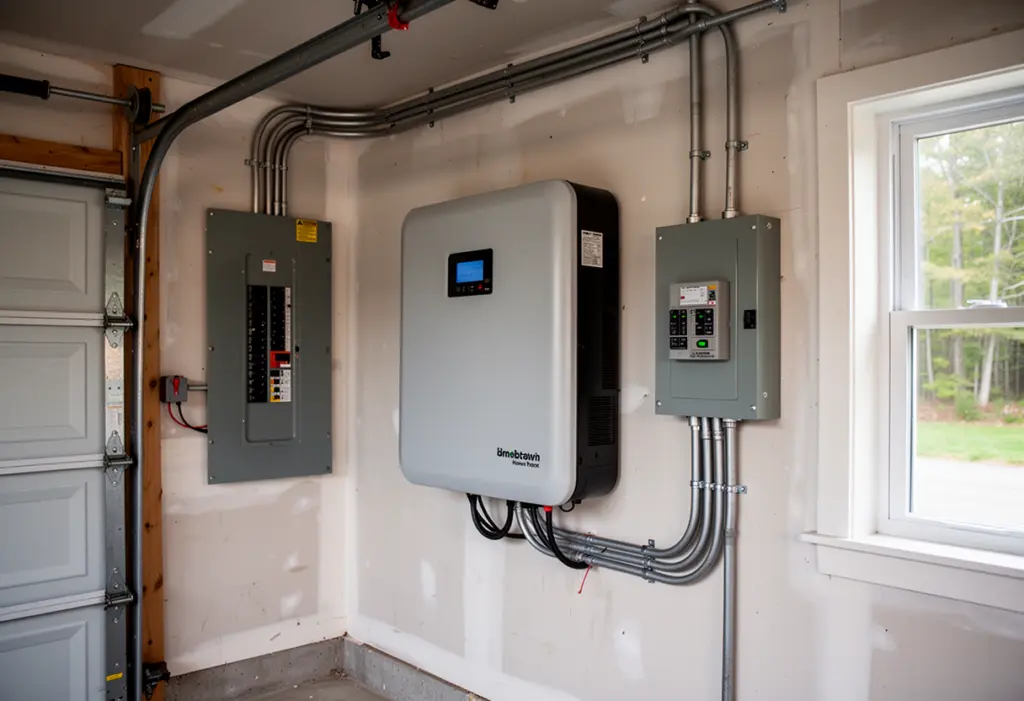
Under New York Phase One net metering a home battery does not lower your electricity bill, and any proposal that argues otherwise is selling a resilience product on economic grounds. That is the answer, and the reason sits in the credit rate.
Why the arbitrage argument does not work in New York
Phase One net metering credits what your array exports at the full retail rate, and a system interconnected today holds that structure for 20 years from interconnection. A kilowatt-hour sent to the grid at noon is worth the same as a kilowatt-hour bought back at nine in the evening.
A battery works by storing that noon kilowatt-hour so you can use it yourself later instead of buying it. Where exports are credited below retail, that gap is the entire business case for storage. In New York, under Phase One, there is no gap. You are spending money on hardware to avoid a charge that was already going to be cancelled by a credit of equal value, and you lose a few percent to round trip efficiency along the way.
So the honest framing is this: a battery in New York is a resilience purchase, not an economic one. That is a perfectly good reason to buy one. It is not the reason most quotes give.
What the battery genuinely changes
- Your house works during an outage. A grid tied array without storage shuts down when the grid goes down, by design, so that it cannot energise lines a utility crew is working on. Panels alone do not keep your lights on.
- Only what you wire to it works. Most installations back up a critical load subpanel rather than the whole house. Which circuits go on that subpanel is a decision you make once and live with, so make it deliberately: well pump, septic pump, boiler or furnace controls, refrigerator, a small number of outlets.
- The battery may recharge from the array while the grid is down, if the system is configured for it. Ask about this specifically. It is the difference between a few hours of backup and several days.
The monthly charge a battery does not change
The Customer Benefit Contribution is billed on the DC size of your solar array in kilowatts, every month, regardless of what the array produces and regardless of whether you have storage. It applies to systems interconnected on or after 1 January 2022, and the rates are recalculated annually rather than locked in at interconnection.
On a 9.6 kW array the 2026 residential arithmetic is 9.6 x $1.29 = $12.38 a month on Con Edison, roughly $149 a year, against 9.6 x $0.97 = $9.31 a month on National Grid, roughly $112 a year. Adding a battery adds nothing to either figure. Adding two more kilowatts of panels does.
Questions to put to the installer before you sign
- Does adding storage require a modified interconnection application, and does it touch the remaining term of my existing net metering arrangement?
- Is the system AC coupled or DC coupled, and what does that mean for efficiency and for expanding later?
- Exactly which circuits are backed up, and what is the continuous power rating measured against the largest motor on that list?
- What happens when the battery is full during an outage and the array is still producing?
- Who commissions it, who inspects it, and what is the workmanship warranty on the electrical work rather than on the battery itself?
If your utility is municipal, none of the above governs you
Municipal electric utilities sit outside Public Service Commission jurisdiction. There is no PSC net metering, no Customer Benefit Contribution and no state interconnection process for their customers. If you are served by Massena Electric Department, the Jamestown Board of Public Utilities, the Village of Fairport or one of the roughly fifty other municipal systems in New York, the terms are set by that utility and you have to ask it directly. Confirm the utility name printed on your own bill before assuming any of this describes you.
Where the 2026 incentives leave storage
The 30% federal residential credit is gone. Section 25D was terminated for expenditures made after 31 December 2025, and an expenditure is treated as made when the original installation is completed. Any 2026 proposal still showing a 30% federal line, for panels or for a battery, is materially wrong and should be sent back.
New York State still offers the 25% solar energy system equipment credit capped at $5,000 on Form IT-255, for equipment installed and used at your principal residence, limited by your actual state tax liability and carried forward up to five years where unused. Whether any part of a storage installation falls inside that definition is a question for the Form IT-255 instructions and your tax preparer rather than for a sales sheet. NY-Sun used to be applied by the contractor as a reduction in price, but as of September 2026 NYSERDA has no open NY-Sun block for homes in any utility territory; check NYSERDA’s NY-Sun dashboard for a new one. Storage incentives where they exist are administered separately. These programmes change, so check the current position at the NYSERDA and New York State tax websites before you rely on any of it.
Frequently Asked Questions
Will a home battery lower my electric bill in New York?
Generally no. Phase One net metering credits exports at the full retail rate for 20 years from interconnection, so storing a kilowatt-hour to use later saves about what the export credit would have saved. A battery in New York is a resilience purchase.
Do solar panels work during a power outage without a battery?
No. A grid tied array shuts down when the grid goes down so it cannot energise lines crews are working on. Backup requires storage and an inverter configured to island.
Does adding a battery increase my Customer Benefit Contribution?
No. The CBC is billed on the DC size of the solar array, not on storage. On a 9.6 kW array that is about $12.38 a month on Con Edison and $9.31 on National Grid at 2026 residential rates.
Can the battery recharge from my panels during an outage?
Only if the system is configured for it. Ask the installer directly, because it is the difference between a few hours of backup and several days of it.
This article is general information, not tax, legal or financial advice. Incentive amounts, eligibility rules and deadlines change and depend on your utility, your tax situation and your property. Confirm current terms with NYSERDA, your utility and a qualified tax professional before making a decision.
NY Solar Incentives
Independent New York solar research. We summarise NYSERDA, NY-Sun and federal programme rules from published sources and state plainly when a figure is an estimate. We are not a government agency and do not sell equipment.
Run the arithmetic on your own system
Check the dated program table and your arrangement before counting an incentive. Standard residential NY-Sun blocks are closed; Long Island Affordable Solar has a conditional income-verification route. The NY credit depends on qualified costs and tax liability, while the NYC abatement reduces future property-tax bills. The estimator keeps those timings separate.