A Home Battery Without Solar in New York: Does It Pay?
Without panels a battery stores electricity you bought rather than electricity you made. That single difference decides both what it can earn and which incentives it can reach.
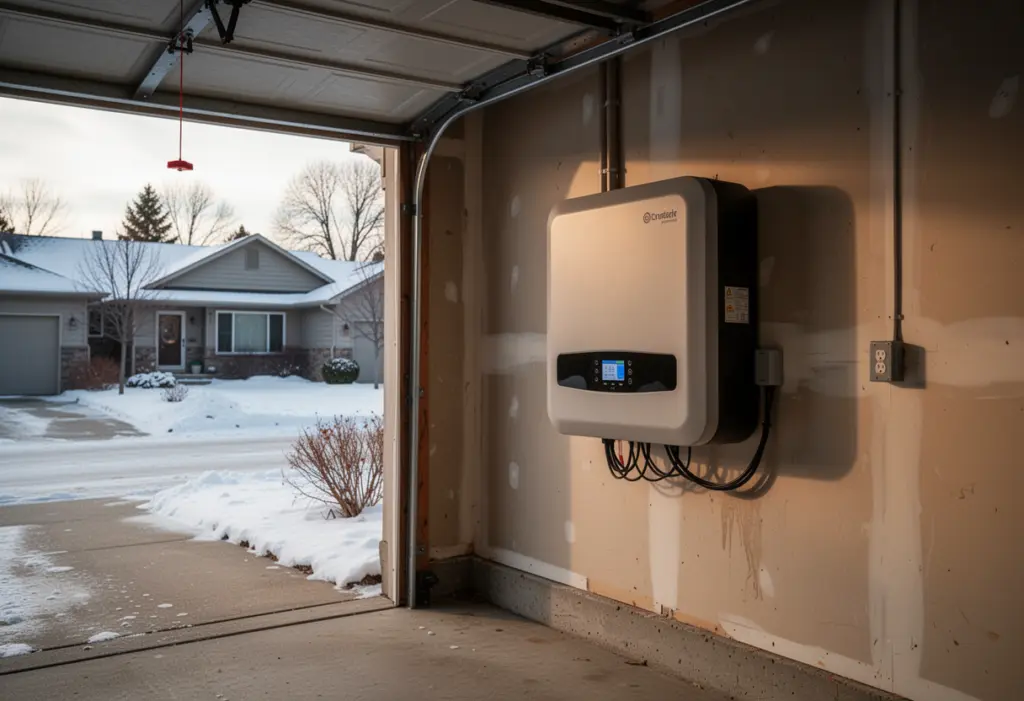
A home battery with no panels behind it stores electricity you bought rather than electricity you made. That single difference decides everything else: what the battery can earn, which incentives it can reach, and whether the purchase makes sense at all. In most New York households the honest description is a very large uninterruptible power supply, and it should be judged as one.
What you are actually buying
Two numbers describe a battery and they are not interchangeable. Kilowatts is how much it can deliver at any instant, which decides whether it can start a well pump or run a fridge compressor and the microwave at the same time. Kilowatt-hours is how long it can keep doing that. A specification with a large capacity and a modest power rating will keep a small set of circuits alive for a long time and will trip immediately if you ask it to run the whole house.
There is also a loss you pay whether you use the battery or not. Round-trip efficiency means some of what you put in never comes back out, so charging from the grid costs slightly more energy than it returns. That is fine in a resilience purchase and fatal in a thin arbitrage argument.
The two ways it can earn, and the honest size of each
The first is a price spread. If you take a time of use tariff, charging when energy is cheap and discharging when it is expensive earns the difference on the kilowatt-hours moved, minus the round-trip loss. Get the peak and off-peak figures from your own rate schedule, not from a sales sheet, and check the length of the peak window: a battery that empties in two hours cannot serve a six-hour window.
The second is a utility programme. Ask your utility directly whether it operates anything you could enrol a home battery in, what it pays, how many events a year it can call, and what control you give up. Do not assume such a programme exists on your rate or in your territory, and do not accept an installer’s assurance in place of the utility’s own answer.
Everything else people cite is outage avoidance, which is real value but is not income. Decide what an outage actually costs you, in spoiled food, in lost working days, in a sump pump that has to keep running, and compare that with the price. It is a defensible purchase on those grounds. It is a weak one on any other.
No solar means no solar incentives
This is the part that surprises people. New York’s incentives are written around solar equipment.
- The 25% state credit, capped at $5,000 on Form IT-255, applies to qualified solar energy system equipment at your principal residence. With no solar there is nothing for it to attach to.
- The state sales tax exemption is on residential solar energy systems equipment.
- NY-Sun is a solar programme too, and as of September 2026 NYSERDA has no open NY-Sun block for homes in any utility territory; check NYSERDA’s NY-Sun dashboard for a new one.
- The federal 30% residential credit is gone for everyone in 2026 in any case: section 25D was terminated for expenditures made after 31 December 2025, and an expenditure is treated as made when the original installation is completed.
If someone tells you a standalone battery carries a tax credit this year, ask which form and which line, and then check it with a tax preparer before signing anything. The one incentive written around the battery itself is not a tax credit: NYSERDA offers incentives through its Residential Energy Storage Program for home batteries installed by approved contractors, and the requirements it lists (25 kilowatt-hours or less, new, permanent and stationary) do not mention solar. On Long Island, storage incentives are offered through PSEG Long Island instead.
One charge you will not pay
The Customer Benefit Contribution is billed on DC panel capacity, monthly, for systems interconnected on or after 1 January 2022. No panels means no capacity to bill, so this line does not appear. It is worth seeing the size of what you are avoiding: a neighbour with an 8 kW array pays about $10.32 a month on Con Edison and about $7.76 on National Grid, which is roughly $124 and $93 a year. That is a small consolation next to what the panels earn, and it is the only cost of ownership that a battery-only household escapes.
Questions to settle before ordering
- Does your utility require an interconnection application or notification for a storage-only system, and is charging from the grid permitted on your rate?
- Which circuits will the battery actually back up, and where does the subpanel go?
- How long can the system hold charge while idle, and what does it draw to keep itself warm in winter?
- How does it behave during a multi-day outage with no way to recharge?
- What is the manufacturer’s stated operating temperature range, and does the proposed location stay inside it in January?
The comparison nobody makes but should
A standby generator is the direct competitor, and it wins on duration for exactly the reason the battery wins on everything else. A generator keeps going as long as fuel keeps arriving; a battery is silent, needs no fuel deliveries, has no exhaust and no annual service call, and stops when it is empty. In a New York winter storm the outage that matters is often measured in days, which is the case where fuel matters more than convenience.
And if the real goal is a lower bill rather than resilience, the cheaper routes are solar with net metering, where exports are credited at full retail under Phase One for 20 years from interconnection, or a community solar subscription, which needs no equipment, no roof and carries no Customer Benefit Contribution. Incentives and utility programmes both change, so confirm the current position with NYSERDA, with your own utility and at tax.ny.gov before you commit.
Frequently Asked Questions
Can you install a home battery without solar panels in New York?
Yes. It charges from the grid and functions as a large uninterruptible supply. It stores electricity you bought rather than electricity you made, so it earns only through a tariff spread or a utility programme, plus the value of avoiding an outage.
Does a standalone battery qualify for New York incentives?
Not for the solar ones. The state credit on Form IT-255 is defined on qualified solar energy system equipment at your principal residence, and the sales tax exemption and NY-Sun are likewise solar programmes. With no solar there is nothing for them to attach to. The exception is NYSERDA's Residential Energy Storage Program, which offers incentives for home batteries installed by approved contractors and does not list solar among its requirements; on Long Island storage incentives come through PSEG Long Island. Check with a tax preparer before relying on any tax claim.
Do I pay the Customer Benefit Contribution on a battery?
No. That charge is billed on DC panel capacity for systems interconnected on or after 1 January 2022. For scale, an 8 kW array pays about $10.32 a month on Con Edison and about $7.76 on National Grid.
Battery or generator for a New York outage?
A generator runs as long as fuel arrives, which matters in a multi-day winter storm. A battery is silent, needs no fuel or annual service, and stops when empty. Choose on the length of outage you are actually protecting against.
This article is general information, not tax, legal or financial advice. Incentive amounts, eligibility rules and deadlines change and depend on your utility, your tax situation and your property. Confirm current terms with NYSERDA, your utility and a qualified tax professional before making a decision.
NY Solar Incentives
Independent New York solar research. We summarise NYSERDA, NY-Sun and federal programme rules from published sources and state plainly when a figure is an estimate. We are not a government agency and do not sell equipment.
Run the arithmetic on your own system
Check the dated program table and your arrangement before counting an incentive. Standard residential NY-Sun blocks are closed; Long Island Affordable Solar has a conditional income-verification route. The NY credit depends on qualified costs and tax liability, while the NYC abatement reduces future property-tax bills. The estimator keeps those timings separate.