Solar Battery Lifespan in a New York Winter
Cold seldom destroys a home battery. It temporarily reduces what the battery will give you, and where you put the equipment matters more than which brand is on the front.
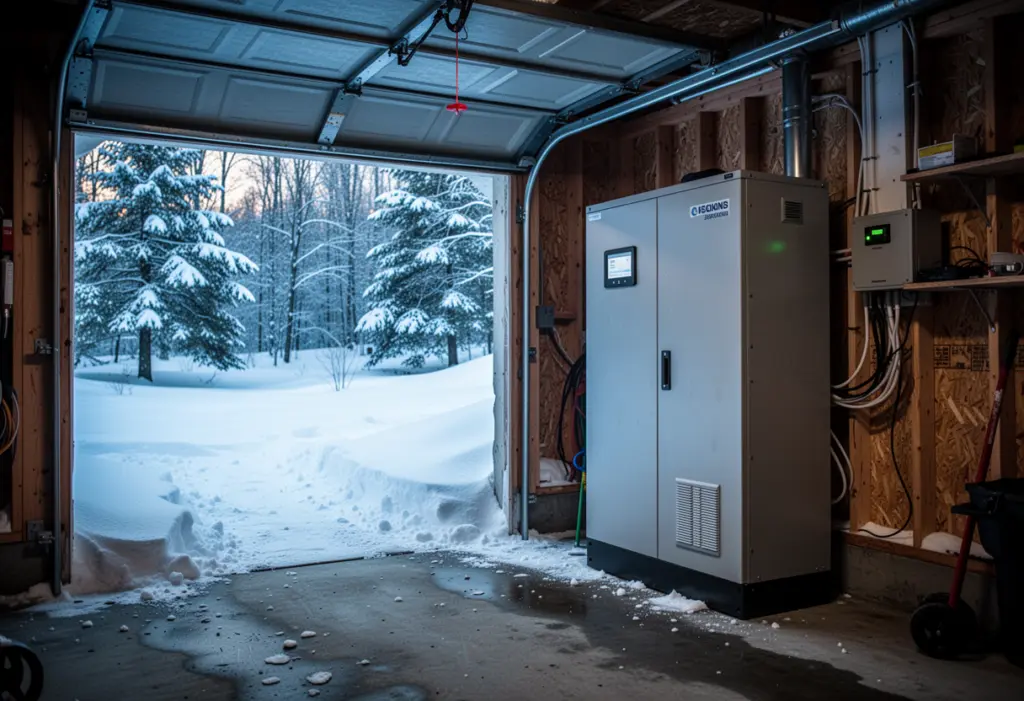
Cold seldom destroys a home battery. What it does is temporarily reduce what the battery will give you on the coldest mornings, and in New York that is the same morning you most want it. The two things that actually decide how long the equipment lasts are the warranty you agreed to and the place you put it, and the second is easier to get wrong than the first.
Read the warranty for three numbers, not one
A home battery warranty is usually written around three separate limits, and it expires when the first of them is reached.
- Years. A calendar term, running from a date the document defines. Check whether that date is installation, commissioning or purchase.
- Throughput. A total quantity of energy the battery may pass over its life, usually stated in megawatt-hours. This is the limit that daily cycling consumes and that occasional outage use barely touches.
- End-of-warranty capacity. The percentage of original capacity the manufacturer guarantees will remain at the end. This is what protects you against gradual fade rather than sudden failure.
Every one of those figures is set by the manufacturer and differs between products, so compare the actual documents rather than the summary a salesperson reads out. Ask for the warranty PDF before signing, and read the exclusions with more attention than the headline: how the claim is made, who pays labour as opposed to parts, whether the warranty survives a change of homeowner, and what happens if the manufacturer is no longer trading.
Cold derating is not damage
Two different things get called cold weather performance and they need separating. The first is reduced output in the cold, where the battery delivers less power or less usable capacity while it is cold and recovers when it warms up. That is a derating, it is temporary, and it is why a January outage drains the system faster than the same outage in May.
The second is charging at low temperature, which is the one to ask about specifically. Many systems restrict or prevent charging below a stated temperature, and many manage it by heating themselves, drawing energy from the battery to do so. Neither is a fault. Both change your planning, because a system that spends the night keeping itself warm is a system with less left for the fridge.
Ask three questions: what is the manufacturer’s stated operating temperature range for discharge, what is it for charging, and does the unit heat itself, from where.
Where it lives matters more than which one you buy
An unheated detached garage in the North Country is a different environment from a basement in Westchester, and the same battery in both will behave differently every winter for the whole of its life. Compare the manufacturer’s stated range against what your proposed location actually reaches in January, not against the outdoor forecast, and remember that a basement is generally the most stable option available in a New York house.
Sustained heat is, as a rule, harder on lithium cells than cold. A location that bakes in July deserves as much scrutiny as one that freezes in January, and installers thinking about outages sometimes only assess the winter case.
What actually consumes the life
Cycles, mostly. A battery bought for resilience and discharged during a handful of outages a year will approach its calendar limit long before its throughput limit. A battery cycled daily to chase a time of use spread does the opposite, and consumes throughput at a rate you can calculate: divide the throughput allowance in the warranty by the usable capacity, and you have roughly the number of full cycles it is warranted for.
That calculation is the honest way to compare a resilience purchase with an arbitrage one, and it usually favours resilience in New York, because Phase One net metering already credits exports at the full retail rate for 20 years from interconnection. There is not much spread left to chase when the grid is already paying retail for every exported kilowatt-hour.
Maintenance is mostly attention
There is little to service, but there are things to notice. Keep the monitoring account in your own name so you can see state of charge and error notices, and check it after the first hard freeze of each winter rather than discovering a fault during an outage. Keep vents and clearances free, keep firmware current if the manufacturer issues updates, and keep the commissioning report with the house paperwork so a future service call starts from facts. Snow around an outdoor enclosure is a clearance problem as much as a temperature one.
Plan the replacement as an unsubsidised cost
This is where the 2026 incentive position bites hardest and the least is said about it. The 30% federal residential credit is gone: section 25D was terminated for expenditures made after 31 December 2025, and an expenditure is treated as made when the original installation is completed. There is nothing federal waiting for a replacement battery a decade from now, and nothing that carries over.
New York’s 25% credit on Form IT-255, capped at $5,000 and limited by your actual state tax liability with unused credit carrying forward for up to five years, is defined on qualified solar energy system equipment at your principal residence, and what a later replacement can claim is a question for the Form IT-255 instructions and a tax preparer rather than for an installer. RPTL 487’s 15-year property tax exemption runs from the original construction and requires that construction to happen before 1 January 2030, so it does not restart with new equipment. Budget the eventual replacement at full price, ask the assessor and tax.ny.gov what the position is when the time comes, and treat any promise made now about incentives a decade out as the guess that it is.
Frequently Asked Questions
Does cold weather damage a home battery in New York?
Usually not. Cold temporarily reduces output and usable capacity, and the battery recovers as it warms. The specific thing to ask about is charging at low temperature, which many systems restrict or manage by heating themselves from stored energy.
What should I look for in a battery warranty?
Three numbers, because the warranty ends when the first is reached: the calendar term, the total energy throughput allowance, and the guaranteed remaining capacity at the end. Then read the exclusions, especially labour versus parts and whether it transfers with the house.
Where should the battery be installed?
Compare the manufacturer's stated operating range against what your proposed location actually reaches in January, not the outdoor forecast. A basement is generally the most stable option. Sustained summer heat deserves as much scrutiny as winter cold.
Will there be an incentive for replacing the battery later?
Plan as if there is not. The federal residential credit was terminated for expenditures made after 31 December 2025, and RPTL 487 runs from the original construction rather than restarting with new equipment. Budget a replacement at full price.
This article is general information, not tax, legal or financial advice. Incentive amounts, eligibility rules and deadlines change and depend on your utility, your tax situation and your property. Confirm current terms with NYSERDA, your utility and a qualified tax professional before making a decision.
NY Solar Incentives
Independent New York solar research. We summarise NYSERDA, NY-Sun and federal programme rules from published sources and state plainly when a figure is an estimate. We are not a government agency and do not sell equipment.
Run the arithmetic on your own system
Check the dated program table and your arrangement before counting an incentive. Standard residential NY-Sun blocks are closed; Long Island Affordable Solar has a conditional income-verification route. The NY credit depends on qualified costs and tax liability, while the NYC abatement reduces future property-tax bills. The estimator keeps those timings separate.