Solar Panel Installation in Garden City, New York
Garden City is an incorporated village with its own building department and a long-standing interest in how the place looks. Both facts reach a solar design before the panels do.
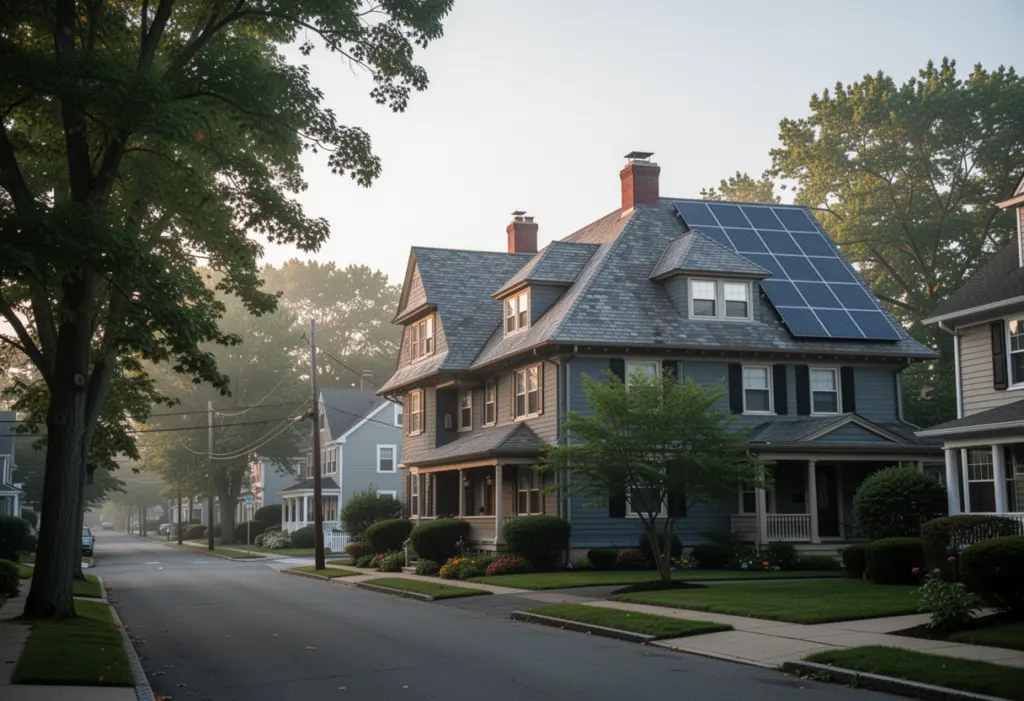
Garden City is an incorporated village inside the Town of Hempstead, and that single fact redirects a solar project: the building department you deal with is the village, not the town. An installer working from a Nassau County map rather than from the village line will file in the wrong place, and the schedule they quoted you was built on the wrong review process.
Ask about appearance before you fix the design
This is a planned village with an unusually consistent architectural character, and villages with that character commonly take an interest in what is visible from the street. Ask the village directly, at the design stage, whether any review applies to roof-mounted equipment on a street-facing plane, and what the process and timeline are.
Do it early for a financial reason rather than an aesthetic one. If the outcome pushes the array to a rear or side roof plane, the production estimate changes, and every payback figure in the proposal changes with it. That is a conversation to have before a contract is signed, not after a design has been drawn and sold.
Older roofs, and what they cost to work on
- Slate and tile. Both appear on the older housing here, and both are specialist work. The attachment and flashing detail matters more than the module brand, and the question that matters most is who warrants the roof after the array is on it, and for how long.
- Roof age against a twenty year horizon. Net metering holds its structure for 20 years from interconnection. If the covering has under ten years left, reroof first and ask now what removal and reinstallation would cost, in writing.
- Mature canopy. The street trees that define these blocks also take the low winter sun. Insist on an on-site shade assessment rather than a satellite estimate, and ask how the model handles bare winter branches against summer leaf.
- Service capacity. Large houses here often add electric vehicle charging and heat pumps as well. Establish the service rating and the cost of any upgrade before the array is sized, not between projects.
The cost of capacity on a big roof
A generous roof invites a generous system, and two things push back. The Customer Benefit Contribution is billed monthly on DC size regardless of production, on systems interconnected on or after 1 January 2022, and at the 2026 PSEG Long Island residential rate of $1.13 per kW-month a 13 kW array pays 13 x $1.13 = $14.69 a month, about $176 a year. Rates are reset annually rather than fixed at interconnection.
The second brake is the state credit. It is 25% of qualified expenditure capped at $5,000, so beyond the point where the cap binds each additional kilowatt earns no state credit while still adding to that monthly charge. Size to the electricity you actually use, including whatever you plan to electrify, rather than to the roof area available.
On the other side of the ledger, mass-market residential projects here settle under Phase One net metering at the full retail rate for 20 years from interconnection, which is the mechanism that makes summer surplus pay for winter consumption. The Value Stack is not the mass-market residential arrangement on Long Island.
Property tax means asking each body separately
RPTL 487 exempts the added value from property tax for 15 years, but the opt-out is available to a county, city, town or village by local law and to a school district by resolution. In a village that means checking each taxing body that appears on your bill in turn — the village, the town, Nassau County and your school district — rather than assuming one answer covers all of them. Garden City is not one of the five cities with fiscally dependent school districts, so the school enquiry applies here in full. The system also has to be constructed before 1 January 2030.
What is left in 2026
Federally, nothing for a buyer. Section 25D was terminated for expenditures made after 31 December 2025, and an expenditure is treated as made when the original installation is completed — so a proposal for a Garden City roof showing a 30% federal line is wrong on its face and should be corrected before it is compared with anything. The carve-out for work forming part of the construction or reconstruction of a structure moves the test again, to when your original use of that structure begins, which is worth knowing on a rebuild.
What remains is the state credit at 25% capped at $5,000 on Form IT-255 for your principal residence, limited by the state tax you owe and carrying forward up to five years, and the state sales tax exemption, with the local share decided separately. NY-Sun is not on that list: NYSERDA’s last residential block on Long Island closed in April 2016, its income-qualified Affordable Solar incentive has no open block either, and as of September 2026 NYSERDA has no open NY-Sun block for homes in any utility territory; check NYSERDA’s NY-Sun dashboard for a new one. Verify each with NYSERDA and the Department of Taxation and Finance rather than from the proposal, because block levels step down and rates change — and confirm your utility from the name printed on your own bill, because a municipal electric customer sits outside Public Service Commission jurisdiction, where none of the state net metering rules, the capacity charge or the state interconnection process apply.
Frequently Asked Questions
Who issues a solar permit in Garden City?
The Village of Garden City building department, not the Town of Hempstead. An installer working from a county map rather than the village line will file in the wrong place and the quoted schedule will be wrong.
Will the village have a view on where panels go?
Ask directly at design stage whether any review applies to equipment visible from the street. If the outcome moves the array to a rear plane, the production estimate and every payback figure change with it.
How much does the capacity charge add on a large system?
At the 2026 PSEG Long Island residential rate of $1.13 per kW-month, a 13 kW array pays 13 x $1.13 = $14.69 a month, about $176 a year, billed on DC size regardless of what it produces.
Does a bigger array earn a bigger state credit?
Only up to a point. The credit is 25% of qualified expenditure capped at $5,000, so past the cap each extra kilowatt earns nothing further while still adding to the monthly capacity charge.
This article is general information, not tax, legal or financial advice. Incentive amounts, eligibility rules and deadlines change and depend on your utility, your tax situation and your property. Confirm current terms with NYSERDA, your utility and a qualified tax professional before making a decision.
NY Solar Incentives
Independent New York solar research. We summarise NYSERDA, NY-Sun and federal programme rules from published sources and state plainly when a figure is an estimate. We are not a government agency and do not sell equipment.
Run the arithmetic on your own system
Check the dated program table and your arrangement before counting an incentive. Standard residential NY-Sun blocks are closed; Long Island Affordable Solar has a conditional income-verification route. The NY credit depends on qualified costs and tax liability, while the NYC abatement reduces future property-tax bills. The estimator keeps those timings separate.