What a Heat Pump Costs in the Finger Lakes
Heat pump cost in the Finger Lakes is set by your existing distribution, your zone count, your panel and your air leakage — not by the equipment. Here is how to get a real number.
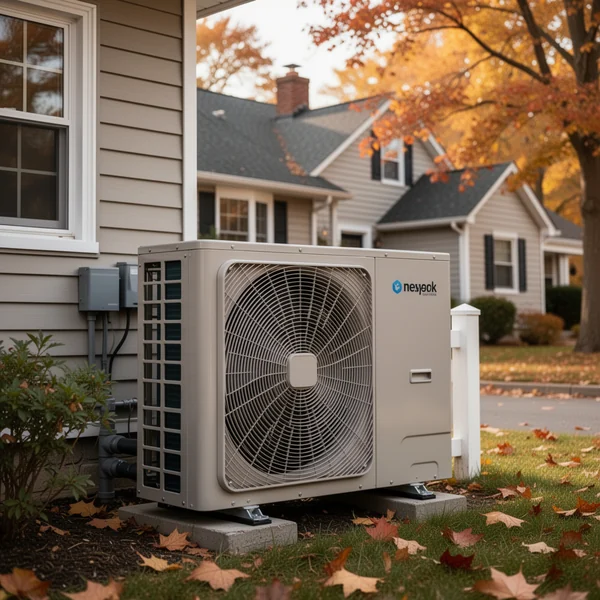
What a heat pump costs in the Finger Lakes is decided almost entirely by what you already have for distributing heat — ducts, hydronic baseboard, or nothing at all — and by how much of the house you are asking it to carry. The equipment is close to a commodity; the labour to get heat into every room of a 1890s farmhouse outside Penn Yan is not.
Before any number matters, one fact does: a 2026 install gets nothing federal. Section 25C, which carried a $2,000 annual cap for heat pumps, applied to property placed in service before 31 December 2025, and Section 25D terminated for expenditures after the same date. The incentive that remains in Ontario, Seneca, Yates, Cayuga, Tompkins, Schuyler and Steuben counties is the NYS Clean Heat rebate paid through your electric utility.
Your utility, and why it decides the rebate
The Finger Lakes are split between two of the seven NYS Clean Heat sponsoring utilities. NYSEG covers most of the region — Ithaca and Tompkins County, Watkins Glen, Penn Yan, Geneva, the Southern Tier fringe. RG&E covers Rochester, Monroe County and the western edge around Canandaigua. Both are Clean Heat sponsors, along with Central Hudson, Con Edison, National Fuel Gas, National Grid and Orange & Rockland.
Clean Heat rebate amounts are not published as a single statewide table. They differ by utility, by equipment category and by programme year, which is why any page quoting you a per-ton dollar figure for “New York” is guessing. The official route is the address-based finder at cleanheat.ny.gov/find-available-rebates/. Put in your address, screenshot the result, and date it.
The mechanism matters as much as the amount. In practice the rebate is claimed by a participating contractor and appears as a deduction on your proposal, rather than as a cheque you receive later. That has a direct consequence for comparing quotes: compare net-of-rebate totals, and make every contractor itemise the rebate as its own line. A quote that folds it into a single number is hiding whether they applied it at all.
The four things that actually move the price
1. What you have for distribution
This is the big one. Finger Lakes housing stock skews old and hydronic. A house with cast-iron radiators or fin-tube baseboard has no ducts, so the choices are ductless heads room by room, an air-to-water unit feeding the existing emitters, or building a duct system that never existed. A house that already has a forced-air furnace and decent ductwork is the cheapest conversion in the region, because the air handler drops into an existing plenum.
2. How many zones
One outdoor unit serving three indoor heads is a very different job from four separate systems for a rambling farmhouse with additions on three sides. Every head is refrigerant line, condensate drainage, a wall penetration and a mounting. Old houses with knee walls, stone foundations and balloon framing make each of those slower.
3. Electrical work
Rural Finger Lakes properties frequently run modest electrical service, because heat came from a propane or oil burner and the panel never needed to be large. Adding a whole-home heat pump — and perhaps an EV charger later — can push you into a service upgrade, which is on NYSEG’s or RG&E’s schedule, not yours. Get the electrician’s load calculation done before you sign, not after.
4. Whether the house needs air sealing first
A leaky building envelope makes the heat pump bigger, which makes it more expensive, which makes it run worse at part load. In a farmhouse with an unsealed attic and a fieldstone cellar, the first dollar spent on air sealing usually buys more comfort than the last dollar spent on capacity.
Full replacement versus keeping the old system
Utility rebate tiers commonly distinguish a heat pump that displaces part of the heating load from one that replaces the fossil system entirely, and the full-replacement tier is generally the better-funded one. That is a real financial pull toward removing the boiler or furnace — but it also removes your fallback.
Most of the Finger Lakes is off the natural gas main. Households here burn propane or delivered oil, which means the comparison is against a delivered-fuel bill, and delivered fuel is exactly where heat pumps look best. Pull your last two winters of delivery invoices — gallons and dollars, not a remembered average — before anyone runs a payback for you.
The microclimate is not a detail here
Sizing is done against a winter design temperature for your specific location, and the Finger Lakes are unusually varied for a small area. The deep lakes moderate temperature along the shoreline; the hills a few miles up are colder and windier. A house on the water at Skaneateles and a house on the ridge above Hammondsport are not the same design problem, and a contractor who quotes both from the same rule of thumb is not doing a load calculation.
What you want from the contractor is the equipment’s certified capacity at your design temperature, from the manufacturer’s extended performance data, not the seasonal average printed on the brochure. That number, set against the room-by-room load, is what tells you whether backup heat runs for six hours a winter or six weeks.
If it is a seasonal lake house
Second homes around Keuka, Seneca and Cayuga bring their own question: freeze protection over a winter when nobody is there. A heat pump held at a low setpoint is a reasonable answer, but only if you have a remote thermostat with an alarm and someone local who can respond. Plumbing does not care that the system was working right up until the outage.
Getting an honest number
| Ask for | Why it matters |
|---|---|
| A room-by-room load calculation | Sizing by square footage is how oversized, short-cycling systems get sold. |
| The AHRI certificate for the exact model pairing | Rebate paperwork needs it, and it proves the indoor and outdoor units were rated together. |
| Capacity and efficiency at your design temperature | The seasonal rating is an average of a test season, not your February. |
| The estimated balance point and backup strategy | Tells you how often resistance heat runs — the difference between a fine bill and a bad one. |
| The Clean Heat rebate as an itemised line | Proves it was applied, and lets you compare quotes net. |
| Confirmation the contractor is Clean Heat participating | A non-participating installer cannot claim the rebate for you. |
Three quotes is the minimum, and they should be from contractors who have actually worked on houses like yours. Our guidance on what a NYSERDA-qualified contractor actually is applies just as much on the heating side as on solar, and the vetting questions in how to vet an installer in New York transfer almost directly.
Financing, with the federal credit gone
Without 25C, financing carries more of the load than it did two years ago. NYSERDA’s on-bill recovery loan lets qualifying clean heating and efficiency work be repaid through the utility bill rather than a bank note, which changes the monthly comparison against a propane delivery. Our explainer on the NYSERDA on-bill recovery loan covers the mechanics. NYSERDA also runs income-qualified programmes including EmPower+ — thresholds and amounts change, so confirm current terms directly at 1-866-NYSERDA rather than from a summary page.
If solar is also on your list, note that the two do not share a credit: New York’s Form IT-255 gives 25% of a solar system’s cost up to $5,000, carried forward up to five years and claimed for the tax year you get Permission to Operate. It does not cover heating equipment. Local context on both fronts is in our guides to solar installation in Ithaca and NYSEG net metering.
What to do next
- Identify your electric utility by name on the bill — NYSEG or RG&E — then run your address through cleanheat.ny.gov/find-available-rebates/.
- Dig out two winters of propane or oil delivery invoices. Gallons and dollars.
- Get three quotes from Clean Heat participating contractors, each with a room-by-room load calculation and an itemised rebate line.
- Ask every quote for the certified capacity at your design temperature and the expected balance point.
- Price a blower-door test and air sealing as a separate item, and ask what it does to the required capacity.
- Have an electrician confirm your panel and file any service upgrade with NYSEG or RG&E early.
- Assume zero federal credit for 2026. Both 25C and 25D ended for property placed in service after 31 December 2025.
NY Solar Incentives
Independent New York solar research. We summarise NYSERDA, NY-Sun and federal programme rules from published sources and state plainly when a figure is an estimate. We are not a government agency and do not sell equipment.
Run the arithmetic on your own system
Check the dated program table and your arrangement before counting an incentive. Standard residential NY-Sun blocks are closed; Long Island Affordable Solar has a conditional income-verification route. The NY credit depends on qualified costs and tax liability, while the NYC abatement reduces future property-tax bills. The estimator keeps those timings separate.