NYSEG Net Metering: What Your Solar Exports Earn
NYSEG territory is scattered across upstate New York and the Hudson Valley. Here is how it credits solar exports, what the 2026 CBC costs, and how interconnection runs.
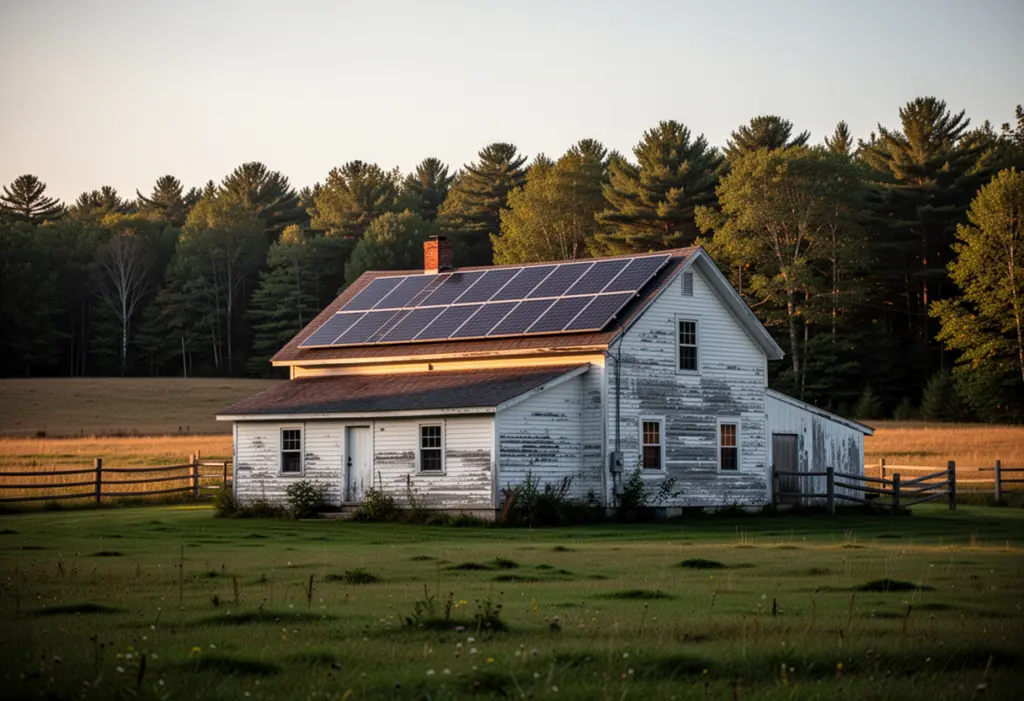
NYSEG — New York State Electric & Gas — serves a famously scattered territory: much of the Southern Tier, parts of the Finger Lakes, pockets of the Hudson Valley and stretches of the North Country. Two neighbours a few miles apart can be on different utilities, which is why the first step is always to read the name on your own bill rather than assume from the county.
How NYSEG credits your exports
Solar production is consumed in the house first. The surplus flows to the grid and is metered as an export, and under Phase One net metering each exported kilowatt-hour earns a credit at the full retail rate. A unit exported at noon offsets a unit imported that evening.
That structure is held for 20 years from interconnection. It is the interconnection date, not the contract date or the installation date, that fixes it.
Seasonal banking
NYSEG’s territory is cold, and much of it is rural with electric heat or heat pumps in the mix. That makes annual sizing more important here than almost anywhere in the state: the winter deficit is deep, and it is paid for out of the credit balance built between March and September.
Pull your twelve-month usage history from NYSEG before accepting a proposal. A design built on an estimate rather than your own consumption is a design built on a guess, and in a heat-pump household the guess is usually low.
The Customer Benefit Contribution on NYSEG
Residential customers who interconnected on or after 1 January 2022 pay a monthly Customer Benefit Contribution, charged on the DC size of the system rather than on production. NYSEG’s final 2026 residential rate for net-metered PV is $1.19 per kW-month.
- A 6 kW system: 6 × $1.19 = $7.14 a month, about $86 a year.
- An 8 kW system: 8 × $1.19 = $9.52 a month, about $114 a year.
- A 12 kW system: 12 × $1.19 = $14.28 a month, about $171 a year.
That places NYSEG in the middle of the state — below Central Hudson at $1.67 and RG&E at $1.31, above Orange & Rockland at $1.00 and National Grid at $0.97. On the Value Stack route NYSEG’s 2026 residential rate is $0.60 per kW-month.
The charge is billed whether or not the sun shines, it is recalculated annually rather than fixed at interconnection, and it does not apply to pre-2022 systems, to community solar subscriptions, or to commercial accounts with a demand charge.
Interconnection in a rural territory
The application sequence is the standard New York one: application, approval to install, installation, electrical inspection, meter change, permission to operate. What differs on NYSEG is the circuits. Long rural feeders with a lot of existing distributed generation are where hosting-capacity limits bite, and where an application comes back needing a study or an upgrade.
Two questions worth asking before you sign:
- Has the installer checked NYSEG’s hosting capacity map for your circuit?
- If a study or distribution upgrade is required, who pays, and what happens to the contract?
What stays on the bill
A NYSEG bill separates supply from delivery. Solar reduces the kilowatt-hours you buy but does not remove the basic service charge or the fixed portion of delivery. A small monthly bill is the honest expectation.
The 2026 incentive position
The federal 30% residential credit under section 25D ended for expenditures made after 31 December 2025, and the statute treats an expenditure as made when the original installation is completed. A NYSEG customer whose install finished in December 2025 still qualifies even if permission to operate came in 2026. A customer buying now claims nothing federally.
Still available: New York’s 25% credit capped at $5,000 on Form IT-255, the state sales tax exemption on residential solar equipment, and the RPTL 487 property tax exemption where your municipality has not opted out — worth confirming with your assessor, because a county, city, town or village can opt out by local law and a school district by resolution. The RPTL 487 exemption is not automatic: file form RP-487 with your assessor by the taxable status date (March 1 in most towns; January 2 in Nassau towns; May 1 or June 1 in Westchester towns; set by charter in cities; usually January 1 in villages), and the system must be built before January 1, 2030 (RP-487 instructions). NY-Sun is not on the list: as of September 2026 NYSERDA has no open NY-Sun block for homes in any utility territory; check NYSERDA’s NY-Sun dashboard for a new one.
Frequently Asked Questions
What is the NYSEG CBC rate in 2026?
$1.19 per kW-month of DC system size for a net-metered residential PV system. An 8 kW system pays about $9.52 a month, roughly $114 a year. On the Value Stack route the 2026 residential rate is $0.60 per kW-month.
Where does NYSEG provide electricity in New York?
A scattered territory covering much of the Southern Tier, parts of the Finger Lakes, pockets of the Hudson Valley and stretches of the North Country. Because the boundaries are irregular, check the utility name on your own bill rather than assuming from your county.
Can a NYSEG interconnection be refused?
An application can come back requiring a study or a distribution upgrade where a rural circuit already carries a lot of distributed generation. Ask your installer to check the hosting capacity map for your circuit before you sign, and to state in writing who pays if an upgrade is required.
Does NYSEG net metering expire?
A system interconnected today holds Phase One net metering for 20 years. The Customer Benefit Contribution is a separate charge and is recalculated annually.
This article is general information, not tax, legal or financial advice. Incentive amounts, eligibility rules and deadlines change and depend on your utility, your tax situation and your property. Confirm current terms with NYSERDA, your utility and a qualified tax professional before making a decision.
NY Solar Incentives
Independent New York solar research. We summarise NYSERDA, NY-Sun and federal programme rules from published sources and state plainly when a figure is an estimate. We are not a government agency and do not sell equipment.
Run the arithmetic on your own system
Check the dated program table and your arrangement before counting an incentive. Standard residential NY-Sun blocks are closed; Long Island Affordable Solar has a conditional income-verification route. The NY credit depends on qualified costs and tax liability, while the NYC abatement reduces future property-tax bills. The estimator keeps those timings separate.