Solar Panel Installation in Ithaca, New York
Ithaca has one of the most solar-engaged populations in New York and some of its most awkward topography. Here is what installing here actually involves.
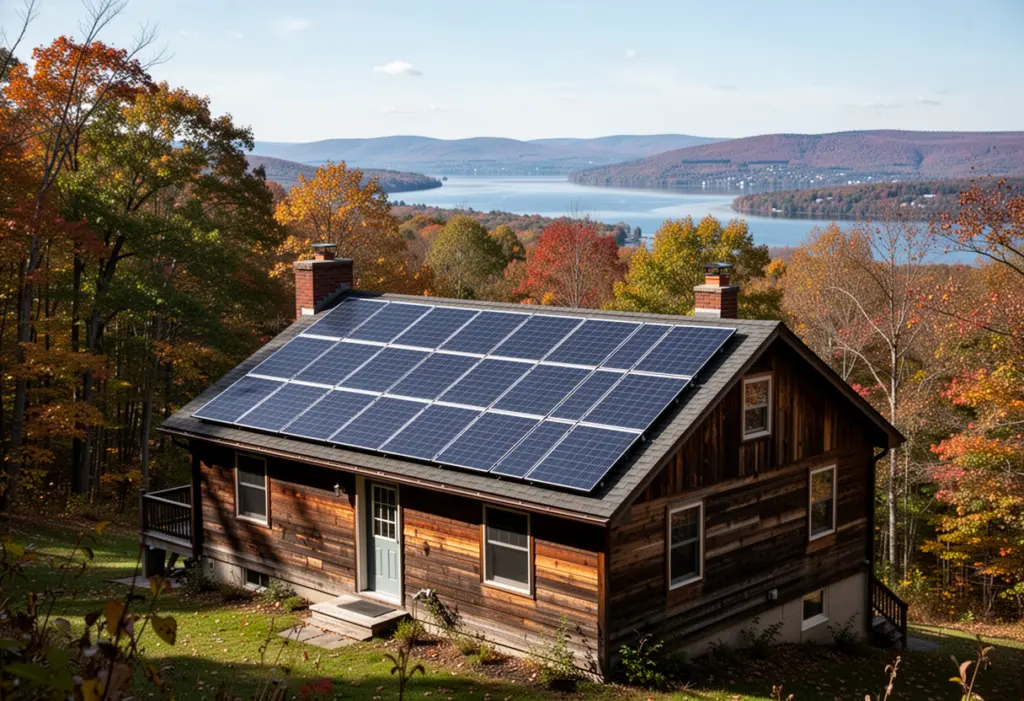
Ithaca has an unusually engaged solar market for a city its size — and unusually difficult ground for it. Steep hillsides, deep gorges, heavy tree cover and a lake that shapes the local weather all interact with what a roof can actually produce.
Topography first
Almost every solar question in Tompkins County resolves to the same one: what does your southern horizon look like? A house on the flats near the lake, a house partway up East Hill and a house on a wooded slope in Danby are three completely different propositions, and no satellite estimate will tell them apart reliably.
Insist on a real shading assessment. In terrain like this, the difference between two installers’ annual production estimates for the same roof can be very large, and the difference between an estimate and reality can be larger still.
Where the roof genuinely will not work, the alternatives are real: a different roof plane, a ground mount if there is open land — common enough on Tompkins County properties — or community solar, which needs no roof at all and whose subscribers are exempt from the Customer Benefit Contribution.
The installation sequence
- Twelve months of NYSEG usage, shading assessment, roof condition and structural check.
- Interconnection application to NYSEG, ideally before installation.
- Building permit from the City of Ithaca, the Town of Ithaca, or your own town — Lansing, Dryden, Danby, Newfield, Caroline, Enfield and Ulysses each run their own.
- Installation, then electrical inspection.
- Certificate to NYSEG, meter exchange, permission to operate. Do not run the system before PTO.
City of Ithaca and Town of Ithaca are separate authorities with separate processes, which catches people out. Confirm which one is issuing your permit.
Housing stock
Ithaca has a lot of older wood-frame housing, a lot of it rented, and a lot of steep roofs. Two consequences: roof age is often the binding constraint, and ownership questions come up more than usual. If you are a landlord, the system offsets whichever meter it is connected behind — and if tenants pay their own electricity, that is not their meter.
Snow load in Tompkins County is moderate for upstate but the racking still has to be specified for it, and hillside sites can see meaningful wind exposure.
NYSEG numbers
Ithaca is NYSEG territory. The 2026 residential Customer Benefit Contribution is $1.19 per kW-month on the DC size of the system, for anyone interconnecting on or after 1 January 2022. An 8 kW system pays $9.52 a month, roughly $114 a year, billed regardless of production and recalculated annually.
Tompkins County has a high density of existing distributed generation for a rural area, so it is worth asking whether hosting capacity was checked for your circuit before the system was designed.
2026 incentives
The 30% federal residential credit under section 25D ended for expenditures made after 31 December 2025, with the expenditure treated as made when the original installation is completed. A December 2025 completion still qualifies; a purchase now does not.
New York’s 25% credit capped at $5,000 on Form IT-255 remains, along with the state sales tax exemption and RPTL 487’s 15-year property tax exemption where the municipality has not opted out. The RPTL 487 exemption is not automatic: file form RP-487 with your assessor by the taxable status date (March 1 in most towns; January 2 in Nassau towns; May 1 or June 1 in Westchester towns; set by charter in cities; usually January 1 in villages), and the system must be built before January 1, 2030 (RP-487 instructions). The exemption still has to be confirmed for your town, the county and your school district rather than assumed. As of September 2026 NYSERDA has no open NY-Sun block for homes in any utility territory; check NYSERDA’s NY-Sun dashboard for a new one.
Questions for an Ithaca installer
- Was the shading assessment done on site, and what does it say about my winter horizon?
- Is a ground mount viable on this property, and how does it compare?
- Which authority issues my permit — city or town?
- Was NYSEG hosting capacity checked for this circuit?
- If I rent the property out, which meter does this system offset?
Frequently Asked Questions
Is Ithaca's terrain a problem for solar?
It can be. Steep hillsides, gorges and heavy tree cover mean the southern horizon varies enormously between properties, so an on-site shading assessment is essential rather than optional. A ground mount is often viable where a roof is not.
Who issues a solar permit in Ithaca?
The City of Ithaca and the Town of Ithaca are separate authorities with separate processes, and surrounding towns such as Lansing, Dryden and Danby each run their own. Confirm which one covers your address.
Which utility handles solar interconnection in Tompkins County?
NYSEG. Its 2026 residential Customer Benefit Contribution rate is $1.19 per kW-month, about $114 a year for an 8 kW system. Because the county has a lot of distributed generation for a rural area, hosting capacity is worth checking early.
What are the options if an Ithaca roof is too shaded?
A different roof plane, a ground mount where there is open land, or community solar — which requires no roof and whose subscribers do not pay the Customer Benefit Contribution.
This article is general information, not tax, legal or financial advice. Incentive amounts, eligibility rules and deadlines change and depend on your utility, your tax situation and your property. Confirm current terms with NYSERDA, your utility and a qualified tax professional before making a decision.
NY Solar Incentives
Independent New York solar research. We summarise NYSERDA, NY-Sun and federal programme rules from published sources and state plainly when a figure is an estimate. We are not a government agency and do not sell equipment.
Run the arithmetic on your own system
Check the dated program table and your arrangement before counting an incentive. Standard residential NY-Sun blocks are closed; Long Island Affordable Solar has a conditional income-verification route. The NY credit depends on qualified costs and tax liability, while the NYC abatement reduces future property-tax bills. The estimator keeps those timings separate.