What a Heat Pump Costs in the Southern Tier
Old housing stock, no gas main, a thin contractor market and a cold design temperature set the price here. The eight line items that make three Southern Tier quotes comparable.
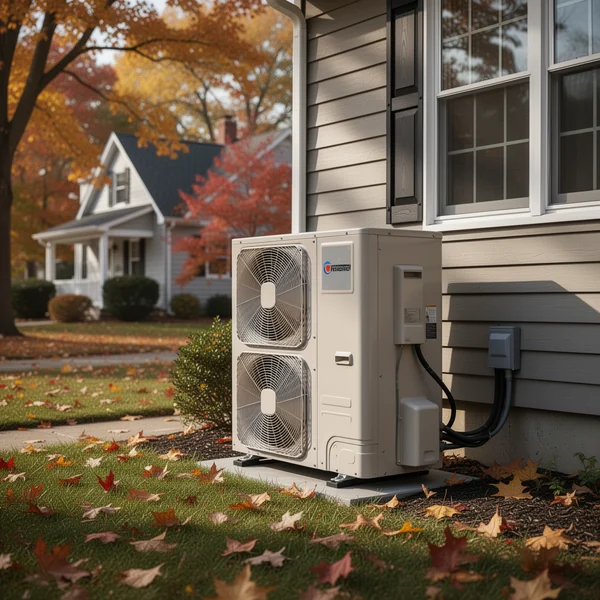
Heat pump cost in the Southern Tier is driven less by the equipment than by four local realities: an old housing stock, a lot of houses with no gas main, a thin contractor market, and a cold design temperature. Two houses on the same street in Binghamton can be a factor apart on price for reasons that have nothing to do with which brand goes on the wall.
We are not going to print a dollar range and call it your price. Anyone who does is quoting a national average dressed up in a New York headline. What follows is the list of things that actually move the number in Broome, Tioga, Chemung, Chenango, Steuben, Delaware, Cattaraugus and Allegany counties, and how to make three quotes comparable enough that you can see the real figure.
What moves heat pump cost in the Southern Tier
1. The fuel you are leaving
Around Binghamton, Vestal, Endicott, Johnson City and Elmira there is gas service, and a gas furnace replacement is a straight equipment swap on existing ductwork. Get five miles out — Chenango County, the Delaware County hill towns, rural Steuben and Allegany — and there is no main. Those houses run on oil or propane, often with a boiler and cast iron radiators and no ducts at all.
That distinction is the single biggest cost fork. A ducted retrofit into an existing forced-air system is one job. A house with hydronic radiators and no ductwork is a different one, and the choice there is usually ductless heads, or a high-static ducted system with new distribution, or an air-to-water heat pump feeding the existing emitters — each with a different price and a different disruption level.
2. The age of the house
The Southern Tier’s housing stock skews old. Balloon-framed farmhouses, pre-war village houses in Owego and Corning, 1920s two-storeys in Elmira, and a fair amount of knob-and-tube still in service. Old houses cost more to heat-pump for three compounding reasons: they leak, so the calculated load is higher and the equipment bigger; there is often no insulation in the walls; and the electrical service is small.
That is why the sequence matters. Air sealing and attic insulation done first reduce the calculated heating load, which reduces the equipment size, which reduces the price of the heat pump — and improves comfort regardless. Doing them in the other order means paying for capacity you would not have needed.
3. The electrical service
A 100-amp service with a full panel is common in this housing stock. Adding a heat pump, and possibly a heat pump water heater and a car charger behind it, may require a load calculation, a subpanel or a full service upgrade. That work is real money and it is not covered by the heat pump rebate. Find out before you sign the HVAC contract, not during install week.
4. The design temperature
The Southern Tier is genuinely cold and it is not uniform. The valley floors along the Susquehanna and the Chemung behave differently from the hill towns above them, and Delaware County winters are not Elmira winters. Equipment has to be selected against the published 99% winter design temperature for the nearest weather station, and cold-climate-rated equipment costs more than the baseline line of the same brand. Ask which station your contractor used and what design temperature went into the calculation.
5. Contractor density
This is the factor no national article mentions and every Southern Tier homeowner feels. There are fewer contractors enrolled in the utility heat pump programme per square mile here than in Westchester or Nassau. Fewer bidders means less price competition and longer lead times, particularly in autumn when everyone decides at once. Booking in spring, when crews are quiet, is a genuine lever.
Who your utility is, and why it decides the rebate
NYSEG serves much of the Southern Tier, including the Binghamton and Elmira areas and a wide rural footprint; parts of the region sit in other territories. Do not guess — your utility determines your rebate, because NYS Clean Heat is administered by NYSERDA through seven sponsoring utilities: Central Hudson, Con Edison, National Fuel Gas, National Grid, NYSEG, Orange & Rockland and RG&E.
Rebate amounts are not published as one statewide table. They vary by sponsor and by equipment type, and the official route is the address-based finder at cleanheat.ny.gov/find-available-rebates. The rebate is claimed by a participating contractor and shows up as a reduction on your invoice, so a contractor who is not enrolled with your sponsor cannot get it for you at all. Background on how NYSEG handles residential energy accounts is in NYSEG Net Metering: What Your Solar Exports Earn, and the county-level incentive picture for the Binghamton area is in Solar Incentives in Broome County, NY.
The federal line is zero. Recompute accordingly.
Both federal residential energy credits ended for property placed in service after 31 December 2025. Section 25C — the Energy Efficient Home Improvement Credit, with its $2,000 annual cap for heat pumps and heat pump water heaters — applied to property placed in service before that date. Section 25D, the 30% Residential Clean Energy Credit, terminated for expenditures after the same date. For a 2026 install in Chemung or Chenango County, the federal contribution is nothing.
This matters for cost comparison specifically because a lot of proposals still circulating were built on templates written in 2024. If a quote shows a “30% federal credit” line against a 2026 install, strike it and recompute the net cost yourself. The equivalent change on the solar side is documented in The Federal Solar Tax Credit and New York: What Changed.
New York’s own solar credit, Form IT-255, is still alive at 25% of system cost capped at $5,000 with a five-year carryforward — but that is a solar credit, not a heat pump credit. Do not let it get blended into a heat pump proposal.
Making three quotes actually comparable
The reason homeowners cannot tell what a heat pump “costs” is that no two quotes describe the same job. Force them onto the same footing by requiring all of the following from every bidder:
| Ask for | Why it changes the price |
|---|---|
| A written Manual J load calculation, with the inputs page | Determines equipment size. An oversized system costs more up front and runs worse. |
| The weather station and design temperature used | Wrong station, wrong capacity, wrong price. |
| Model numbers and the AHRI certificate | Confirms cold-climate rating and eligibility for the rebate. |
| The stated balance point and the backup plan | Electric resistance backup versus keeping the existing boiler changes both cost and running cost. |
| Electrical scope, itemised | Subpanel or service upgrade is often the hidden difference between two bids. |
| Ductwork scope: reuse, seal, modify or replace | Reusing undersized ducts is the cheapest bid and the worst outcome. |
| Gross price, rebate, net price as three separate lines | Otherwise you cannot tell whether the rebate was passed to you. |
| Permit and inspection responsibility | Whose job it is, and whether it is in the price. |
When all three quotes carry those eight items, the spread between them usually collapses to something explainable — and where it does not, you will be able to see exactly which line is responsible.
What to do next
- Look up your address at the Clean Heat finder and write down your sponsoring utility. That, not your county, decides your rebate.
- Book a home energy assessment and get an air sealing and attic insulation scope priced separately, before equipment.
- Have an electrician run a load calculation on your existing service and tell you in writing whether a subpanel or service upgrade is needed.
- Get three quotes from contractors enrolled with your sponsor, each carrying the eight items in the table above.
- Strike any federal credit line from every 2026 proposal and recompute the net cost and payback yourself.
- If you can, book the work for spring or early summer rather than October.
NY Solar Incentives
Independent New York solar research. We summarise NYSERDA, NY-Sun and federal programme rules from published sources and state plainly when a figure is an estimate. We are not a government agency and do not sell equipment.
Run the arithmetic on your own system
Check the dated program table and your arrangement before counting an incentive. Standard residential NY-Sun blocks are closed; Long Island Affordable Solar has a conditional income-verification route. The NY credit depends on qualified costs and tax liability, while the NYC abatement reduces future property-tax bills. The estimator keeps those timings separate.