How to Vet a Heat Pump Contractor in New York
Four documents settle it: Clean Heat participation, a Manual J for your house, the AHRI certificate for the matched pair, and current insurance certificates.
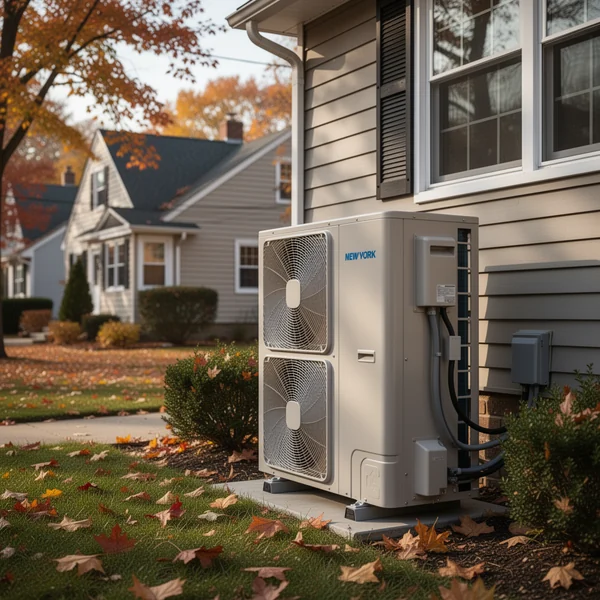
Vetting a heat pump contractor in New York comes down to four documents you ask for before anybody quotes a price: proof they participate in your utility’s NYS Clean Heat network, a Manual J load calculation done for your house, the AHRI certificate for the exact indoor and outdoor pair they propose, and current insurance certificates including New York workers’ compensation. A company that produces all four without friction is already in a different category from one that does not.
Everything else — reviews, showroom, the brochure, the salesperson’s manner — is downstream of those four. Heat pumps punish bad design far more than boilers do, and in New York the money is tied to the contractor’s programme status, so the vetting is not optional politeness.
The four documents, and why each one matters
1. Clean Heat participation, in your utility’s territory
NYS Clean Heat is administered by NYSERDA with seven sponsoring utilities: Central Hudson, Con Edison, National Fuel Gas, National Grid, NYSEG, Orange & Rockland and RG&E. PSEG Long Island is not a Clean Heat sponsor and runs its own separate programmes, which is a distinction Long Island homeowners are routinely misled about. Rebates run through participating contractors rather than arriving as a cheque you apply for afterwards, so if the company is not on your utility’s participating list, ask in writing exactly how the rebate would reach you. Confirm the rebate amount yourself with the official address-based finder at cleanheat.ny.gov/find-available-rebates — amounts are not published as a single statewide table and vary by utility and equipment type.
2. A Manual J load calculation for your house
Manual J is the industry-standard room-by-room heat loss and heat gain calculation. It is not the same as looking at the input rating on your old boiler, and it is not the same as square footage times a rule of thumb. Boilers were routinely oversized, so sizing new equipment from an old one perpetuates the error — and an oversized heat pump short-cycles, dehumidifies poorly in summer and costs more to buy.
Ask for the printout with your address on it. Ask what outdoor design temperature they used, because a Plattsburgh design temperature and a Nassau County design temperature are not remotely the same, and a contractor who cannot answer that question has not done the calculation.
3. The AHRI certificate for the matched pair
Performance is a property of the combination, not the outdoor unit. The AHRI certificate identifies the specific indoor and outdoor model numbers tested together and the rated performance of that pair. Ask for the certificate number and check the model numbers against your proposal. This is also how you catch the swap where an expensive outdoor unit is paired with whatever indoor unit is in the van.
4. New York insurance certificates in your name
Ask for a certificate of general liability naming you as certificate holder, and for workers’ compensation coverage — in New York that is normally a Form C-105.2 certificate of insurance, or a CE-200 certificate of attestation of exemption if the business genuinely qualifies as exempt. A one-person shop with no employees may legitimately hold a CE-200; a crew of four should not. Verify the certificate is current, not last year’s.
Licensing in New York is local, not statewide
New York does not license HVAC contractors at state level the way some states do. Licensing sits with cities and counties, so where you live determines what you should check:
- New York City — home improvement contractors are licensed by the Department of Consumer and Worker Protection, and the relevant trades have their own city licences. Check the licence number on the city’s public lookup, not on the truck.
- Nassau and Suffolk Counties — both run consumer affairs licensing for home improvement work; Suffolk also licenses at town level in places. Look the company up on the county’s licence search.
- Westchester, Rockland and Putnam Counties — each operate consumer protection licensing for home improvement contractors.
- Most upstate counties — licensing may be at city or town level or effectively absent, which makes the insurance certificates and permit history matter more, not less.
- Refrigerant handling is federal: anyone opening a refrigerant circuit needs EPA Section 608 certification. Ask.
Separately, ask whether the company pulls its own permits with your building department. A contractor who asks the homeowner to pull the permit is asking you to carry their liability, and it is a reliable warning sign.
Questions that separate a heat pump installer from a boiler company with a new line
Plenty of good New York oil and gas companies have added heat pumps. Some have added the words and not the practice. These questions tell them apart:
- What outdoor design temperature did you size to, and what does this system deliver at that temperature? A real answer names a temperature and a capacity, not a brand claim.
- What is your backup strategy below design temperature — electric strips, the existing boiler as a hybrid, or nothing? All three can be right. Not having thought about it is not.
- Will the existing ductwork carry the airflow this equipment needs? Heat pumps deliver air at a lower temperature than a furnace, so they move more of it. Ductwork sized for a furnace is often too small, and the honest answer is sometimes “we need to modify returns”.
- How will you set the auxiliary heat lockout? If the strips are free to run whenever the thermostat feels behind, your bills will not look like the projection.
- Where does the outdoor unit sit, and how high? North and west of Albany, an outdoor unit at grade can end up in drifted snow and its own refrozen defrost water. Wall brackets or a tall stand is a real answer.
- What is your commissioning procedure? Refrigerant charge verification, airflow measurement, and a written report. “We turn it on and check it blows hot” is not commissioning.
Red flags
- A quote produced without anyone entering the house and looking at the ductwork, the electrical panel and the condenser location.
- A federal tax credit line on a 2026 proposal — see the next section. It means the template has not been updated since 2025, which raises the question of what else has not been.
- A rebate figure the contractor will not source. Make them point at the finder result for your address.
- Pressure to sign today for a price that expires today.
- A large deposit before any equipment is ordered.
- Refusal to put the model numbers of both indoor and outdoor units in writing.
The money question, answered honestly
Both federal residential energy credits ended for property placed in service after 31 December 2025. The 25C efficiency credit — $2,000 annual cap for heat pumps while it existed — and the 25D clean energy credit are gone. A New York household installing a heat pump in 2026 gets nothing federal. A contractor who still has it on the proposal is not lying to you on purpose, but they are quoting last year, and you should ask for a corrected proposal before comparing bids.
What is live: NYS Clean Heat through your sponsoring utility, NYSERDA programmes including the income-qualified EmPower+ (call 1-866-NYSERDA for current eligibility rather than trusting a figure online), and NYSERDA financing. If solar is part of the same project, New York’s own Form IT-255 credit — 25% of system cost, capped at $5,000, carried forward up to five years, claimed for the tax year you receive Permission to Operate — is unaffected by the federal expiry.
The same due-diligence habits transfer across trades. Our guides to vetting a solar installer in New York and to what a NYSERDA-qualified contractor actually is cover the paperwork side in more depth, and the second one is worth reading before you accept anybody’s claim about their programme status.
What to do next
- Get your utility’s Clean Heat participating contractor list first, and start your shortlist from it rather than from search ads.
- Run your address through the Clean Heat finder yourself so you know the rebate before anyone quotes it to you.
- Ask all three bidders for the four documents. Drop anyone who stalls on the Manual J.
- Check the licence on your county or city consumer affairs lookup, and verify the C-105.2 or CE-200 is current.
- Require the final proposal to state both model numbers, the design temperature, the capacity at that temperature, the backup strategy, who pulls the permit, and the commissioning report you will receive.
NY Solar Incentives
Independent New York solar research. We summarise NYSERDA, NY-Sun and federal programme rules from published sources and state plainly when a figure is an estimate. We are not a government agency and do not sell equipment.
Run the arithmetic on your own system
Check the dated program table and your arrangement before counting an incentive. Standard residential NY-Sun blocks are closed; Long Island Affordable Solar has a conditional income-verification route. The NY credit depends on qualified costs and tax liability, while the NYC abatement reduces future property-tax bills. The estimator keeps those timings separate.