What a Heat Pump Costs in NYC
The equipment is not what makes a New York City heat pump quote expensive. Condenser location, line-set routing, electrical work and building approvals are.
On this page 7 sections
- 01What actually moves the price of a heat pump in NYC
- 02Building type changes the job more than the brand does
- 03Approvals add time, and time adds cost
- 04Comparing three NYC quotes without being fooled
- 05The 2026 incentive picture for a Con Edison address
- 06Running cost is a separate question from install cost
- 07What to do next
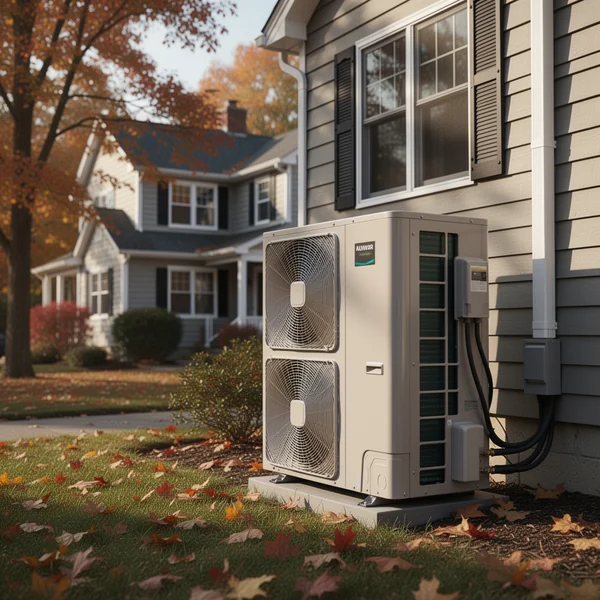
There is no single figure for what a heat pump costs in NYC, and any page that hands you one has invented it. The equipment is roughly the same price it is anywhere in the country; what moves the number in the five boroughs is the building — where the outdoor unit can physically go, what has to be opened up to run a line set, who has to approve it, and how the crew gets material to the fourth floor.
So the useful version of this article is not a price. It is the list of things that make one New York City quote twice another for the same nominal equipment, so you can read three proposals and see which one is actually cheaper.
What actually moves the price of a heat pump in NYC
Where the outdoor unit goes
This is the single biggest swing factor. A condenser on a flat roof needs roof access, sometimes a crane or hoist, structural support, and a route for refrigerant lines and condensate down through the building. A condenser at grade in a Queens or Staten Island side yard needs a pad, a disconnect and a short line set. A wall-mounted bracket on a rear façade needs anchors into masonry and, in some buildings, permission you may not get. Same equipment, entirely different labour.
Line-set routing
In a Brooklyn brownstone with plaster over brick and no soffits, running refrigerant lines and condensate from a rear or roof condenser to heads on three floors means either a chase built in a closet corner, a run through an existing flue, or line-hide on the exterior. Every one of those is a design decision with a labour cost attached, and it is where a cheap quote quietly differs from an expensive one — ask each bidder to draw the route.
Electrical
Many older city homes and apartments have limited spare capacity. If a service upgrade or a new subpanel is needed, that work comes with its own electrician, its own permit and its own utility coordination — and that coordination is on Con Edison’s timetable, not yours. Any quote that does not state clearly whether it includes electrical work is not comparable to one that does.
Access and logistics
Parking, walking material through a finished apartment, elevator reservations and building hours, a sidewalk shed if façade work is involved, protection of finished floors and stairs. None of this exists in a suburban install and all of it is real money in the city.
Building type changes the job more than the brand does
- Co-op or condo apartment. The board and the alteration agreement decide what is possible. Through-wall and window heat pumps, or a ductless system with the condenser on the roof or a terrace, are the usual options. Expect an architect’s or engineer’s sign-off requirement, insurance certificates naming the building, and a review period. Buildings that already have PTAC sleeves through the wall are the easiest case, because a replacement unit fits an existing opening.
- Brownstone or rowhouse. Usually ductless multi-split, roof or rear-yard condenser, and the plaster and chase questions above.
- Detached or semi-detached house in Queens, Staten Island or the eastern Bronx. The closest thing to a suburban job — often ducted or a ducted/ductless hybrid, condenser at grade.
- Landmarked building or historic district. Anything visible from the street is a separate approval question, the same logic our guide to solar in a New York historic district walks through for panels.
Approvals add time, and time adds cost
Permit and approval work is a line item in New York City in a way it is not upstate. Depending on the scope you may be dealing with the Department of Buildings, your co-op or condo board, and — for a landmarked property — the Landmarks Preservation Commission, before any electrical permit is filed. Our walkthrough of the NYC permitting process for rooftop equipment covers the same agencies and the same rhythm.
Practically, that means you should ask every bidder: who files, what do they file, is the filing fee in the quote, and what is their honest estimate of the approval window for a building like yours? A contractor who has done a dozen jobs in buildings like yours will answer immediately. One who has not will change the subject.
Comparing three NYC quotes without being fooled
| Ask for | Why it separates the quotes |
|---|---|
| A Manual J load calculation for your unit or house | Sizing from the old boiler’s rating instead of the actual load is how oversized, short-cycling systems get sold |
| The AHRI certificate for the exact indoor/outdoor combination | Performance is a property of the matched pair, not the outdoor unit alone |
| Rated capacity at the cold design temperature, not just at 47°F | Tells you what the system delivers on the coldest days, and whether backup heat is assumed |
| Whether electrical work, permits and filings are included | The most common reason a low quote grows |
| The condenser location and line-set route, drawn | Forces the hard part of the job into the open before you sign |
| The NYS Clean Heat rebate they expect and its source | A figure they cannot source is a figure that may not arrive |
The 2026 incentive picture for a Con Edison address
Two facts, and the first one is worth more than everything else on this page.
Both federal residential energy credits ended for property placed in service after 31 December 2025. Section 25C, which capped heat pumps at $2,000 a year while it existed, and Section 25D are both gone. A New York City household installing a heat pump in 2026 gets nothing federal. If a proposal shows a 30% federal credit or a $2,000 credit line, it was built from a stale template — ask for a corrected version before you compare it with anything else.
Second: NYS Clean Heat is alive. It is administered by NYSERDA with seven sponsoring utilities — Central Hudson, Con Edison, National Fuel Gas, National Grid, NYSEG, Orange & Rockland and RG&E. Con Edison serves the five boroughs, so a city address is in a sponsoring territory. Amounts are not published as one statewide table; they vary by utility and equipment type, so run your address through the official finder at cleanheat.ny.gov/find-available-rebates and treat that as the authority. Income-qualified households should ask NYSERDA about EmPower+ on 1-866-NYSERDA.
Running cost is a separate question from install cost
A heat pump’s operating cost in the city is a function of your delivered electricity price, which is not the supply rate on a marketing sheet. Take the total charges on your Con Edison bill, divide by the kilowatt-hours used, and you have the number that actually matters — supply plus delivery plus everything else. Do the same for whatever you burn now, on a per-unit-of-heat basis, and you have a real comparison instead of a national average that ignores the fact that Con Edison territory does not price like National Grid’s upstate service area. Our explainer on reading a Con Edison bill shows where those lines sit.
What to do next
- Settle the condenser location first. Roof, yard, terrace, wall or through-wall determines most of the price, and in a co-op it determines whether the job happens at all.
- If you are in a co-op or condo, get the alteration agreement and read what it demands before you get quotes, not after.
- Get three quotes and hold each to the six items in the table above. Same equipment class, same scope, or the comparison is meaningless.
- Run your address through the Clean Heat finder yourself, and ask any contractor quoting a rebate figure to show you where theirs comes from.
- Strike any federal tax credit line from a 2026 proposal, and rebuild your budget without it.
NY Solar Incentives
Independent New York solar research. We summarise NYSERDA, NY-Sun and federal programme rules from published sources and state plainly when a figure is an estimate. We are not a government agency and do not sell equipment.
Run the arithmetic on your own system
Check the dated program table and your arrangement before counting an incentive. Standard residential NY-Sun blocks are closed; Long Island Affordable Solar has a conditional income-verification route. The NY credit depends on qualified costs and tax liability, while the NYC abatement reduces future property-tax bills. The estimator keeps those timings separate.