Ground Source Heat Pumps in New York: The Real Numbers
A geothermal system in New York costs what its loop field costs. Here is how the quote breaks down, what the ground decides, and why 2026 economics changed.
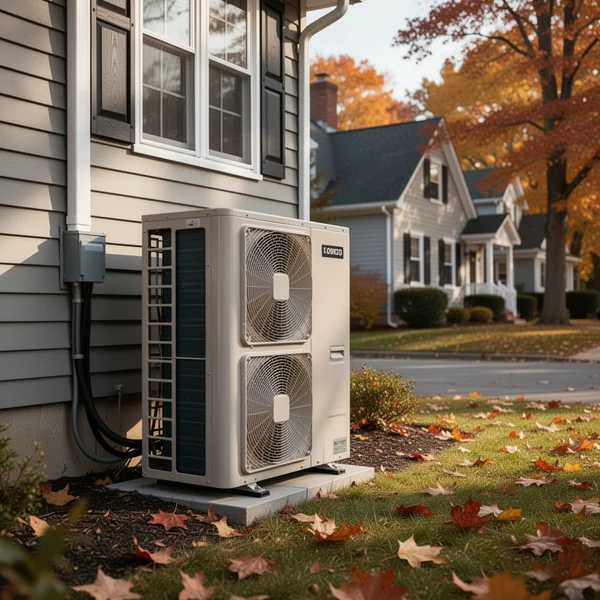
A ground source heat pump in New York costs whatever its loop field costs. The indoor equipment is a reasonably predictable line item that any competent contractor can price from a load calculation, and almost the entire spread between two quotes on the same house sits in the drilling or the excavation outside it.
That is why any ground source heat pump New York cost quoted before someone knows your lot size, your soil and your depth to bedrock is a guess dressed up as a number. What follows is the structure those numbers are built from, so you can read a real quote when you get one — and the incentive picture, which changed sharply for 2026.
The four line items in a geothermal quote
Ask for the quote broken into these and you will immediately see where a contractor is confident and where they are padding.
- The loop field. Drilling or trenching, the pipe, the grout, the header, and getting it into the house. The variable one.
- The heat pump itself and the interior mechanical work. Water-to-air or water-to-water unit, circulation pumps, buffer tank if there is one, ductwork or hydronic tie-in, controls.
- Electrical. A dedicated circuit for the compressor and pumps, and a load calculation to establish whether your existing service takes it. In older Hudson Valley and upstate housing this is where a 100-amp service problem surfaces.
- Site restoration. Genuinely worth itemising. A vertical bore field leaves a smaller mess than a horizontal loop, which involves excavating a substantial part of your yard, and “we’ll rake it over” and “we’ll restore the lawn” are different prices.
Vertical bores or horizontal loops, and what New York ground decides
A horizontal loop is trenched at a shallow depth over a wide area. It is generally the cheaper option per unit of capacity when you have the land and the digging is easy — open lots in the Finger Lakes, farm parcels in the Mohawk Valley, larger properties in the Southern Tier. It needs real acreage, and it needs ground you can dig.
A vertical bore field goes deep in a small footprint. It is what a suburban Westchester or Long Island lot forces on you, and it is what New York geology often forces regardless. That is the crux: drilling cost per foot depends heavily on what the rig is going through.
Broadly, and this is the kind of thing a local driller will know cold for your town:
- Shallow bedrock through the Hudson Highlands, the Adirondack fringe, parts of Westchester and Putnam means rock drilling early, which is slower and more expensive per foot but often gives excellent thermal conductivity and lets you drill fewer feet overall.
- Deep glacial till and lake sediments across the Finger Lakes and central New York can be easier drilling but may need casing through unstable material, which adds cost back.
- Long Island’s outwash sand and gravel is a different problem again, with the aquifer and sole-source protections shaping how the work is permitted and constructed.
The practical upshot: get quotes from contractors who drill in your county regularly. A firm that knows it hits rock at a typical depth in your town prices with confidence; one that does not will either pad heavily or write in a per-foot overrun clause. Read that clause carefully — it is often where the real cost lives.
The permit behind the hole
Geothermal boreholes in New York are wells, and the state regulates them. Water well drillers operating in New York are required to register with the Department of Environmental Conservation, and well completion reports are filed with DEC. Depending on the county and the type of system there may be additional local health department requirements — Nassau, Suffolk and Westchester all have active county health departments with their own well rules, and Long Island’s aquifer protections make that scrutiny meaningful rather than nominal.
Ask your contractor to name the driller, confirm the driller’s DEC registration, and confirm who files the completion report. This is not paperwork pedantry: an unregistered driller putting holes in the ground over a sole-source aquifer is a problem that becomes yours when you sell the house.
The incentive picture, and the part most pages still get wrong
Ground source has its own tier within NYS Clean Heat, the programme NYSERDA runs with seven sponsoring utilities — Central Hudson, Con Edison, National Fuel Gas, National Grid, NYSEG, Orange & Rockland and RG&E. Geothermal incentives are typically among the more substantial in the programme, reflecting the loop field cost, and they are paid off-invoice through an enrolled contractor rather than to you.
Amounts are not published as one statewide table and they are revised. Use the official address-based finder at cleanheat.ny.gov/find-available-rebates and take the number it returns for your service address. Note that PSEG Long Island is not a Clean Heat sponsor — Nassau and Suffolk households need to look at PSEG Long Island’s own programmes instead.
The federal credit is gone
Geothermal heat pump property was claimed under Section 25D, the Residential Clean Energy Credit. Section 25D terminated for expenditures after 31 December 2025. Section 25C, which carried a $2,000 annual cap for heat pump equipment, likewise applied to property placed in service through 31 December 2025.
A New York household putting a geothermal system in during 2026 gets nothing federal. This is the single most consequential correction on this page, because geothermal economics were carried by that 30 per cent credit more than any other measure in the house — the loop field is a large number, and 30 per cent of a large number is a large number. Any quote, payback calculation or salesperson’s spreadsheet that still shows a federal credit for a 2026 install is overstating your return substantially. Delete the line and redo the arithmetic before you sign anything. The wider story of what changed is set out in the federal solar tax credit and New York: what changed.
State credits: check what actually applies
New York’s solar equipment credit, claimed on Form IT-255 at 25 per cent of system cost capped at $5,000, is written for solar energy systems — it is not a geothermal credit, and you should not assume a geothermal loop qualifies for it. If you want to understand how that credit works for the solar half of an electrification project, the Form IT-255 guide covers it, including the five-year carryforward and the rule that you claim in the year you receive Permission to Operate.
New York does maintain separate tax provisions touching geothermal systems. Do not take an amount or a form number for that from a marketing page — ask your tax preparer, and confirm the current form and cap on tax.ny.gov, before you count anything toward your total. For the map of what the state funds outside its solar programmes, see New York State renewable energy incentives beyond solar.
What you actually get for the money
The reason people pay for the loop is that the ground is thermally stable. An air source heat pump loses capacity and efficiency exactly when a Watertown or Binghamton winter demands the most from it; a ground loop is drawing from earth that does not care what the air is doing. A properly sized geothermal system generally does not need supplemental resistance heat on a design day, which is where an air source system’s expensive kilowatt-hours accumulate.
It is also long-lived in a way the indoor equipment is not. The loop is buried pipe, and the interior heat pump will be replaced at least once during the loop’s service life — a real consideration when you compare against replacing an outdoor condenser every fifteen years or so.
Against that: the capital cost is the highest of any residential heating option in New York, the payback now runs longer than it did before the federal credit expired, and it is not available to every lot. On a small NYC or inner-suburb parcel with no yard and no drilling access, the question does not arise.
What to do next
- Run your address through the Clean Heat rebate finder and note the ground source tier, before any sales conversation.
- Ask two or three contractors who regularly drill in your county for quotes itemised into loop field, equipment, electrical and site restoration.
- Read the per-foot overrun clause in each quote. Ask what depth they expect to hit rock at on your parcel and what happens if they are wrong.
- Confirm the driller is DEC-registered and ask who files the well completion report, plus any county health department requirement.
- Strike every federal tax credit line out of every 2026 quote and recalculate the payback yourself.
- Ask your tax preparer — not your installer — which New York State credits actually apply to a geothermal system, and confirm the form on tax.ny.gov.
NY Solar Incentives
Independent New York solar research. We summarise NYSERDA, NY-Sun and federal programme rules from published sources and state plainly when a figure is an estimate. We are not a government agency and do not sell equipment.
Run the arithmetic on your own system
Check the dated program table and your arrangement before counting an incentive. Standard residential NY-Sun blocks are closed; Long Island Affordable Solar has a conditional income-verification route. The NY credit depends on qualified costs and tax liability, while the NYC abatement reduces future property-tax bills. The estimator keeps those timings separate.