Solar Panels in a Historic District in New York
In a historic district the review board decides your layout before the utility ever sees the project. Here is how to design for approval.
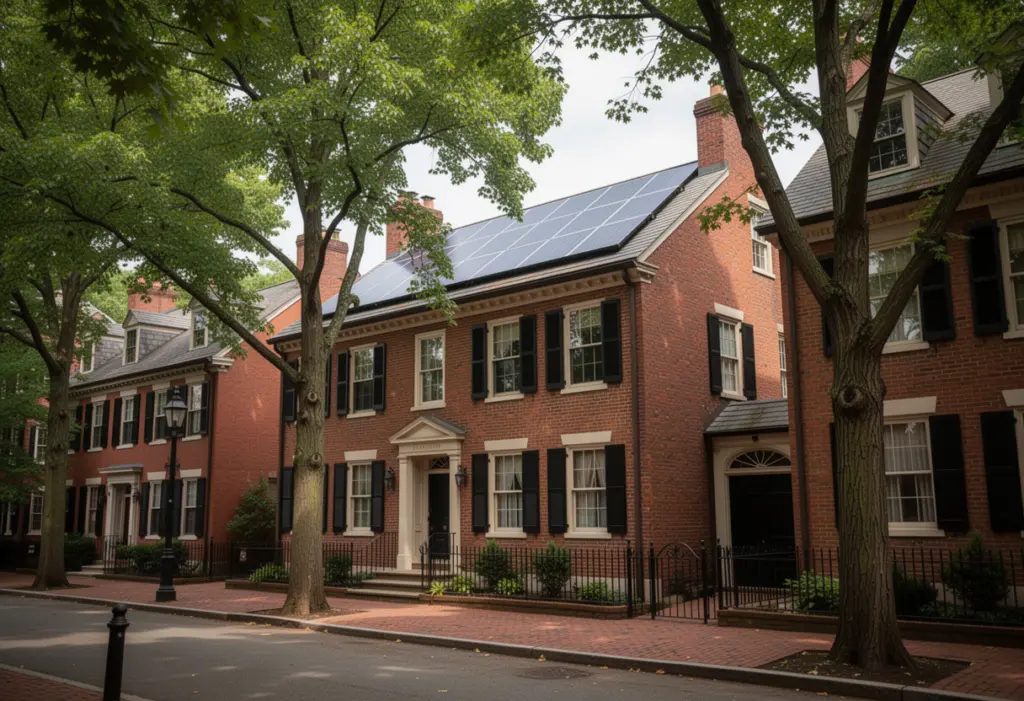
New York has more designated historic districts than most states, and they are not confined to famous places. Kingston, Newburgh, Albany, Buffalo, Saratoga Springs, Rhinebeck, Sag Harbor and dozens of villages have them, and so do large parts of New York City.
If your property is inside one, review is not a formality bolted onto the end. It is the first step, and it shapes the design.
Establish whether you are in one
Do this before you take quotes. Designation can be local, state or federal, and the one that governs what you may build is usually the local designation — a local landmarks or architectural review commission with authority over exterior changes visible from the public way.
Your municipality can tell you. So can your deed and, frequently, your neighbours. What you should not do is rely on an installer’s assumption, particularly one who works mostly outside your town.
What review boards actually object to
Almost always the same thing: visibility from the street and the effect on the building’s historic character. Rarely the existence of solar as such.
Which means the design decisions that get an application approved are reasonably predictable:
- Put the array on a rear or secondary roof plane where it is not visible from the public way. This single choice resolves most applications.
- All-black modules with black frames. Silver frames and light backsheets read as industrial equipment; all-black reads as a dark roof.
- Flush mounting, following the roof plane. Tilted racking on a pitched historic roof is the most likely thing to be refused.
- Conduit concealed, run internally or discreetly, and painted where it must be exposed.
- Keep the array off prominent features — the principal elevation, a tower, a dormer face, a mansard front.
- Reversibility. Boards respond well to the point that mounting is removable and the historic fabric is unchanged beneath. Say it explicitly.
Where this collides with production
Honestly, sometimes it does. The rear plane may face north; the unshaded plane may be the street elevation. When that happens the options are:
- A smaller array on the acceptable plane.
- A garage, outbuilding or rear extension roof instead.
- A ground mount screened from the street — frequently the best answer on a larger historic property, and one boards are often comfortable with because it does not touch the building at all.
- Community solar, which needs no building, no roof and no review of any kind.
An installer who reaches one of these conclusions is being straight with you. One who proposes the street elevation and assures you it will be fine is not.
Where it sits in the sequence
- Historic or architectural review. First. Months, not weeks, in some municipalities.
- Building permit.
- Installation, then electrical inspection.
- Utility meter change and permission to operate.
Review boards frequently meet monthly, so a missed agenda deadline is a month. Ask when the board meets and what the submission deadline is, and build it into the schedule rather than discovering it.
Making the application
- Submit drawings, not descriptions. A roof plan showing panel placement and a street-view rendering answer the board’s actual question.
- Include the module appearance — all-black, specified.
- Address visibility explicitly, with photographs from the public way.
- Cite precedent. If the board has approved solar in the district before, reference it. Boards are far more comfortable with a decision they have already made.
- Attend the meeting if you can. Applications with someone present to answer a question are approved more often than ones that are not.
One thing worth knowing about timing
A review process that pushes a project from one year into the next has consequences beyond patience. The 30% federal residential credit ended for expenditures made after 31 December 2025 — the statute treating an expenditure as made when the original installation is completed — and projects held in review over that boundary lost it. Programme terms move; a delay is not always cost-free.
Frequently Asked Questions
Can you install solar panels in a New York historic district?
Usually yes. Boards rarely object to solar as such — they object to visibility from the public way and the effect on historic character. An array on a rear or secondary plane, all-black, flush-mounted with concealed conduit resolves most applications.
What comes first, historic review or the building permit?
Historic or architectural review, and it can take months rather than weeks. Boards frequently meet monthly, so a missed agenda deadline costs a month. Only then the building permit, installation, inspection and the utility's permission to operate.
What if the only good roof plane faces the street?
The options are a smaller array on an acceptable plane, a garage or outbuilding roof, a ground mount screened from the street — often the best answer on a larger property because it does not touch the building — or community solar, which needs no review at all.
How do I make a historic district solar application more likely to pass?
Submit drawings rather than descriptions, specify all-black modules and flush mounting, address visibility explicitly with photographs from the public way, cite any precedent the board has already approved in the district, and attend the meeting.
This article is general information, not tax, legal or financial advice. Incentive amounts, eligibility rules and deadlines change and depend on your utility, your tax situation and your property. Confirm current terms with NYSERDA, your utility and a qualified tax professional before making a decision.
NY Solar Incentives
Independent New York solar research. We summarise NYSERDA, NY-Sun and federal programme rules from published sources and state plainly when a figure is an estimate. We are not a government agency and do not sell equipment.
Run the arithmetic on your own system
Check the dated program table and your arrangement before counting an incentive. Standard residential NY-Sun blocks are closed; Long Island Affordable Solar has a conditional income-verification route. The NY credit depends on qualified costs and tax liability, while the NYC abatement reduces future property-tax bills. The estimator keeps those timings separate.