Solar Panel Installation in NYC: Permits and Process
Bolting an array to a city roof takes days. The approvals around it take months. Here is who controls each stage, and how to check the company that will run them.
On this page 9 sections
- 01Solar panel installation in NYC runs on three approval tracks
- 02The site survey decides how much roof is actually usable
- 03Fire-code pathways take roof area before the design starts
- 04Who issues what, and in which order
- 05Checking the company that will run all this
- 06Landmark and historic district review is a separate track
- 07Con Edison controls the moment the system may switch on
- 08What is left on the incentive side
- 09Frequently asked questions
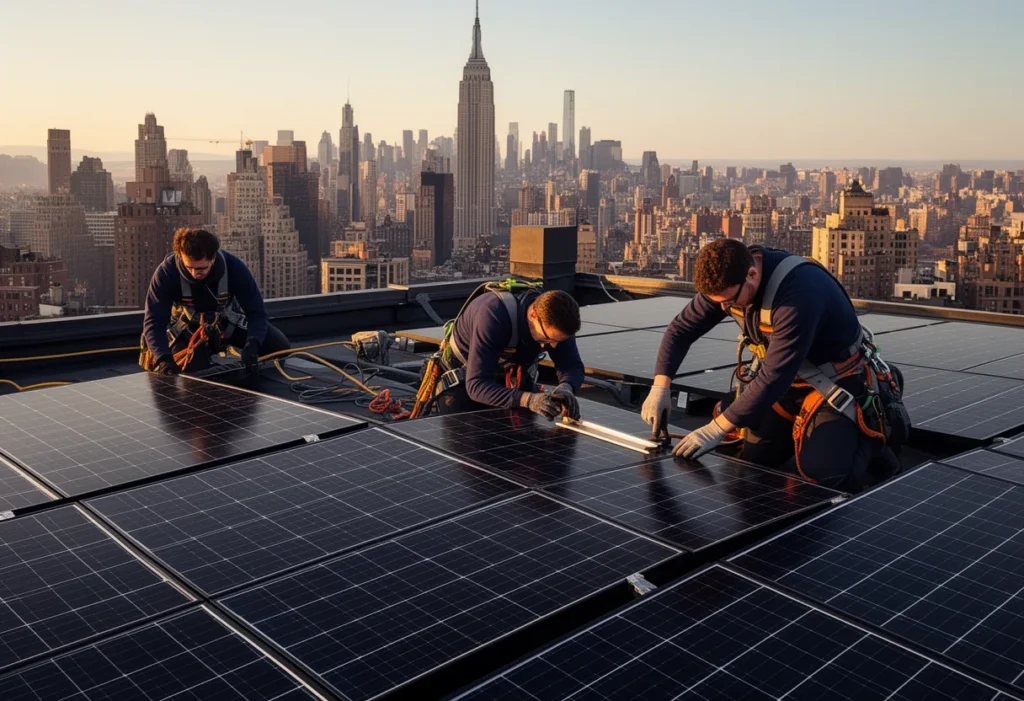
Solar panel installation in NYC is less a construction project than a permitting exercise with a construction project attached. Bolting an array to a Brooklyn or Bronx roof is usually one to three days of work. The approvals wrapped around those days are what stretch the job across months.
Three authorities have to be satisfied before a system produces a single billable kilowatt-hour, and a fourth applies to a large slice of the city’s housing stock. Knowing which body controls which stage is the difference between a delay you can chase and a delay nobody can explain.
Solar panel installation in NYC runs on three approval tracks
The first track is the Department of Buildings. A rooftop array is an alteration to the building, so the work is filed with DOB, and the electrical portion is filed separately by a licensed master electrician. Neither filing is something a homeowner submits personally.
The second is the fire code, which governs how much of the roof the array may occupy and how firefighters reach and ventilate it. This is applied during plan review rather than as a standalone application, but it shapes the design more than any other single rule.
The third is Con Edison. The utility runs the interconnection review, sets the metering arrangement and issues permission to operate. Until that approval exists, energising the system is not permitted, however finished the roof looks.
The site survey decides how much roof is actually usable
A survey looks at three things: structure, shading and the electrical service. Structure means whether the framing and roof deck can carry the added dead load and resist wind uplift, which on an older building sometimes requires reinforcement first.
Shading in New York City is rarely about trees. It is the neighbouring building, the parapet, the stair bulkhead, the water tank and the HVAC condensers. A roof that looks open from street level often carries three or four obstructions that cost real production across the year.
The electrical service matters because many older city homes have a panel with no room for a solar backfeed breaker. A service upgrade is a common and unwelcome line on a quote, and it brings its own utility and DOB steps.
Ask for the shading analysis in writing
A competent installer models annual production with a shading tool rather than by eye. Ask to see the modelled annual kilowatt-hour figure and the shade losses it assumes, and keep that document. Every later savings claim rests on that one number.
Fire-code pathways take roof area before the design starts
New York City requires clear perimeter setbacks and access pathways around rooftop arrays. The required widths depend on roof type, building size and construction classification, and they have been revised as the code has been updated.
On a large roof this is an inconvenience. On a narrow rowhouse roof it can remove most of the usable area, which is why two apparently identical buildings support very different system sizes. A flat-roof design conversation is really a fire-code conversation, and the mechanics are covered in the guide to solar on flat roofs in New York City.
Check the clearance figures behind each quote
Setbacks and pathway widths are set by code, not by the installer, and they change when the code is amended. If two proposals differ sharply in system size on the same roof, ask each company which clearance figures it used and verify the current requirement with the Department of Buildings before choosing.
Who issues what, and in which order
The sequence matters because several approvals depend on one another. The interconnection application generally moves in parallel with the building permit, but the final utility approval cannot come until inspections have signed off.
| Approval | Who issues it | What it governs |
|---|---|---|
| Construction or alteration permit | NYC Department of Buildings | Structural attachment, roof loading, array layout |
| Electrical permit and sign-off | DOB, filed by a licensed master electrician | Wiring, inverters, disconnects, panel work |
| Rooftop access and clearance review | Fire code, applied at plan review | Perimeter setbacks, access paths, venting |
| Certificate of appropriateness or permit | Landmarks Preservation Commission | Visibility of the array from public streets |
| Interconnection and permission to operate | Con Edison | Grid impact, metering, when the system may run |
| Property-tax abatement | DOB application, applied by the Department of Finance | Abatement instalments against property tax |
Checking the company that will run all this
Because the job is mostly filings, the question that matters is not which panel brand a company sells but who is authorised to file and be inspected. Ask which entity will appear on the DOB filing as applicant of record, and which licensed master electrician will make the electrical filing. A company that subcontracts either should still be willing to name them.
Then establish the boundary of responsibility in writing: who schedules and attends inspections, who submits the interconnection application to Con Edison, who files the property-tax abatement, and what happens if the plan examiner objects. Those are the points where a job stalls, and a company that cannot answer them is usually reselling the work rather than performing it.
NYSERDA participation is a separate check again, and it is what makes the NY-Sun incentive available at all — set out in what a NYSERDA-qualified contractor actually is. As of September 2026, though, NYSERDA has no open NY-Sun block for homes in any utility territory, Con Edison’s included; check NYSERDA’s NY-Sun dashboard for a new one.
Landmark and historic district review is a separate track
A substantial number of New York City buildings sit in historic districts or carry individual landmark status. Where that applies, the Landmarks Preservation Commission reviews the installation before DOB will issue a permit, and its concern is visibility from public thoroughfares rather than energy performance. In practice the array often must sit behind a parapet, be set back from the street-facing edge, or use low-profile mounting, and while some designs clear an expedited staff-level review, others need a full public hearing. Check the building’s status early: it can change the system size a roof will support.
Con Edison controls the moment the system may switch on
New York uses a standardised interconnection process, and small residential systems follow an expedited track within it. The installer submits the application, Con Edison reviews it, and after construction and inspection the utility swaps or reprograms the meter and issues permission to operate.
The credit arrangement afterwards is the other half of the equation. Mass-market residential customers in New York are still credited for exported energy under net metering rules, with a separate per-kilowatt charge applied to systems interconnected after the phase-in date. How that works is set out in the explainer on net metering in New York, and the current charge should be confirmed with Con Edison.
On timing, the model is that construction is short and the queue is long: most elapsed time sits in plan review, inspection scheduling and utility processing. Ask any installer for its observed average from contract to permission to operate, and what that figure is based on.
What is left on the incentive side
The federal residential clean energy credit under section 25D ended for expenditures made after 31 December 2025, the test being when the original installation was completed rather than when the system was switched on. A New York homeowner buying today receives nothing on their federal return, though installations completed in 2025 fall under the old rules and unused credit can generally still be carried forward.
What remains is the state credit on Form IT-255 (25% of the cost up to $5,000, not refundable but carried forward up to five years), the city abatement taken over four years, no sales tax on the equipment and installation (New York City provides the local exemption as well as the state one), the RPTL 487 exemption where it has not been opted out, and bill credits for exported power minus the monthly Customer Benefit Contribution; NY-Sun, which paid per watt through the contractor, has no open block for homes in any utility territory as of September 2026. The RPTL 487 exemption is not automatic: file form RP-487 with your assessor by the taxable status date (March 1 in most towns; January 2 in Nassau towns; May 1 or June 1 in Westchester towns; set by charter in cities; usually January 1 in villages), and the system must be built before January 1, 2030 (RP-487 instructions). One point matters when comparing offers: a business-side credit still applies to the company that owns a leased or third-party system, which is why some offers price in a federal incentive you never claim. Ownership and installer choice are usually settled in the same conversation — see how to choose a solar installer in New York.
Frequently asked questions
Do I need a permit to install solar panels in New York City?
Yes. A rooftop solar system requires a Department of Buildings filing for the installation itself and a separate electrical filing made by a licensed master electrician. Homeowners do not submit these personally; the installer and its licensed professionals do. Work performed without permits can block the tax abatement and cause problems at sale.
How do I check a solar company before signing in NYC?
Ask which entity appears on the DOB filing as applicant of record and which licensed master electrician makes the electrical filing, then get the division of responsibility for inspections, the Con Edison interconnection application and the abatement filing in writing. Separately, as of September 2026 NYSERDA has no open NY-Sun block for homes in any utility territory, so do not count on a NY-Sun deduction; if a new block opens, only a participating company can apply it.
How long does solar panel installation in NYC take from signing to switch-on?
The physical installation is usually one to three days. Everything around it, meaning design, plan review, permit issuance, inspection and utility approval, is where the elapsed months go. Ask your installer for its current average from contract signature to permission to operate rather than relying on a general figure.
Can I claim the 30 percent federal tax credit on a system installed now?
No. The residential clean energy credit under section 25D terminated for expenditures made after 31 December 2025, so a homeowner buying a system today claims nothing federally. A system whose installation was completed in 2025 was covered by the old rules and unused credit from that year can generally be carried forward. A separate business credit still applies to companies that own leased or third-party systems.
What happens if my building is in a historic district?
The Landmarks Preservation Commission reviews the proposal before the Department of Buildings will permit it, and its test is how visible the array is from public streets. Many installations are approved with the array set back from the street-facing edge or hidden behind a parapet. Check the building’s landmark status early, because it can change the system size the roof will support.
Verify current figures before you commit
Incentive rates, abatement percentages, code clearances and utility charges all change, sometimes mid-year. Confirm the NY-Sun incentive with NYSERDA, the state credit with the New York State Department of Taxation and Finance, the abatement with the Department of Buildings, and interconnection terms with Con Edison before signing a contract. This site is independent and is not a government agency.
This article is general information, not tax, legal or financial advice. Incentive amounts, eligibility rules and deadlines change and depend on your utility, your tax situation and your property. Confirm current terms with NYSERDA, your utility and a qualified tax professional before making a decision.
NY Solar Incentives
Independent New York solar research. We summarise NYSERDA, NY-Sun and federal programme rules from published sources and state plainly when a figure is an estimate. We are not a government agency and do not sell equipment.
Run the arithmetic on your own system
Check the dated program table and your arrangement before counting an incentive. Standard residential NY-Sun blocks are closed; Long Island Affordable Solar has a conditional income-verification route. The NY credit depends on qualified costs and tax liability, while the NYC abatement reduces future property-tax bills. The estimator keeps those timings separate.