What a Heat Pump Costs in Long Island
PSEG Long Island is not a NYS Clean Heat sponsor, so Nassau and Suffolk rebates work differently. What actually drives the installed price, from duct reuse to salt-air corrosion.
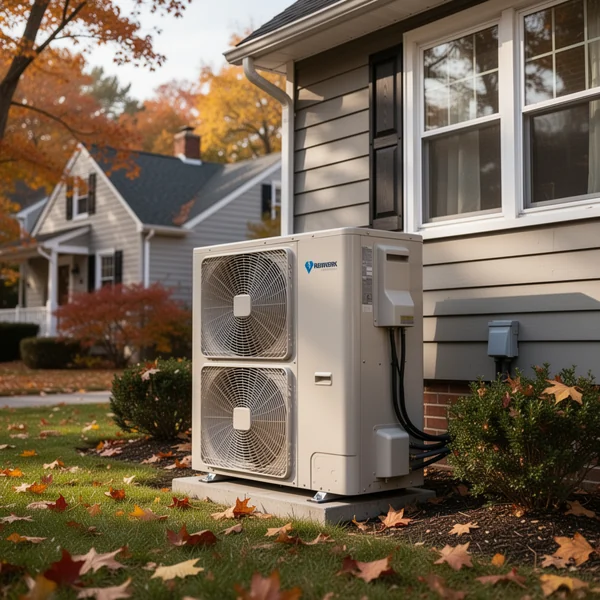
Heat pump cost on Long Island is driven by one fact that changes the arithmetic against the rest of New York State: PSEG Long Island is not a NYS Clean Heat sponsoring utility. The seven utilities that sponsor Clean Heat are Central Hudson, Con Edison, National Fuel Gas, National Grid, NYSEG, Orange & Rockland and RG&E — so a homeowner in Massapequa or Riverhead cannot simply read a Clean Heat rebate figure off a page written for Syracuse and subtract it.
PSEG Long Island runs its own efficiency and heat pump programmes, separately funded and separately structured. That does not mean there is no money; it means the money comes from a different place and you have to look it up in a different place. Anyone quoting you a “NYSERDA Clean Heat rebate” for a Nassau or Suffolk address should be asked to show you where that comes from.
What drives heat pump cost on Long Island
Installed price is not a function of square footage. It is a function of six things, and on Long Island they land differently than upstate.
Ducted or ductless, and what is already in the house
The postwar Levitt-era ranches and capes across Nassau and western Suffolk fall into two camps. Houses with existing forced-air ductwork — often run through an unconditioned attic — can sometimes take a ducted air handler and reuse the ducts, which is the cheapest path if the ducts are sound. Houses with hydronic baseboard fed by an oil boiler have no duct path at all, and the realistic option is ductless heads or a new ducted system with new duct runs, which is a different order of work.
Reusing attic ductwork on Long Island deserves scepticism. Ducts in a vented attic that has never been sealed lose a meaningful share of what you paid to heat, and a heat pump delivers air at a lower supply temperature than an oil furnace did, so duct losses matter more, not less. Get the ducts tested and sealed, or price replacement, before you accept the “we can reuse your ducts” line as a saving.
How many heads, and whether the bedroom doors close
Multi-zone systems are priced substantially by head count, and Long Island’s floor plans push in both directions: an open living-dining-kitchen space in a ranch can be served by one head, while four bedrooms down a hallway with closed doors cannot. Every additional head adds indoor equipment, a line-set run, a condensate route, and labour.
Electrical service
A cape on 100-amp service that is also getting an EV charger will need a load calculation, and possibly a panel or service change. That is a real line item and a real scheduling dependency, because the utility’s side of a service change has its own queue. Ask for the electrical scope to be itemised rather than folded into a single number.
Coastal exposure
This is genuinely a Long Island item and it is often missing from quotes. On the South Shore, the barrier beaches, the North Fork and the East End, salt air corrodes aluminium fins and cabinet fasteners. Manufacturers offer coastal coil coatings and stainless hardware, and there are guidelines about minimum distance from open salt water. If your house is in Long Beach, Southampton or Montauk, ask each bidder specifically what corrosion protection is in the quoted model and what the warranty says about coastal installation — some warranties are limited near salt water unless the protected version is used.
Flood zone and equipment height
Along the South Shore, post-Sandy elevation requirements and flood-zone rules affect where mechanical equipment can sit. An outdoor unit on a raised stand or a platform is not the same price as one on a slab, and in some cases the town will have something to say about it. Check with the building department in Hempstead, Babylon, Islip, Brookhaven, Oyster Bay, Smithtown, Huntington, Southampton, East Hampton or Riverhead — the permitting standards are not uniform across those towns.
Removing what is there
If you are leaving oil, decommissioning or removing an underground or basement oil tank is its own scope with its own rules, and it is frequently quoted separately or not at all. Ask.
Why we will not print a single number
Every “average Long Island heat pump cost” figure you will find online is a national average with a regional multiplier applied, and it will not survive contact with your house. A three-head ductless retrofit in a Levittown ranch with adequate electrical service and a two-stage ducted replacement in a Great Neck colonial with a service upgrade and duct replacement are not the same product.
What you can do is make the quotes comparable, which is worth more than an average. Insist that every bidder provides:
- A Manual J load calculation for your actual house, using the design temperature for your location — a Long Island design temperature is materially milder than a Watertown one, and a contractor who sizes from the old boiler’s nameplate is sizing for a machine that was itself oversized.
- Specific model numbers for outdoor unit, indoor units and coil, plus the AHRI reference for the matched combination. A tonnage without model numbers is not a quote.
- Rated capacity at low outdoor temperature, from the manufacturer’s submittal, not the marketing sheet.
- The electrical scope, itemised.
- Permit and inspection responsibility, named.
- The backup heat plan — whether the oil or gas system stays as backup, and on what control strategy.
The incentive picture for a 2026 Long Island install
There is no federal credit. Section 25C, which capped heat pump credits at $2,000 a year, applied to property placed in service through 31 December 2025, and Section 25D terminated for expenditures after that date. A Long Island household installing in 2026 gets nothing from either. This is the most common error in circulation right now and it is worth several thousand dollars of budgeting mistake if you plan around it.
On the state and utility side, the honest instruction for Long Island is: check both. Put your address into the Clean Heat finder at cleanheat.ny.gov to confirm what it says for your service address, and go to PSEG Long Island’s own energy efficiency programme pages for its heat pump offers, which are the ones that actually apply to most of Nassau and Suffolk. Rebate levels are not published as a single statewide table anywhere, and they change, so a number in an article is a number you should not trust.
Two other things worth knowing while you are in the paperwork. First, the picture for Long Island incentives generally is not the same as the upstate picture across any technology, which our pages on solar incentives in Suffolk County and solar incentives in Nassau County go into. Second, if a salesperson has told you PSEG Long Island pays a large rebate on something, verify it — we went through exactly this question for solar in the PSEG Long Island solar rebate: what actually exists, and the pattern of quoted-but-unverifiable utility money is the same one to watch for on heat pumps.
Running cost is a rate question, not a technology question
Whether a heat pump saves you money on Long Island depends on your PSEG Long Island rate against your oil or propane price. Read the supply and delivery lines on your own bill; a statewide average electric rate will mislead you in either direction. If you are leaving oil, note that you are also leaving annual burner service, summer boiler standby losses and delivery-price volatility, none of which appear in a simple cents-per-kWh comparison.
What to do next
- Confirm your utility. If it is PSEG Long Island, start at PSEG LI’s efficiency programme pages, and use cleanheat.ny.gov only to verify what does or does not apply to your address.
- Get three quotes, each with a Manual J, model numbers, low-temperature capacity, and an itemised electrical scope.
- If you are within a few miles of open salt water, require coastal-protected equipment and get the warranty language in writing.
- Call your town building department about permits and, on the South Shore, about equipment elevation in a flood zone.
- Build the budget with zero federal credit, and treat any quote that shows one as a reason to check that contractor’s other claims.
NY Solar Incentives
Independent New York solar research. We summarise NYSERDA, NY-Sun and federal programme rules from published sources and state plainly when a figure is an estimate. We are not a government agency and do not sell equipment.
Run the arithmetic on your own system
Check the dated program table and your arrangement before counting an incentive. Standard residential NY-Sun blocks are closed; Long Island Affordable Solar has a conditional income-verification route. The NY credit depends on qualified costs and tax liability, while the NYC abatement reduces future property-tax bills. The estimator keeps those timings separate.