Solar Panel Repair Costs in New York and Who Actually Pays
The first question on a solar repair is not what it costs. It is which of three warranties covers it, and whether the company that wrote the labour warranty still exists.
On this page 8 sections
- 01Three documents, three different answers
- 02What actually breaks on a New York roof
- 03If you do not own the system
- 04The cost that does not stop while you wait
- 05The repair nobody quotes for: the roof underneath
- 06Insurance and the parts that are not warranty claims
- 07What repairs do and do not do to your incentives
- 08Frequently Asked Questions
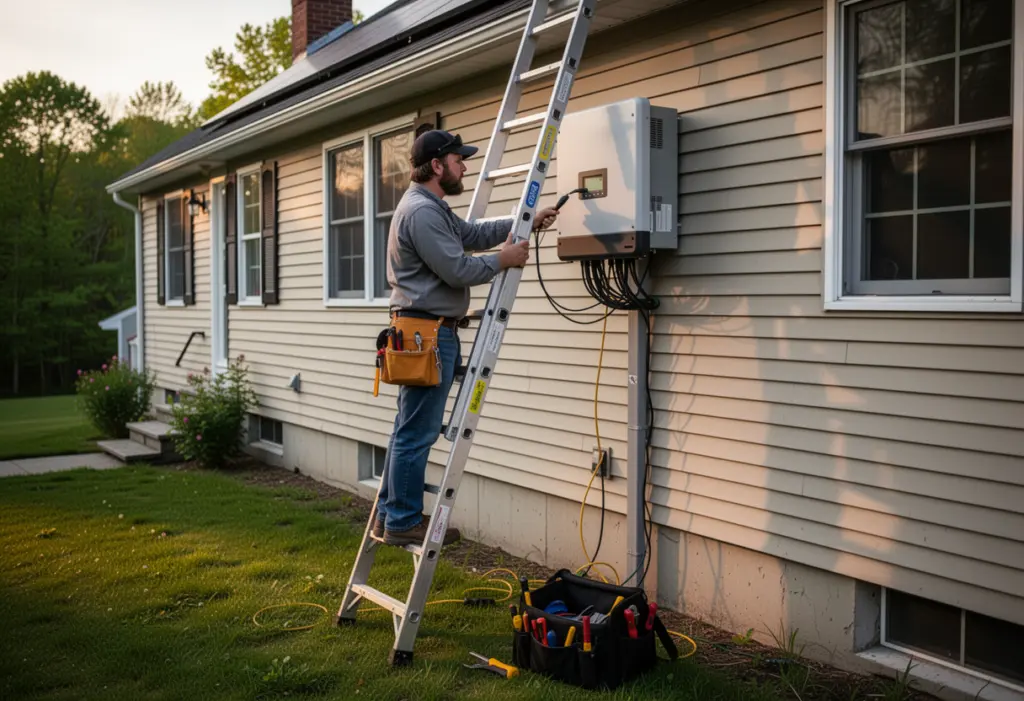
The price of a solar repair in New York is decided long before the fault, by paperwork you signed at installation. There are three separate warranties on a typical residential system and they expire at three different times, so the useful exercise is finding out today which one would cover the failure you are most likely to have.
Three documents, three different answers
- The panel warranties. Panels normally carry two: a product warranty against defects and a performance warranty about output over time. They have different lengths and different remedies. Read both rather than the marketing summary.
- The inverter or microinverter warranty. This is usually the shorter one, and the inverter is the component most likely to fail, which makes it the warranty that decides most real repair bills.
- The installer labour warranty. Separate from the manufacturer terms and normally the first to lapse. It is the one that pays for the truck, the ladder and the technician time.
The uncomfortable combination is a live manufacturer warranty and a dead labour warranty, or an installer that has gone out of business. A manufacturer will typically send a replacement part and nothing else, leaving you to find a company willing to work on another firm’s installation and to pay them at their own rate. Ask, before you sign anything, who honours the labour warranty if the installing company ceases trading.
What actually breaks on a New York roof
- Inverters and module-level electronics. The single most common real repair.
- Rodent damage to DC wiring. Squirrels nest in the gap under an array. Critter guard is far less than a rewire.
- Connector and conduit faults after years of freeze and thaw, particularly at the roof edge.
- Roof leaks at flashing and penetrations. Frequently a workmanship claim rather than a product one, which is why the labour warranty length matters.
- Monitoring gateway failures. Worth diagnosing before panicking: a system that has stopped reporting has not necessarily stopped producing.
- Racking movement or ice damage after a hard winter, mostly in the snow belts.
If you do not own the system
Under a lease or a power purchase agreement the equipment belongs to the provider and repairs are their obligation. Read the operations and maintenance clause and look specifically for the response time commitment and for whether you are permitted to engage your own contractor. Many agreements say you are not. If you are being billed for production you are not receiving, that is a contractual matter and the agreement will say how it is handled, so keep your own production records.
The cost that does not stop while you wait
A system that is down produces nothing, but the Customer Benefit Contribution is billed on DC capacity regardless, for systems interconnected on or after 1 January 2022. An 8 kW array pays 8 x $1.31 = $10.48 a month on RG&E, roughly $125.76 a year, and 8 x $1.13 = $9.04 a month on PSEG Long Island, roughly $108.48 a year, at the 2026 residential rates. Three weeks of unnoticed downtime in June also costs more than three weeks in December, because June is when the credits you spend in winter are being built under Phase One net metering. Check your monitoring monthly for that reason alone.
The repair nobody quotes for: the roof underneath
If the roof needs replacing while the array is on it, someone has to remove and reinstall the panels, and that is a separate job with a separate price. It is almost never included in an original solar contract and it is the largest predictable future cost of a rooftop system on older New York housing stock. Ask for the removal and reinstall price in writing at the time of purchase, and match the roof age against the array life before you commit. A roof with a few years left in it is an argument for replacing it first.
Insurance and the parts that are not warranty claims
Storm, hail, fire and falling-tree damage are homeowner insurance questions rather than warranty ones. Tell your carrier the array exists, get the coverage position in writing, and keep the commissioning photographs. A denied claim on an undisclosed installation is an expensive way to learn this.
What repairs do and do not do to your incentives
Repairing or replacing a failed component is not a new installation, so it does not create a fresh 25% credit capped at $5,000 on Form IT-255 for equipment you have already claimed; that determination belongs to your tax preparer, not to a repair company. There is no federal residential credit to rescue any of it, since section 25D was terminated for expenditures made after 31 December 2025. If a repair turns into a genuine expansion of the array, treat it as a new project: a new interconnection application, a new permit, and a recalculated capacity charge on the larger DC size. On expansions of systems interconnected before 2022, the current version of the NYSERDA fact sheet treats the older capacity as remaining outside the charge, which reverses what earlier versions said, so confirm the position that applies on the day rather than trusting an industry blog. Programme terms change; check with NYSERDA and your utility.
Frequently Asked Questions
Who pays for a solar repair in New York?
It depends which warranty applies. A manufacturer warranty usually covers the part only, while the installer labour warranty covers the technician time and site visit, and those two expire at different times.
What fails most often?
Inverters and module-level electronics, followed by rodent damage to wiring, connector faults after freeze and thaw cycles, and flashing leaks at the roof penetrations.
What if my installer is out of business?
The manufacturer warranty on the part normally survives, but you will be paying another company for labour at its own rate. Ask before signing who honours the labour warranty if the installing company stops trading.
Who repairs a leased system?
The provider owns the equipment and carries the repair obligation. Read the operations and maintenance clause for the response time and for whether you are allowed to bring in your own contractor, since many agreements say you are not.
This article is general information, not tax, legal or financial advice. Incentive amounts, eligibility rules and deadlines change and depend on your utility, your tax situation and your property. Confirm current terms with NYSERDA, your utility and a qualified tax professional before making a decision.
NY Solar Incentives
Independent New York solar research. We summarise NYSERDA, NY-Sun and federal programme rules from published sources and state plainly when a figure is an estimate. We are not a government agency and do not sell equipment.
Run the arithmetic on your own system
Check the dated program table and your arrangement before counting an incentive. Standard residential NY-Sun blocks are closed; Long Island Affordable Solar has a conditional income-verification route. The NY credit depends on qualified costs and tax liability, while the NYC abatement reduces future property-tax bills. The estimator keeps those timings separate.