Ice Dams and Solar Panels in New York
Ice dams are caused by heat escaping into the attic, not by solar panels. But an array changes how snow leaves a roof and makes the underlying fix harder to reach later, which is why sequence matters.
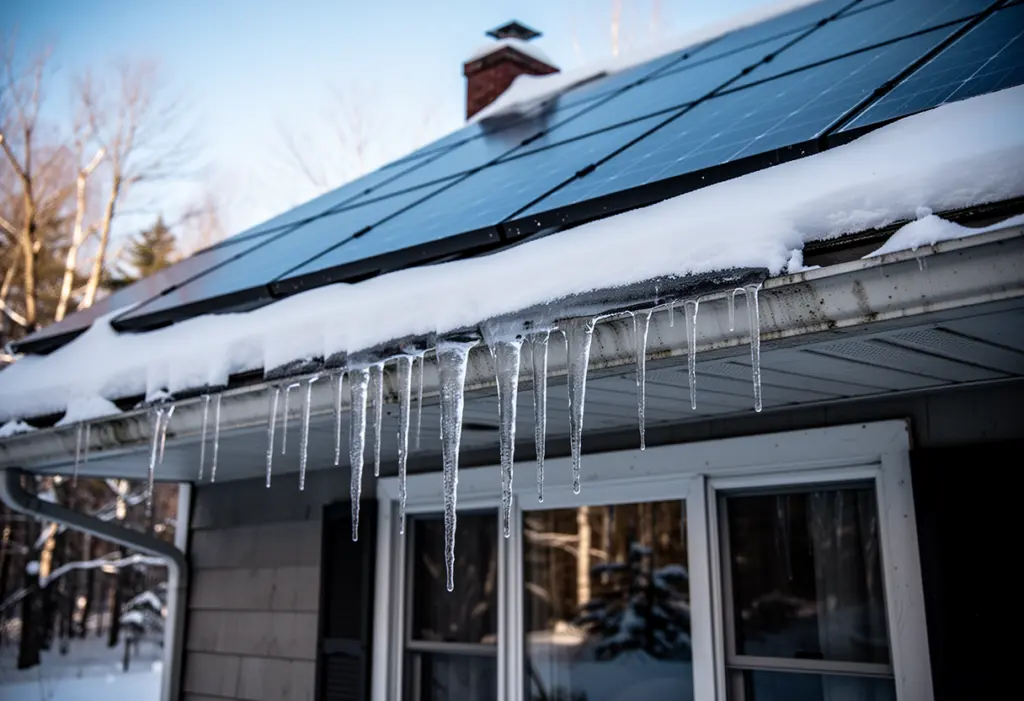
An ice dam is a building problem before it is a solar problem. Heat escaping from the living space into the attic warms the roof deck, snow melts against that warm surface, the water runs down to the cold overhang beyond the heated envelope, and it refreezes there. The ridge of ice that forms holds the next meltwater back until it finds a way under the roof covering. Panels do not cause that sequence. What they do is change how snow behaves on the way down, and make the real repair harder to reach once they are installed.
Do the attic work before the array goes on
The durable fix is air sealing, insulation and ventilation: stop the heat reaching the deck, and keep what does reach it moving out under the ridge. All of that is work done from inside the attic, and in principle it can be done at any time.
In practice, sequence still matters. Anything that has to be done on the roof surface — replacing damaged covering, correcting flashing, adding an ice barrier membrane at the eave during a re-roof — means removing and reinstalling modules once the array exists. That is a crew mobilisation and an electrical recommissioning to fix a problem that was visible before the panels arrived.
So if the house already produces icicles at the eave every February, treat that as part of the solar project rather than as a separate household chore, and get it addressed first. Ask the solar installer directly whether they saw evidence of it during the site survey.
What an array changes about the snow
Glass is smoother than any roof covering, and it warms in the sun. Snow therefore leaves an array in slabs, at once, rather than sliding gradually or melting in place. That is generally good for production and it introduces one genuine hazard: whatever is directly below the eave.
Walk the perimeter before design is finalised and identify what sits under each roof plane — a front door, a walkway, a driveway where cars park, a gas meter, an air conditioning condenser, a deck. Then ask the installer two questions: where snow will discharge from this layout, and whether snow guards are recommended for the planes that discharge over something that matters. Ask also how far up from the eave the array starts, because a row set back from the edge behaves differently from one that ends at the gutter.
Things not to do
Do not chip or hack at ice on a roof with an array on it. You are working above glass, wiring and mounting hardware with a tool designed to break things, and this is how a winter maintenance job turns into a spring repair bill.
Do not add heat cables under or around an array without asking the installer first. They are an electrical load with their own circuit and their own attachment method, and both interact with what is already up there.
Do not attack the array with a roof rake to speed the melt. Marked glass and a damaged frame are permanent, and the winter production being chased is the smallest of the year.
Where the water actually gets in
If you have had interior staining after a hard freeze, the useful diagnostic is where the water appeared relative to the eave and the array, and whether it appeared during a thaw rather than during rain. Keep the dates and photographs. When the roof is next open, the questions are whether an ice barrier membrane is present at the eaves and whether the mount flashings were installed correctly, because a leak found at a penetration and a leak caused by damming are different repairs with different responsible parties.
The efficiency work is a separate programme
One practical warning. Insulation, air sealing and ventilation are not part of a solar quote and are not covered by solar incentives. They are administered separately, frequently through your utility or through NYSERDA programmes with their own eligibility and their own paperwork. Ask about them as their own project rather than expecting a solar contractor to fold them in, and do not assume a combined saving figure covers both.
What the solar side is worth in 2026
For the array itself, New York still offers 25% of qualified expenditure capped at $5,000 on Form IT-255 for a principal residence and the state sales tax exemption on residential solar equipment. The NY-Sun incentive, which a contractor applies as a price reduction, is not on offer for homes right now: as of September 2026 NYSERDA has no open NY-Sun block for homes in any utility territory; check NYSERDA’s NY-Sun dashboard for a new one. RPTL 487 exempts the added assessed value from property tax for 15 years where the municipality, the county and the school district have each not opted out, with construction required before 1 January 2030. Federally there is nothing for a 2026 residential installation, since section 25D ended for expenditures made after 31 December 2025 on the original installation completed test.
And the running cost is indifferent to weather. The Customer Benefit Contribution is billed on DC system size for anything interconnected on or after 1 January 2022, so a 7 kW array in Central Hudson territory pays 7 × $1.67, about $11.69 a month or $140 a year, in February under a foot of snow exactly as in July. Confirm your own utility figure from your own bill, since rates are recalculated annually.
Frequently Asked Questions
Do solar panels cause ice dams?
No. Ice dams come from heat escaping into the attic, melting snow on the warm deck and refreezing at the cold eave. Panels change how snow leaves the roof, and they make roof side repairs harder once installed.
Should I fix ice dams before installing solar?
Yes, if the house already ices at the eave. Air sealing, insulation and ventilation are the durable fix, and any repair to the roof surface after installation means removing and reinstalling modules to reach it.
Is snow sliding off panels dangerous?
It can be, because glass sheds snow in slabs rather than gradually. Identify what sits under each roof plane, such as a door, walkway or driveway, and ask the installer about snow guards for those planes.
Can I use heat cables with solar panels?
Ask the installer before adding any. Heat cables are an electrical load with their own circuit and attachment method, and both interact with the mounting and wiring already on the roof.
This article is general information, not tax, legal or financial advice. Incentive amounts, eligibility rules and deadlines change and depend on your utility, your tax situation and your property. Confirm current terms with NYSERDA, your utility and a qualified tax professional before making a decision.
NY Solar Incentives
Independent New York solar research. We summarise NYSERDA, NY-Sun and federal programme rules from published sources and state plainly when a figure is an estimate. We are not a government agency and do not sell equipment.
Run the arithmetic on your own system
Check the dated program table and your arrangement before counting an incentive. Standard residential NY-Sun blocks are closed; Long Island Affordable Solar has a conditional income-verification route. The NY credit depends on qualified costs and tax liability, while the NYC abatement reduces future property-tax bills. The estimator keeps those timings separate.