Solar Panels on Staten Island: What to Expect
Staten Island is the one borough where the suburban solar model mostly works. It still sits inside New York City's permitting system, and coastal exposure adds engineering that other boroughs rarely face.
On this page 7 sections
- 01Solar panels on Staten Island start with an advantage in roof area
- 02Trees are the shading problem here, not neighbouring towers
- 03Coastal exposure adds engineering the other boroughs skip
- 04How Staten Island compares with the denser boroughs
- 05The permitting is still New York City permitting
- 06What decides payback on a Staten Island roof
- 07Frequently asked questions
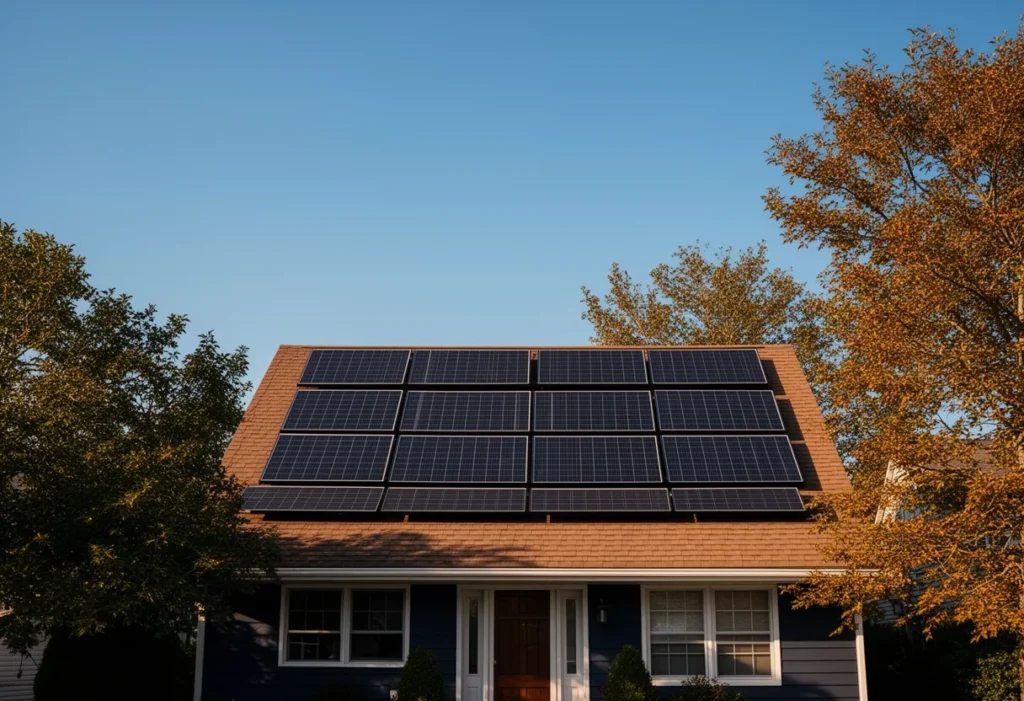
Solar panels on Staten Island behave more like solar in Westchester or Nassau than solar in Manhattan. The borough has the highest share of detached single-family housing in New York City, and that single fact changes almost every part of the calculation.
What does not change is the regulatory environment. A Staten Island roof sits inside the New York City permitting system, inside Con Edison’s service territory and inside the city’s property-tax abatement scheme, which makes it an unusual hybrid: suburban roofs on city paperwork.
Solar panels on Staten Island start with an advantage in roof area
Detached and semi-detached houses give something the denser boroughs rarely offer: a continuous roof plane with a single owner and no shared parapet. That allows a larger array, and larger arrays spread fixed costs such as permitting, mobilisation and electrical work across more watts.
Pitched roofs also change the mounting method. Instead of the ballasted racking used on flat city roofs, panels are attached through the roof covering into the rafters with flashed penetrations. Done correctly this is routine and watertight; done poorly it is the most common source of long-term roof complaints.
Orientation matters more on a pitched roof than on a flat one, because the array follows the roof rather than a chosen tilt. South-facing planes produce most, east and west planes produce less but spread output across the day, and a north-facing plane is generally not worth using.
Match the array to the roof’s remaining life
Removing and reinstalling an array for a reroof is a substantial avoidable cost. If the shingles have under roughly a decade left, price the roof replacement and the solar together and decide in one go. Ask the installer to state the roof’s condition and estimated remaining life in the proposal.
Trees are the shading problem here, not neighbouring towers
In Brooklyn and Manhattan the shading question is about adjacent buildings. On Staten Island it is usually about mature trees, and trees differ in one important way: they grow.
A shading model run in winter on a bare canopy will overstate summer production. A credible assessment accounts for full leaf-out and for growth over the system’s life. Where trimming is part of the plan, it should be written down along with who is responsible for it.
Street trees add a wrinkle, because pruning or removing them is regulated by the Parks Department rather than being the homeowner’s decision. That is worth confirming before a design depends on it.
Coastal exposure adds engineering the other boroughs skip
Parts of Staten Island sit in higher design wind speed zones and in mapped flood areas. Both affect a solar design in concrete ways.
Wind loading determines attachment spacing and racking specification, so a coastal roof may require more attachment points than an inland one of the same size. Flood zone status affects where inverters, disconnects and any battery equipment may be mounted, since elevation requirements apply to electrical equipment in certain zones.
Neither is an obstacle. Both are reasons a Staten Island design should be engineered for the specific address rather than copied from a template, and reasons to ask which wind speed and flood zone the design assumed.
How Staten Island compares with the denser boroughs
| Factor | Staten Island | Denser boroughs |
|---|---|---|
| Dominant housing type | Detached and semi-detached houses | Rowhouses, co-ops, rentals |
| Typical roof | Pitched, single owner | Small flat roof, often shared |
| Main shading source | Mature trees, growing over time | Adjacent buildings and bulkheads |
| Mounting method | Flashed penetrations into rafters | Ballasted racking on membrane |
| Fire-code impact on size | Present but less limiting | Often removes most usable area |
| Who controls the roof | Usually the homeowner | Frequently a board or landlord |
The permitting is still New York City permitting
A Staten Island installation is filed with the Department of Buildings like any other city job, with a separate electrical filing by a licensed master electrician, and it is subject to the city’s fire-code clearance rules on the roof. The suburban appearance does not move it into a suburban permitting regime.
Staten Island also contains designated historic districts and individually landmarked houses, which trigger Landmarks Preservation Commission review before a permit is issued. Landmark status should be checked at the outset because it can change the achievable design.
The full sequence of filings, inspections and utility approvals is set out in the guide to solar panel installation in NYC. The stages are the same on Staten Island; the roofs are simply easier to work on.
Buying no longer carries a federal credit
The federal residential clean energy credit under section 25D ended for expenditures made after 31 December 2025. An expenditure counts as made when the original installation is completed, so a system finished in December 2025 but switched on in January 2026 still falls under the old rules. A homeowner purchasing with cash or a loan today receives nothing on their federal return. Systems whose installation was completed in 2025 fell under the old rules and unused credit from that year can generally be carried forward. If a proposal still shows a 30 percent federal line for an owned system, ask the company to correct it.
What decides payback on a Staten Island roof
Larger arrays and cheaper cost per watt shorten payback compared with a small rowhouse system. Working against that, Staten Island houses are often larger and use more electricity, so a system that offsets a high bill may itself need to be larger.
On the incentive side, an owner still has the New York State credit for solar energy system equipment, a percentage of qualified expenditure up to a statutory cap claimed on Form IT-255. NYSERDA’s NY-Sun per-watt incentive does not add to that: as of September 2026 NYSERDA has no open NY-Sun block for homes in any utility territory. Because Staten Island is inside the city, the NYC solar property-tax abatement also applies, taken in four annual instalments against the property tax bill.
The other input is what you were paying Con Edison beforehand, and how exported energy is credited under New York’s net metering rules with the per-kilowatt charge that applies to systems interconnected after the phase-in date. How those pieces combine into a payback figure is set out in the explainer on the solar payback period in New York, and the underlying credit mechanics in the guide to net metering in New York.
Frequently asked questions
Is Staten Island a better place for solar than the other boroughs?
Structurally, yes for most homeowners, because detached houses give larger single-owner roofs and fewer fire-code constraints per square foot. That usually means a bigger system at a lower cost per watt. The trade-off is tree shading and, near the coast, additional wind and flood engineering.
Do I still need city permits on Staten Island?
Yes. Staten Island is part of New York City, so installations are filed with the Department of Buildings with a separate electrical filing, and the city’s rooftop clearance rules apply. Landmark review also applies to designated houses and historic districts. The process is the same as elsewhere in the city.
Does the NYC property tax abatement apply on Staten Island?
Yes, it is a citywide programme applied against the property tax bill in four annual instalments and applied for through the Department of Buildings. The abatement percentage and eligibility rules have changed over time, so confirm the current terms with DOB rather than relying on an older quote. It is separate from the New York State credit claimed on your tax return.
Will trees ruin production on a Staten Island roof?
They can, and the risk is understated when shading is modelled on a winter canopy. Ask for an analysis that assumes full summer leaf cover and accounts for growth over the system’s life. If trimming is part of the plan, get it written into the proposal along with who is responsible for doing it.
Verify current programme figures
Incentive rates, the state credit cap, the city abatement percentage and utility charges are revised periodically. Confirm current values with NYSERDA, the New York State Department of Taxation and Finance, the NYC Department of Buildings and Con Edison before signing anything. This site is independent and is not a government agency.
NY Solar Incentives
Independent New York solar research. We summarise NYSERDA, NY-Sun and federal programme rules from published sources and state plainly when a figure is an estimate. We are not a government agency and do not sell equipment.
Run the arithmetic on your own system
Check the dated program table and your arrangement before counting an incentive. Standard residential NY-Sun blocks are closed; Long Island Affordable Solar has a conditional income-verification route. The NY credit depends on qualified costs and tax liability, while the NYC abatement reduces future property-tax bills. The estimator keeps those timings separate.