Solar Panel Degradation: What to Expect Over 25 Years
Panels lose output slowly and predictably, and the number that matters is not the one on the brochure but the guaranteed floor in the performance warranty table.
On this page 6 sections
- 01What the warranty table actually says
- 02Degradation is almost never why your production dropped this month
- 03The charge that does not degrade with the panels
- 04What to do with all this before you sign
- 05Incentives, and the fifteen-year clock that runs shorter than the panels
- 06Frequently Asked Questions
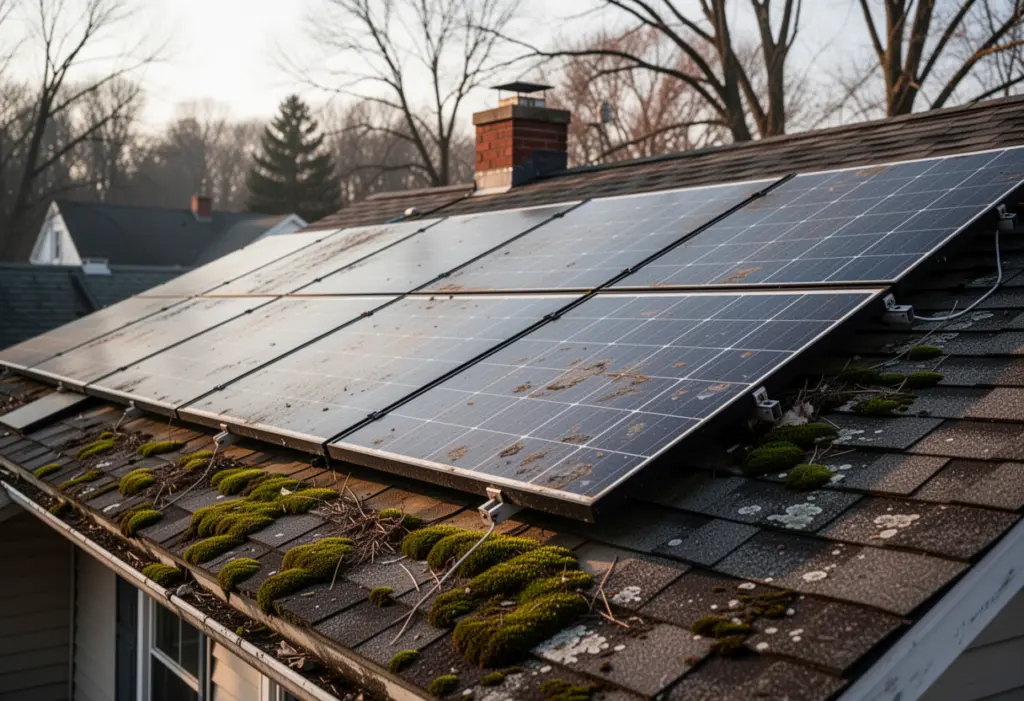
Solar panels lose output slowly, and the honest answer to how much is: read the performance warranty table on the datasheet, because that table is the only number anybody is contractually standing behind. Everything else is a brochure adjective.
What the warranty table actually says
A modern module warranty is usually written in two parts. There is a larger step in the first year, when the cells settle, and then a smaller annual decline for the remainder of the term. The manufacturer guarantees a percentage of the original rated output at year one and another at the end of the term, commonly year 25 or 30.
Ask for both figures rather than the annual rate on its own. A headline of a fraction of a percent per year sounds trivial until you notice the first-year step is charged separately, and the two together are what the guaranteed floor at year 25 reflects.
The arithmetic that matters to a homeowner runs on your own consumption, not on watts. Suppose the design covers 90% of your household usage in year one, and the warranty floor is 87% of rated output at year 25. Multiply: at the end of the term the same array covers roughly 78% of that same usage. That is a real erosion, and it is also small enough that it is rarely the reason a system disappoints.
Degradation is almost never why your production dropped this month
This is the useful part. Degradation is gradual, monotonic and boring. A sudden or seasonal fall in output has other causes, and reaching for degradation as the explanation delays finding the real one.
- Shade that grew. Trees put on height every year. A design shaded for two hours in the afternoon at installation can be shaded for four a decade later, and nothing on the roof changed.
- Snow and ice cover. Days of partial cover fall in the months when production is scarce anyway, which exaggerates their effect on a monthly chart.
- A failed or derated inverter or module-level device. This shows as a step change rather than a slope, and it is the failure your monitoring exists to catch.
- Soiling. On a pitched New York roof, rainfall does most of the cleaning. Paying somebody to wash a rain-washed pitched array is rarely worth what it costs, and roof work carries its own risk. A flat roof, a very low pitch or a site under heavy pollen or agricultural dust is a different conversation.
The charge that does not degrade with the panels
Here is the uncomfortable arithmetic. The Customer Benefit Contribution is billed on the DC nameplate size of your system, not on what it produces, and nameplate does not fall as cells age. At the 2026 Con Edison residential rate of $1.29 per kW-month, a 7 kW array pays $9.03 a month, about $108 a year. It pays that in year one and it pays the same in year 25, by which time the array is delivering meaningfully less. The charge applies to systems interconnected on or after 1 January 2022 and is recalculated annually.
Community solar subscribers pay no Customer Benefit Contribution at all, which is one of several reasons the two options do not compare cleanly on a spreadsheet.
What to do with all this before you sign
Three requests, all cheap. Ask for the module datasheet by model number rather than by brand, so you can read the warranty table yourself. Ask what the production estimate assumes about degradation over the term, because an estimate that quietly assumes none overstates the later years. And ask who honours the module warranty if the installing company no longer exists, since a manufacturer warranty on a part is not the same thing as somebody arriving at your house with a ladder.
Incentives, and the fifteen-year clock that runs shorter than the panels
The incentive worth foregrounding on an article about longevity is RPTL 487, New York’s real property tax exemption on the added value a solar system gives your home. It runs for 15 years, which is notably shorter than the working life of the equipment, so a system installed today is exposed to whatever assessment practice looks like in the second half of its life.
Two things are commonly got wrong about it. It requires three separate checks, because the municipality, the county and the school district can each opt out independently, and any one of them opting out removes that portion of the benefit. In New York City, Buffalo, Rochester, Syracuse and Yonkers there is no separate school check, because those school districts are fiscally dependent and levy no separate property tax. The exemption also is not open-ended: the system must be constructed before 1 January 2030.
The federal residential credit under section 25D is terminated for expenditures made after 31 December 2025, with the expenditure treated as made when the original installation is completed, so nothing federal is coming to a 2026 residential buyer. New York’s own 25% credit capped at $5,000 on Form IT-255, for equipment installed and used at your principal residence in New York, and the state sales tax exemption remain. Confirm all of it at source before signing, because these rules are amended more often than equipment is replaced.
Frequently Asked Questions
How much output do solar panels lose each year?
Read the performance warranty table on the module datasheet rather than a brochure figure. It normally guarantees one percentage at the end of year one, after the cells settle, and a lower percentage at the end of the term, commonly year 25 or 30.
My production fell this year. Is that degradation?
Almost certainly not. Degradation is gradual and monotonic. A sudden or seasonal drop points to shade that has grown, snow cover, soiling, or a failed inverter or module-level device, and the last of those shows as a step rather than a slope.
Does my monthly charge fall as the panels age?
No. The Customer Benefit Contribution is billed on DC nameplate capacity, not output. A 7 kW array on Con Edison pays 9.03 dollars a month at the 2026 residential rate of 1.29 dollars per kW-month, in year 25 as in year one.
Is it worth paying to clean my panels in New York?
On a pitched roof, rarely. Rainfall does most of the work and the roof access carries real risk. A flat roof, a very low pitch, or a site under heavy pollen or agricultural dust is a different case worth assessing on its own.
This article is general information, not tax, legal or financial advice. Incentive amounts, eligibility rules and deadlines change and depend on your utility, your tax situation and your property. Confirm current terms with NYSERDA, your utility and a qualified tax professional before making a decision.
NY Solar Incentives
Independent New York solar research. We summarise NYSERDA, NY-Sun and federal programme rules from published sources and state plainly when a figure is an estimate. We are not a government agency and do not sell equipment.
Run the arithmetic on your own system
Check the dated program table and your arrangement before counting an incentive. Standard residential NY-Sun blocks are closed; Long Island Affordable Solar has a conditional income-verification route. The NY credit depends on qualified costs and tax liability, while the NYC abatement reduces future property-tax bills. The estimator keeps those timings separate.