Solar Installation Day in New York: What to Expect
Panels on the roof is not the finish line. The gap between installation day and permission to operate is where most of the frustration in a solar project lives.
On this page 8 sections
- 01What should already be done before anyone arrives
- 02Agree the conduit route in advance
- 03How the day tends to run
- 04What is definitely not happening that day
- 05Winter installations in New York
- 06The documents to collect, and when
- 07The incentives that are settled on paper, not on the roof
- 08Frequently Asked Questions
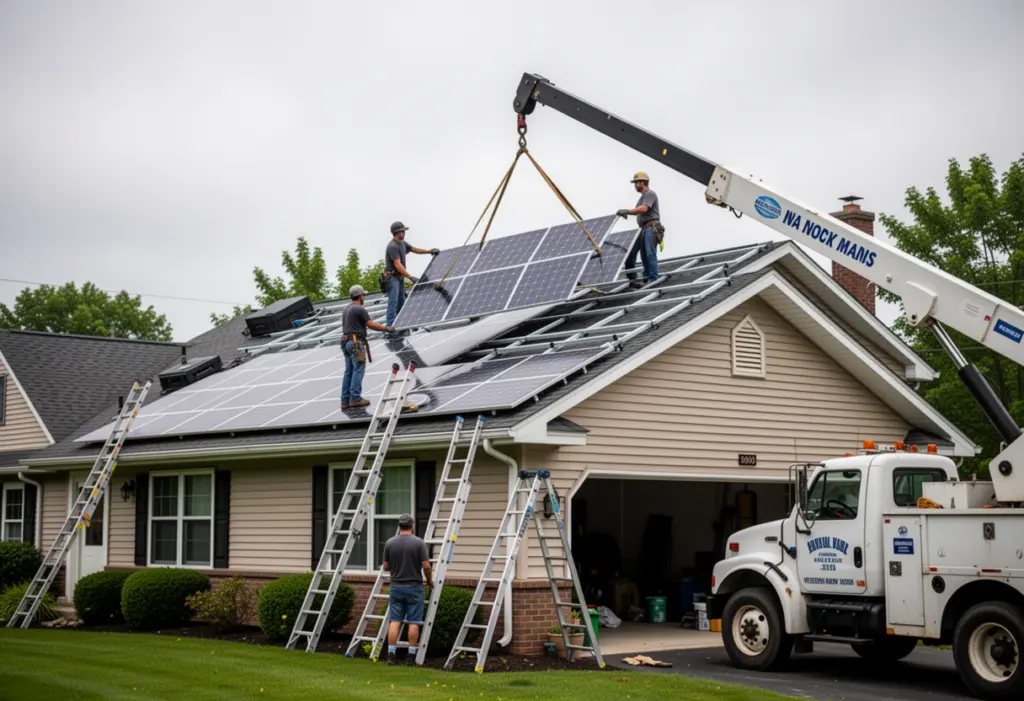
Installation day is usually the short part of a solar project, and the system does not switch on at the end of it. Knowing that in advance removes most of the disappointment, because the wait that follows is not a sign of anything going wrong.
What should already be done before anyone arrives
- The permit is issued, not applied for. Ask to see it.
- The utility interconnection application is submitted and acknowledged.
- Any structural documentation the authority asked for has been accepted.
- The equipment on site matches the equipment in the contract — check the module and inverter model numbers yourself, on the pallet, before installation begins.
Agree the conduit route in advance
Conduit routing is a frequent aesthetic complaint after a solar installation, and it is entirely avoidable. Walk the house with the crew lead before work starts and agree where the inverter goes, where the AC disconnect goes, and exactly which wall the conduit runs down. Once it is drilled and mounted, moving it is a paid change. Ten minutes at the start of the day is worth more than any conversation afterwards.
How the day tends to run
Ladders, roof safety anchors and staging first. Then racking and flashings, which is the part that touches your roof and the part worth watching. Modules go on after that, and it moves quickly. The electrical work happens in parallel or afterwards: inverter mounting, conduit, the disconnect and the tie-in at your service panel. Expect the power to your house to be off for part of that tie-in, and expect noise and roof debris. Ask where the crew will park, where materials will be staged, and how the site will be left.
What is definitely not happening that day
The electrical inspection, the utility sign-off and permission to operate. The monitoring, which usually needs the system energised to commission properly. And frequently the final building inspection. A crew that leaves at four in the afternoon has finished their part, not the project.
Winter installations in New York
They happen and they are normal, with two caveats worth raising. Snow and ice on a roof stops work outright on safety grounds, so winter schedules slip more than summer ones. And some sealants and adhesives have low-temperature limits, so ask what is being used and what the crew does if the temperature is below its range. A day lost to weather is a good outcome compared with a penetration sealed with a product outside its working range.
The documents to collect, and when
- As-built drawings showing the final layout, including any panels that were dropped from the plan.
- Module and inverter serial numbers — needed for warranty claims, and painful to gather later.
- Manufacturer warranty registrations, confirmed as submitted rather than promised.
- The workmanship warranty on roof penetrations, with its term stated.
- After sign-off: the inspection certificate and the permission to operate letter with its date.
The incentives that are settled on paper, not on the roof
NY-Sun does not arrive as a payment to you: when a block for homes is open, it is applied by the contractor as a reduction in the installed price. As of September 2026 NYSERDA has no open NY-Sun block for homes in any utility territory; check NYSERDA’s NY-Sun dashboard for a new one. If a contract still shows a NY-Sun deduction, ask which open block it relies on. The same goes for NYSERDA’s Affordable Solar incentive for low- to moderate-income households: its last blocks for homes closed on 15 October 2025 in Con Edison territory and on 9 March 2026 in the Upstate region.
Keep the invoice itemised for the New York State credit, 25 percent of qualified expenditure capped at $5,000 on Form IT-255, available for equipment at your principal residence in New York. The credit is limited by the state tax you actually owe, with unused amounts carried forward up to five years. There is no federal line to keep it alongside: the 30 percent residential credit at section 25D was terminated for expenditures made after 31 December 2025, with an expenditure treated as made when the original installation is completed, so any 2026 paperwork still showing a 30 percent federal line is materially wrong.
And note the monthly charge that starts once you are interconnected. The Customer Benefit Contribution is billed on DC capacity rather than production for systems interconnected on or after 1 January 2022. On Central Hudson at $1.67 per kW-month for 2026, the highest residential rate in the state, a 6 kW array is about $10.02 a month, near $120 a year. Rates are recalculated annually, so check the current figure rather than assuming today’s number is permanent.
Frequently Asked Questions
Will my solar system work on installation day?
No. The electrical inspection and the utility's permission to operate both come afterwards, and monitoring is usually commissioned once the system is energised. Panels on the roof is not the finish line.
What should I agree before the crew starts work?
Where the inverter and AC disconnect are mounted and exactly which wall the conduit runs down. It is the most common aesthetic complaint afterwards and moving it once it is drilled is a paid change.
Will my power be off during the installation?
For part of it, yes. The tie-in at your service panel requires the supply to be off for a period. Ask the crew lead for the expected window at the start of the day so you can plan around it.
What documents should I have at the end?
As-built drawings, module and inverter serial numbers, confirmed warranty registrations, the workmanship warranty on roof penetrations, and later the inspection certificate and the permission to operate letter with its date.
This article is general information, not tax, legal or financial advice. Incentive amounts, eligibility rules and deadlines change and depend on your utility, your tax situation and your property. Confirm current terms with NYSERDA, your utility and a qualified tax professional before making a decision.
NY Solar Incentives
Independent New York solar research. We summarise NYSERDA, NY-Sun and federal programme rules from published sources and state plainly when a figure is an estimate. We are not a government agency and do not sell equipment.
Run the arithmetic on your own system
Check the dated program table and your arrangement before counting an incentive. Standard residential NY-Sun blocks are closed; Long Island Affordable Solar has a conditional income-verification route. The NY credit depends on qualified costs and tax liability, while the NYC abatement reduces future property-tax bills. The estimator keeps those timings separate.