Solar on a Flat Rubber Roof: What Changes
A flat membrane roof changes the mounting, the snow behaviour and the warranty question all at once. Here is what to settle before anyone touches it.
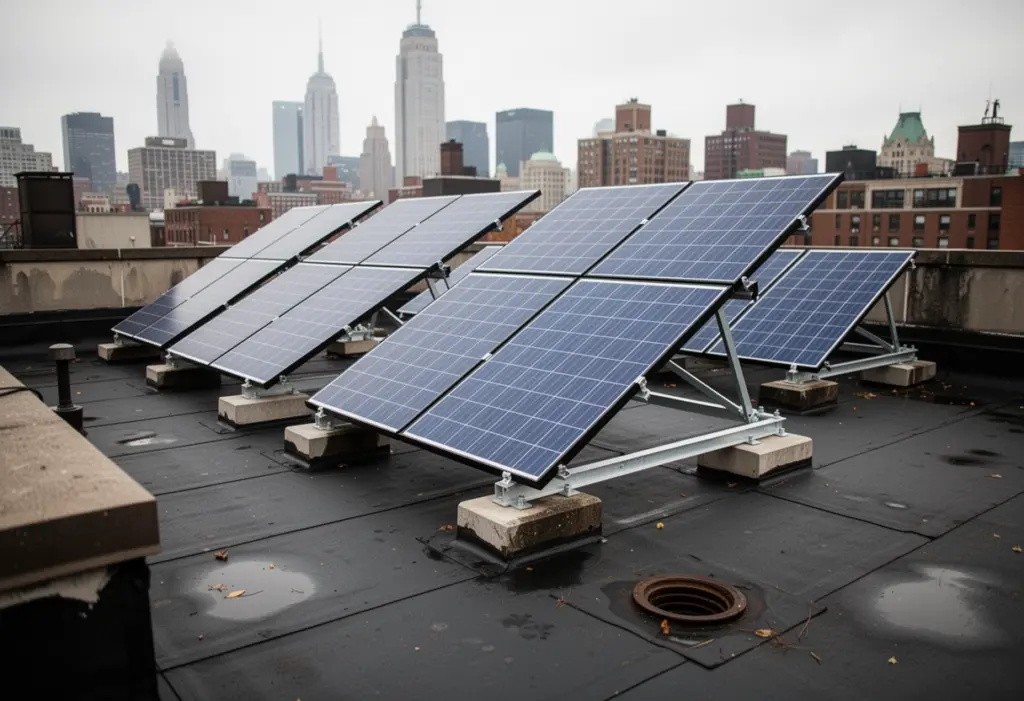
Flat membrane roofs — EPDM rubber, TPO, modified bitumen — are everywhere in New York City, on Long Island, and on row and commercial-style buildings statewide. Solar works on them, and it works differently enough that a quote written for a pitched shingle roof is not transferable.
Ballasted or penetrating
This is the first decision and it drives everything else.
Ballasted racking sits on the membrane, weighted down — typically with concrete blocks — and is not fixed to the structure. Nothing is penetrated, which is the whole point: your roof membrane stays intact and the warranty question mostly evaporates.
The cost is weight. Ballast adds real dead load, and whether the roof can carry it is a structural question answered by an engineer, not by an installer’s assurance. On an older New York building it is the question that decides whether the project happens.
Penetrating mounts fix into the structure and are flashed into the membrane. Far lighter, and appropriate where ballast is not viable — but every penetration is a potential leak and a warranty conversation.
The membrane warranty
Commercial membrane roofs carry manufacturer warranties, and they typically require that any work on the roof be done in a specified way, sometimes by a certified contractor.
The order of operations matters:
- Find out who holds the roof warranty and what it says about attachments and rooftop equipment.
- Get the solar installer’s mounting method in writing.
- Confirm with the roofing manufacturer or the warranty holder before work starts.
Doing this afterwards is how a valid roof warranty becomes an invalid one.
Tilt, and why flat roofs are not really flat
Panels laid flat on a flat roof produce less than tilted ones and, more importantly, they never clean themselves and never shed snow. So arrays on flat roofs are almost always tilted on racking.
Tilt brings two consequences:
- Row spacing. Tilted rows shade the row behind them at low sun angles, so they must be spaced apart. That means a flat roof fits meaningfully less capacity per square metre than its area suggests — frequently a surprise on a first quote.
- Wind. A tilted panel is a sail. Ballast and attachment must be specified for the local wind zone, which matters most on Long Island and in exposed coastal locations.
Tilting toward the south is normal; on constrained roofs an east-west layout at a shallower tilt fits more panels at lower output each, and is sometimes the better total.
Snow does not slide off a flat roof
This is the New York-specific point that gets least attention. A pitched array sheds snow within a day or two of a storm. A flat or shallow-tilt array does not — it can stay covered for weeks, which is a materially larger winter production loss than on a pitched roof.
Two things follow. Ask what snow assumption the production estimate used, and expect it to be larger than for a pitched roof. And if snow clearing is ever needed, it is a professional job on a flat roof, not a homeowner with a broom.
Drainage
Flat roofs drain to internal drains or scuppers. An array must not obstruct them, and ballast blocks must not create ponding. Ponding water is what destroys membrane roofs, so a layout that ignores the drainage pattern is storing up an expensive problem.
Ask to see the layout drawn over the roof plan with the drains marked.
What to establish before signing
- Ballasted or penetrating, and why?
- If ballasted, who confirmed the structure can carry the added dead load?
- Who holds the membrane warranty and have they approved the method in writing?
- What tilt and row spacing, and what capacity does that actually fit?
- What wind load is the system specified for?
- What snow-cover assumption is in the production estimate?
- Does the layout clear the drains?
Frequently Asked Questions
Can solar panels go on a flat rubber roof?
Yes, usually on ballasted racking that sits on the membrane without penetrating it. The trade-off is weight — ballast adds real dead load, and whether the roof can carry it is a structural question for an engineer rather than an installer's assurance.
Will solar void my flat roof membrane warranty?
It can. Membrane warranties typically specify how rooftop work must be done and sometimes by whom. Establish who holds the warranty, get the mounting method in writing, and confirm with the warranty holder before work starts rather than after.
Why does a flat roof fit fewer panels than I expected?
Tilted rows shade the row behind them at low sun angles, so they have to be spaced apart. A flat roof therefore fits meaningfully less capacity per square metre than its bare area suggests.
Does snow slide off a flat solar array?
No. A pitched array clears itself within a day or two, but a flat or shallow-tilt array can stay covered for weeks, which is a materially larger winter loss. Ask what snow assumption the production estimate used, and expect it to be larger than for a pitched roof.
This article is general information, not tax, legal or financial advice. Incentive amounts, eligibility rules and deadlines change and depend on your utility, your tax situation and your property. Confirm current terms with NYSERDA, your utility and a qualified tax professional before making a decision.
NY Solar Incentives
Independent New York solar research. We summarise NYSERDA, NY-Sun and federal programme rules from published sources and state plainly when a figure is an estimate. We are not a government agency and do not sell equipment.
Run the arithmetic on your own system
Check the dated program table and your arrangement before counting an incentive. Standard residential NY-Sun blocks are closed; Long Island Affordable Solar has a conditional income-verification route. The NY credit depends on qualified costs and tax liability, while the NYC abatement reduces future property-tax bills. The estimator keeps those timings separate.