Solar Hot Water or Solar Electric for a New York Home?
These are two different machines competing for the same roof. The decisive difference in New York is that surplus electricity has somewhere to go and surplus hot water does not.
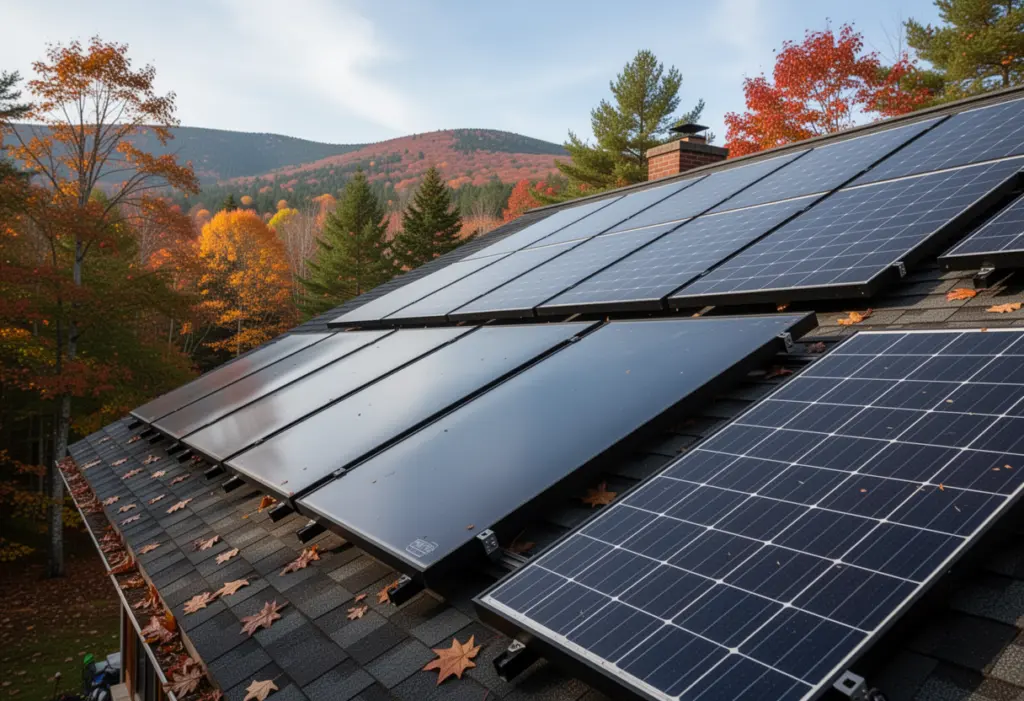
Solar hot water and solar electric are not two versions of the same product. One heats water and nothing else. The other makes electricity that can run anything in the house, including the water heater. On a New York roof they compete for the same area, and the decisive difference between them is what happens to a surplus.
The difference that settles most decisions
A photovoltaic array that produces more than the house needs at that moment exports the surplus, and under Phase One net metering that export is credited at the full retail rate, holding for 20 years from interconnection. Surplus in June therefore pays for consumption in December.
A solar thermal collector has no equivalent. On a hot July afternoon with a full tank there is nowhere for the heat to go. The system stagnates, which well-designed installations handle safely but which is still energy collected and thrown away. Nobody buys your hot water.
That single asymmetry is why solar electric became the mass-market residential path in New York while solar thermal stayed a niche, and it is the first thing to weigh if you can only fit one on the good roof plane.
What solar thermal is genuinely good at
It is not a bad machine. Per square foot of collector it captures more usable energy than a photovoltaic module does, because turning sunlight into heat is a far shorter path than turning it into electricity. If your household uses a lot of hot water, if the roof area is small, and if the alternative is an old resistance electric tank, the case is real.
The New York specifics that decide it:
- Freeze protection. Any collector on a New York roof needs a design that survives winter, typically an antifreeze loop with a heat exchanger or a drainback arrangement. Both add components and both need periodic attention.
- Maintenance is real and recurring. Glycol degrades and is checked and replaced on a schedule. Pumps, controllers, sensors and expansion tanks are all wear items. A photovoltaic array has no fluid and no moving parts, which is the quiet reason it wins on total ownership effort.
- You still need a backup heat source. Sizing a thermal system to cover a New York winter is not realistic, so the existing water heater stays and becomes the backup. You are buying a fuel saver, not a replacement.
- Roof competition. Collectors occupy the best-oriented, least-shaded area, which is precisely the area photovoltaic modules want.
The option that changed the comparison
Before committing to either, price a heat pump water heater against both. It uses a fraction of the electricity of a resistance tank for the same output, it sits in a basement or utility room rather than on a roof, and it can be run on your own solar electricity. In many New York houses the sequence that produces the most result for the least complexity is a heat pump water heater first, then photovoltaic panels sized to include its load. That is not a universal answer, but it is the comparison most solar thermal quotes are not shown alongside.
Which frameworks each one sits inside
Most of what this site describes is the framework around solar electric, and it does not transfer automatically.
Net metering, interconnection with your utility and the Customer Benefit Contribution all attach to net metered photovoltaic capacity. The contribution is charged monthly per kilowatt of DC size on systems interconnected on or after 1 January 2022: at the 2026 RG&E residential rate of $1.31 per kW-month, a 5 kW array pays $6.55 a month, about $79 a year. A thermal collector generates no electricity and does not interconnect, so it sits outside that arrangement entirely. Confirm the treatment of your specific installation with your own utility rather than assuming from either direction.
If your electricity comes from a village or city electric department rather than an investor-owned utility, none of the state framework applies to the photovoltaic side either. Municipal electric utilities are outside Public Service Commission jurisdiction, so net metering terms and interconnection rules are set locally and have to be asked for directly. Read the utility name on your bill.
Incentives, and the question to take to your tax preparer
New York’s 25% solar energy system equipment credit, capped at $5,000 on Form IT-255, is the centrepiece for a homeowner in 2026. Three conditions decide whether you get the full benefit. The equipment must be at your principal residence in New York, so a seasonal cottage, a second home or a rental does not qualify. The credit is limited by your actual New York State tax liability, though unused amounts carry forward for up to five years. And it reaches leases and power purchase agreements only where the agreement runs ten years or more, with the $5,000 acting as a lifetime ceiling per agreement.
Whether a particular solar thermal installation qualifies under that credit is a question for the Form IT-255 instructions and your own tax preparer rather than for a contractor’s sales sheet, and it is worth settling before you sign. Do not count on NY-Sun for either system: as of September 2026 NYSERDA has no open NY-Sun block for homes in any utility territory; check NYSERDA’s NY-Sun dashboard for a new one, and if a block does open, ask NYSERDA or the contractor to confirm in writing that the exact equipment quoted is eligible. The federal residential credit under section 25D is terminated for expenditures made after 31 December 2025, measured by completion of the original installation, so no 2026 purchase earns it.
Frequently Asked Questions
Is solar hot water better than solar panels in New York?
Rarely, for a whole-house decision. A photovoltaic array can export its surplus for full retail rate credit, while a thermal collector with a full tank has nowhere to put the heat. Thermal wins mainly on small roofs with heavy hot water use.
Does solar hot water work through a New York winter?
It works, but not enough to cover winter demand alone, so the existing water heater stays as backup. The system also needs freeze protection, typically an antifreeze loop or a drainback design, and that adds recurring maintenance.
What should I price against solar hot water?
A heat pump water heater. It uses far less electricity than a resistance tank for the same output, sits indoors rather than on the roof, and can run on your own solar generation. Most thermal quotes are not shown alongside it.
Do the same New York incentives apply to solar thermal?
Do not assume they do. Net metering, interconnection and the Customer Benefit Contribution attach to photovoltaic capacity. For the state credit, take the exact equipment to the Form IT-255 instructions and your tax preparer before signing.
This article is general information, not tax, legal or financial advice. Incentive amounts, eligibility rules and deadlines change and depend on your utility, your tax situation and your property. Confirm current terms with NYSERDA, your utility and a qualified tax professional before making a decision.
NY Solar Incentives
Independent New York solar research. We summarise NYSERDA, NY-Sun and federal programme rules from published sources and state plainly when a figure is an estimate. We are not a government agency and do not sell equipment.
Run the arithmetic on your own system
Check the dated program table and your arrangement before counting an incentive. Standard residential NY-Sun blocks are closed; Long Island Affordable Solar has a conditional income-verification route. The NY credit depends on qualified costs and tax liability, while the NYC abatement reduces future property-tax bills. The estimator keeps those timings separate.