The PSEG Long Island Solar Rebate: What Actually Exists in 2026
There is no general NY-Sun rebate open for Long Island homes in 2026. Here is what replaced it, what you can still claim, and what to ask an installer.
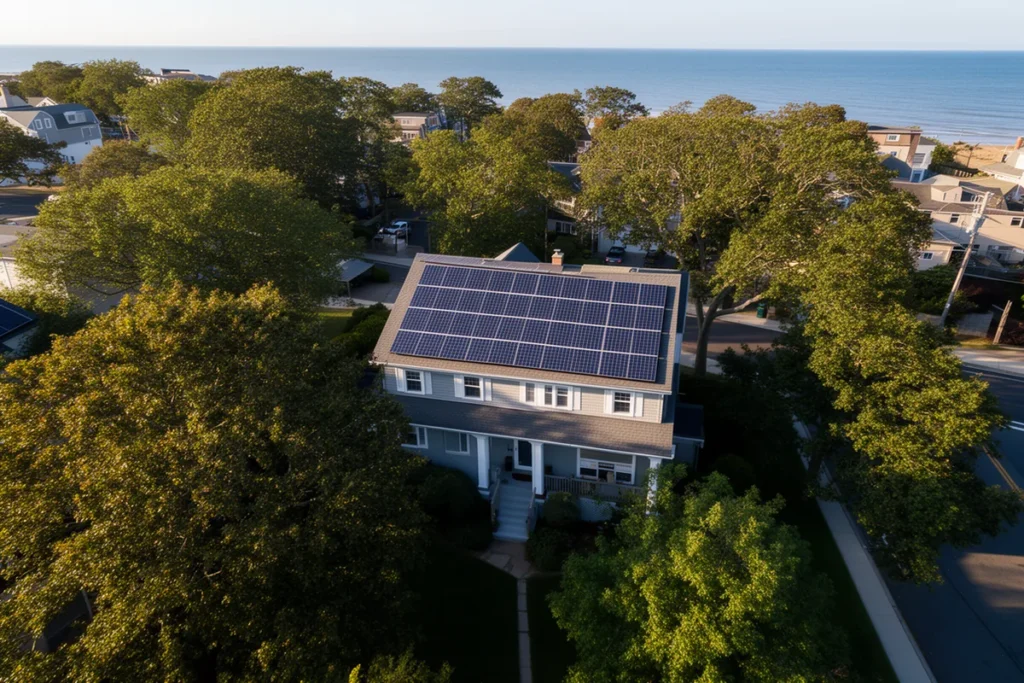
If you have searched for a PSEG Long Island solar rebate, you have probably found installer pages promising one and a NYSERDA site that never quite confirms it. The honest answer is worth more than the optimistic one: for most Long Island homeowners there is no upfront NY-Sun rebate open any more; the one NY-Sun incentive NYSERDA still lists there is for income-qualified households. What replaced it is a smaller set of incentives that are still worth real money — and one of them is worth more on Long Island than almost anywhere else in the state.
The short answer
NY-Sun, the state programme that pays an upfront incentive per watt of installed solar, is administered by NYSERDA and released region by region in what it calls Megawatt Blocks. Each block holds a fixed volume of capacity at a fixed rate. When a block fills, the rate steps down; when the last block fills, the incentive for that sector and region is finished.
In PSEG Long Island territory, the standard residential block has been exhausted for years. So a homeowner on Long Island in 2026 should not budget for a NY-Sun rebate unless the household qualifies for Affordable Solar (below): as of September 2026 NYSERDA has no open NY-Sun block for homes in any utility territory. Three related routes come up in every search:
- Affordable Solar — an income-qualified incentive for homeowners whose household income is under 80% of the area or state median income, whichever is higher. NYSERDA’s April 2026 NY-Sun Program Manual still lists it on Long Island at $0.40 per watt; it is not tied to a block, so it does not appear on the block chart. You apply through NYSERDA’s Income Eligibility Application, and a participating NY-Sun contractor claims the incentive and must pass it on in your contract. Ask the contractor to confirm funding is still available. The Con Edison and Upstate Affordable Solar blocks closed on 15 October 2025 and 9 March 2026.
- Solar plus a battery — NYSERDA says home battery incentives on Long Island are offered through PSEG Long Island; its NY-Sun manual lists a Solar Plus Energy Storage incentive for Long Island homes that is claimed by a participating contractor and requires enrolment in PSEG Long Island’s Dynamic Load Management program.
- Community solar — no rooftop, no rebate, no equipment. You subscribe to a share of a larger array and take bill credits instead. It is the route that actually works for renters, co-op residents and anyone with a shaded or leased roof. We cover the mechanics in Community Solar in New York: How It Actually Works, and the income-eligible version in NYSERDA Solar for All.
Before you take anyone’s word on block status — including ours — check it at source. NYSERDA publishes live Megawatt Block dashboards broken out by region and sector. The Long Island dashboard is the only document that settles the question on any given day.
Why the rebate question is the wrong one on Long Island
Homeowners fixate on the rebate because it is the number an installer leads with. But the rebate was never the largest line in a Long Island solar economics sheet — the electricity rate is.
PSEG Long Island’s residential rates sit at the high end for New York State. The value of a solar array is the retail electricity it displaces over twenty-five years, so a high rate does more for payback than any one-time cheque. That is the whole reason Long Island stayed a strong solar market after its incentive block closed, and it is why block closure was not the death sentence it sounds like.
The mechanism that converts production into bill savings is net metering, and its rules are what you should actually be reading before you sign. We walk through them in Net Metering in New York: How Credits Work.
What you can still claim in 2026
The New York State solar tax credit
New York State’s Solar Energy System Equipment Credit is worth 25% of your system cost, capped at $5,000, taken against your state income tax. It survived the federal changes intact, it applies to purchased and to leased systems under the right structure, and on a typical Long Island residential system it hits the cap. Full rules are in New York State Tax Credit for Solar Panels in 2026.
The federal credit — read this before you assume
The residential federal solar credit under IRC §25D is no longer available for systems completed after 31 December 2025. If a quote you are holding still shows 30% off for the federal credit, that quote is built on a rule that has expired, and the number at the bottom of it is wrong. We set out what changed and what the test actually is in The Federal Solar Tax Credit and New York: What Changed.
Property tax treatment
Under RPTL 487, New York State exempts the added assessed value of a residential solar installation from property tax for 15 years, unless your county, city, town, village or school district has opted out. You have to file Form RP-487 with the assessor (in Nassau County, the County Board of Assessors) by the taxable status date, which is January 2 in Nassau County towns; ask your assessor for the date elsewhere. It is not a cheque, but over fifteen years it is not small either.
What to ask a Long Island installer
Because the headline rebate is gone, the quotes you receive will differ mainly in assumptions rather than in incentives — which makes them harder to compare, not easier.
- “Which NY-Sun incentive are you claiming, and at what rate?” If a NY-Sun incentive appears on a Long Island home quote, it can only be the income-qualified Affordable Solar incentive ($0.40 per watt): ask for your NYSERDA income-eligibility approval. As of September 2026 there is no open NY-Sun block for homes in any utility territory.
- “What electricity rate escalation is in this model?” A model assuming aggressive annual rate increases produces a flattering payback. Ask for the number and check it is defensible.
- “Is this a purchase, a loan, a lease or a PPA?” A purchase, with or without a loan, lets you claim the state tax credit on your own cost; a lease or PPA qualifies only under a written agreement of at least 10 years, and the four are frequently presented with similar monthly figures.
- “Who files the interconnection application with PSEG Long Island, and what is the current queue time?” An install date is not a permission-to-operate date — and the gap between them is where most of the frustration in residential solar now lives: Permission to Operate: The Wait Between Install Day and Switch-On.
For the wider cost picture — what components actually drive the number, and what a fair price per watt looks like this year — see What Solar Panels Cost in New York in 2026.
The realistic Long Island stack
Strip out the rebate that no longer exists and a 2026 Long Island homeowner is left with: a 25% state tax credit capped at $5,000 (not refundable, but unused credit carries forward up to five years); no sales tax on the equipment and installation, because Nassau and Suffolk counties both provide the local exemption (Publication 718-S, Part 2); a property tax exemption where the municipality has not opted out and you file form RP-487 in time; and net metering against one of the state’s higher retail rates, minus the monthly Customer Benefit Contribution. If the household qualifies on income and funding remains, NYSERDA’s $0.40-per-watt Affordable Solar incentive comes on top. Community solar sits alongside all of it for anyone who cannot host an array.
That is a smaller stack than the one on the installer flyer from three years ago. It is also the real one, and it is still enough to make Long Island solar work. A full inventory of what New York currently offers is kept up to date on our New York solar incentives page.
This article is general information, not tax advice. Eligibility for the state credit and for income-eligible programmes depends on your individual circumstances — confirm with a tax professional and with NYSERDA before you rely on either.
NY Solar Incentives
Independent New York solar research. We summarise NYSERDA, NY-Sun and federal programme rules from published sources and state plainly when a figure is an estimate. We are not a government agency and do not sell equipment.
Run the arithmetic on your own system
Check the dated program table and your arrangement before counting an incentive. Standard residential NY-Sun blocks are closed; Long Island Affordable Solar has a conditional income-verification route. The NY credit depends on qualified costs and tax liability, while the NYC abatement reduces future property-tax bills. The estimator keeps those timings separate.