What Solar Panels Cost in New York in 2026
Solar pricing in New York is assembled from components you can check. What moves the number, why panels for sale are not the same purchase as a system, and what the incentives do.
On this page 8 sections
- 01Solar panel cost in NY is quoted per watt, not per panel
- 02Solar panels for sale and an installed system are two different purchases
- 03The federal 30% credit is gone for people who buy
- 04NY-Sun currently takes nothing off a home’s contract price
- 05The state credit reduces your tax bill, not your invoice
- 06New York City has its own abatement and its own costs
- 07The variables that actually move your quote
- 08Frequently asked questions
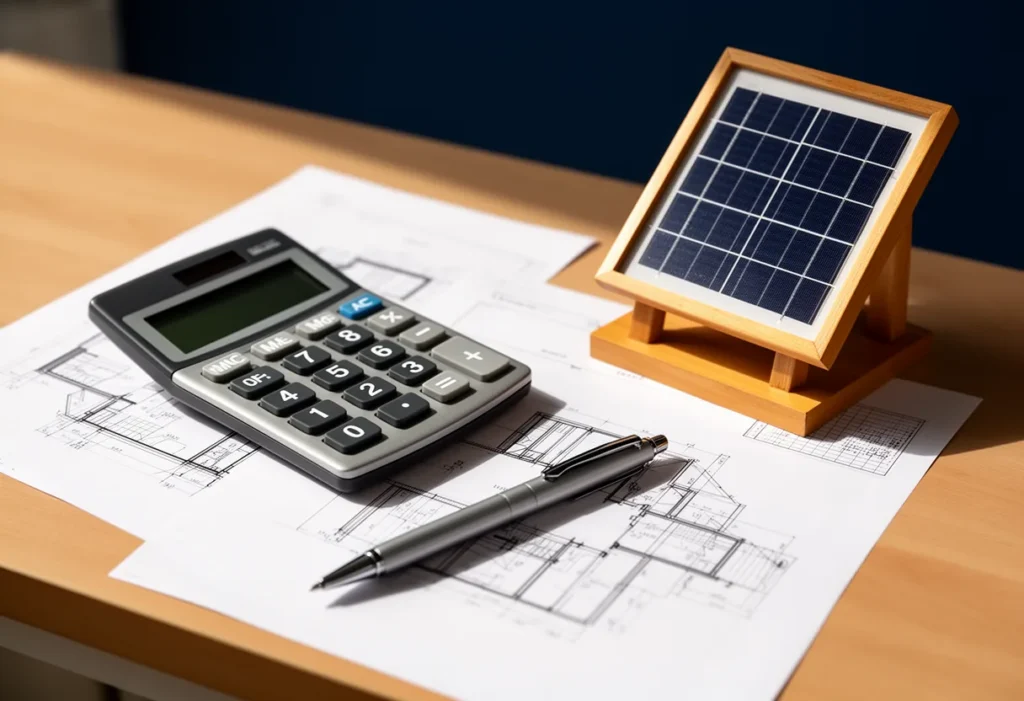
Most New York homeowners start with one question: what does a rooftop system actually cost here, before anyone talks about savings. The honest answer is that solar panel cost in NY is a range, and it is wide enough that one quote can be half again as much as a neighbour’s without either being unreasonable.
What makes the number knowable is that a solar price is assembled from a short list of components, each moving for reasons you can check. Below is what those components are, what the incentives now do to them, and which variables are worth arguing about.
Solar panel cost in NY is quoted per watt, not per panel
Residential solar is priced in dollars per watt of direct-current capacity. The installer multiplies the system size, in watts, by a price per watt to reach the gross contract price. Panels, inverters, racking, labour, permits, overhead and margin are all folded into that one figure.
This is why comparing panel counts misleads. Fewer high-output modules and more moderate ones can land at the same capacity and a similar price. Capacity and price per watt are the comparable numbers; panel count is downstream of both.
It also explains why small systems look expensive. Design, permitting, interconnection paperwork and the crew’s travel do not shrink much when the array does, so those fixed costs are spread across fewer watts. The article on how cost scales with system size works through that arithmetic.
Solar panels for sale and an installed system are two different purchases
Panels are sold as equipment, by the module or by the pallet, and those prices are a fraction of an installed price per watt. That gap is not a markup to negotiate away. It is the rest of the job: inverters, racking, wiring, a permit set, a licensed crew, inspection and the utility interconnection.
Buying the hardware yourself changes more than the invoice. The NY-Sun incentive, when NYSERDA has a residential block open, is paid only through a participating contractor, so an owner-supplied or self-installed array would forfeit it. Interconnection still requires a licensed electrician, a permit and utility approval before anything can be energised. And many manufacturer warranties condition coverage on installation by a qualified installer, so read the warranty document before assuming it survives.
Equipment pricing is still worth knowing, because it tells you how much of a quote is hardware. Convert any proposal to dollars per watt of capacity before setting it beside an online panel price, which is a different unit entirely.
The federal 30% credit is gone for people who buy
This is the biggest change to New York solar economics in years, and much of the material online has not caught up with it. The federal residential clean energy credit under section 25D of the Internal Revenue Code has terminated: the One Big Beautiful Bill Act, signed on 4 July 2025, moved its end date to 31 December 2025. A homeowner who buys a system, with cash or a loan, and whose original installation is completed after that date claims nothing for it on their federal return. There is no phase-down and no transition relief for projects that ran late.
The test is completion of the installation, not the date the system is placed in service. A system finished in December 2025 but energised by the utility in January 2026 therefore falls under the old rules — a distinction worth getting right before assuming you missed the deadline. Unused credit from a 2025 installation can generally be carried forward, so it is worth raising with whoever prepares your return.
Separately, a business-side credit still exists for the company that owns a leased or third-party-owned system, which is why some lease and power purchase offers still price an incentive into the deal — one the homeowner never claims directly.
Check the date on any quote that shows 30%
If a proposal includes a federal tax credit line for a system that will be installed now, the arithmetic behind the whole proposal is wrong, not only that line. Ask for a revised version with the federal line removed before you compare it against anything else.
NY-Sun currently takes nothing off a home’s contract price
NYSERDA’s NY-Sun programme has paid a per-watt incentive for residential systems, paid to the participating contractor rather than to you and shown on a compliant quote as a deduction on the contract, so the figure you were asked to finance was already net of it. As of September 2026 NYSERDA has no open NY-Sun block for homes in any utility territory; check NYSERDA’s NY-Sun dashboard for a new one. Until one opens, a residential quote should carry no NY-Sun deduction at all.
The rate was never fixed statewide or over time. NY-Sun is organised into regional megawatt blocks, broadly Upstate, Con Edison territory and Long Island, and as each block filled with committed projects the incentive generally stepped down to the next level until the standard residential blocks ran out: Con Edison’s last one closed on 29 May 2025, Upstate’s on 17 December 2025 and Long Island’s on 17 April 2016, and the income-qualified Residential Affordable Solar blocks that followed closed on 15 October 2025 (Con Edison) and 9 March 2026 (Upstate). If NYSERDA opens a new one, the rate that applies is the one current in your region when your project is registered, not the one quoted to you weeks earlier. The megawatt block explainer covers how the steps work.
The state credit reduces your tax bill, not your invoice
New York’s solar energy system equipment credit is a personal income tax credit claimed on Form IT-255, calculated as a percentage of qualified expenditure subject to a statutory cap. It can apply to purchased systems as well as to certain lease and power purchase arrangements.
Because it is claimed on a return, it arrives months after installation, and only to the extent you have New York tax liability, with any balance generally carried forward. Confirm the current percentage, cap and carryforward rules with the New York State Department of Taxation and Finance before building them into a budget. The page on the state equipment credit sets out how the form fits into a return.
New York City has its own abatement and its own costs
City properties can also claim a solar property tax abatement, filed with the Department of Buildings and applied against the property tax bill in four annual instalments rather than paid out as cash. It is a real reduction, but slow, and it only helps a property with a tax liability to abate.
City installations also start from a higher base: professional DOB filings, roof access on a dense street, sidewalk protection and Con Edison interconnection all add cost a detached upstate house never incurs. The breakdown of NYC-specific pricing goes through each of those.
| Programme | Administered by | How you receive it | Timing |
|---|---|---|---|
| NY-Sun incentive | NYSERDA, through your contractor | Deducted from the contract price when a residential block is open; none is open as of September 2026 | Before you pay anything, if a new block opens |
| State equipment credit | NYS Department of Taxation and Finance | Credit on your income tax return, Form IT-255 | When you file for the installation year |
| NYC property tax abatement | NYC Department of Buildings | Reduction applied to the property tax bill | Four annual instalments after approval |
| Federal section 25D credit | Internal Revenue Service | Not available to buyers for installations completed after 31 December 2025 | Ended 31 December 2025 |
The variables that actually move your quote
Roof geometry comes first. A simple south-facing plane with clear runs is cheap to work on; multiple small planes, dormers, valleys, skylights and vent stacks all add racking, labour and design time for the same number of watts.
Electrical service comes second. If your service panel has no room for a solar breaker, or the busbar rating will not allow the interconnection, a panel upgrade is added work with its own permit and utility coordination. Then comes the roof itself: slate and tile are slower and riskier to penetrate than asphalt shingle, and a roof near the end of its life should be replaced before panels go on. Equipment tier and battery storage move the total as well, though a battery is best priced on its own terms.
Ask for three numbers in writing
System size in watts, gross price, and price per watt after any NY-Sun deduction, which should be none while NYSERDA has no residential block open. With those three figures from each installer you can compare quotes on one line instead of reading through four different proposal formats. The guide to comparing New York solar quotes lists what else to request.
Frequently asked questions
Can I buy solar panels in New York and install them myself?
You can buy the equipment, but the installation still needs a permit, a licensed electrician for the interconnection and utility approval before it can be energised. NY-Sun, when a residential block is open, is paid only through a participating contractor, so a self-installed array would forfeit it (as of September 2026 no residential block is open), and many manufacturer warranties require installation by a qualified installer. Check the warranty terms and your local permitting requirements before buying hardware.
Can I still claim a 30% federal tax credit on solar in New York?
Not if you buy the system. The federal residential credit under section 25D ended for expenditures made after 31 December 2025, and an expenditure counts as made when the original installation is completed rather than when the system is placed in service. A system finished in December 2025 but switched on in January 2026 therefore still falls under the old rules. A separate business credit may still apply to a company that owns a leased or PPA system.
Why do two quotes for the same system size differ so much?
Usually because of scope rather than greed. One quote may include a service panel upgrade, roof work, tree trimming or a battery that the other excludes, and the two may assume different equipment tiers. Compare price per watt alongside a written list of inclusions and exclusions.
Verify current figures before you commit
NY-Sun residential blocks open and close by region, with none open as of September 2026, and the state credit percentage and cap are set in statute and can change. Confirm the incentive with NYSERDA, the tax credit with the New York State Department of Taxation and Finance, and the abatement with the NYC Department of Buildings before relying on any number in a proposal.
This article is general information, not tax, legal or financial advice. Incentive amounts, eligibility rules and deadlines change and depend on your utility, your tax situation and your property. Confirm current terms with NYSERDA, your utility and a qualified tax professional before making a decision.
NY Solar Incentives
Independent New York solar research. We summarise NYSERDA, NY-Sun and federal programme rules from published sources and state plainly when a figure is an estimate. We are not a government agency and do not sell equipment.
Run the arithmetic on your own system
Check the dated program table and your arrangement before counting an incentive. Standard residential NY-Sun blocks are closed; Long Island Affordable Solar has a conditional income-verification route. The NY credit depends on qualified costs and tax liability, while the NYC abatement reduces future property-tax bills. The estimator keeps those timings separate.