The NYSEG Solar Interconnection Application
NYSEG's rural feeders are where interconnection applications hit limits. Here is what the process involves and the two questions to settle before signing.
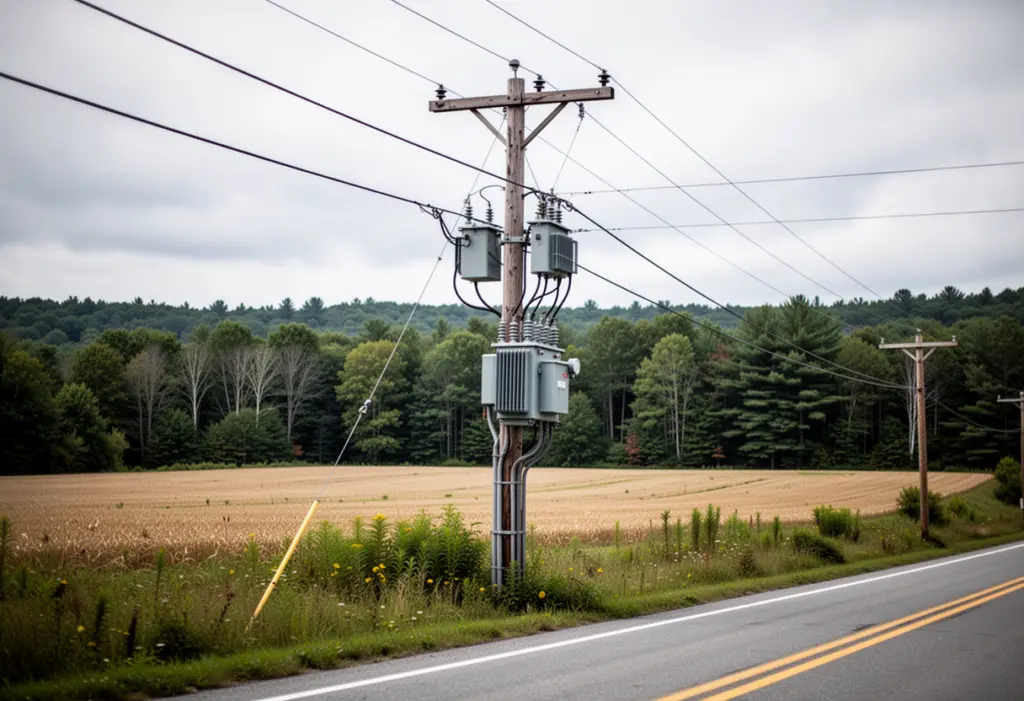
The interconnection application decides whether your solar project happens on schedule, and on NYSEG it is more likely to produce a surprise than on most New York utilities. The reason is geography.
What it is
An interconnection application is a formal request to connect a generator to NYSEG’s distribution network. NYSEG has to establish that your system can export onto your circuit without causing voltage or protection problems for everyone else connected to it. For a standard residential rooftop system that is normally straightforward.
It stops being straightforward when the circuit already carries a lot of distributed generation — and NYSEG’s territory has a great deal of that on long rural feeders that were never built with export in mind.
Why NYSEG is different
NYSEG serves a scattered territory: much of the Southern Tier, parts of the Finger Lakes, pockets of the Hudson Valley, stretches of the North Country. A lot of it is rural, which means long feeders serving relatively few customers, and a lot of it has seen significant solar development, both residential and commercial.
Hosting capacity — how much additional generation a given circuit can accept — is therefore a live question here in a way it is not in a dense suburban territory. An application can come back requiring a study, or requiring a distribution upgrade before the system can be accepted.
Ask your installer whether they checked NYSEG’s hosting capacity information for your specific circuit before designing the system. It is the single most useful question you can ask at the quoting stage in this territory, and it costs one sentence.
The sequence
- Application submitted with the system design, inverter specification and your account details. Your installer files it; you remain the customer of record.
- Screening. NYSEG checks the proposal against the capacity and characteristics of your circuit.
- Approval to install — permission to build, not permission to run.
- Installation, then municipal electrical inspection.
- Certificate filed with NYSEG, which then exchanges or reprograms the meter.
- Permission to operate. Only now may the system be energised.
Running the system before permission to operate puts the interconnection agreement and the net-metering arrangement at risk, and puts power onto a network whose operator has no record of it.
Two things to settle in writing before you sign
When the application will be filed. Best practice is before installation, so that an unexpected screening result arrives before your roof has been drilled.
What happens if a study or an upgrade is required. Specifically: what happens to your deposit, whether you can cancel without penalty, and who pays for any distribution work. In NYSEG territory this is not a hypothetical clause — it is the scenario the territory produces most often.
What you get at the end
Phase One net metering, crediting exported kilowatt-hours at the full retail rate, held for 20 years from interconnection. And a new line on your bill: the Customer Benefit Contribution, charged monthly on the DC size of your system at NYSEG’s 2026 residential rate of $1.19 per kW-month — about $114 a year on an 8 kW system. That charge is recalculated annually rather than fixed.
What to have ready
- Your NYSEG account number and the service address exactly as NYSEG holds it. A mismatch here can leave a file sitting unresolved with nobody flagging it.
- Twelve months of usage history, which you should have obtained for sizing anyway.
- Confirmation of who owns the property, and written landlord consent if you do not.
Where the delay usually is
Even in NYSEG territory, most project delay is municipal rather than utility: the building permit, then the electrical inspection and any re-inspection, then the handoff of the inspection certificate — which depends on your installer’s paperwork discipline rather than on any queue. Asking for a copy of the certificate and the date it was submitted resolves a surprising share of stalled projects.
Frequently Asked Questions
Can NYSEG refuse a solar interconnection?
An application can come back requiring a study or a distribution upgrade where a circuit already carries substantial distributed generation, which is more common on NYSEG's long rural feeders than in dense suburban territories. Ask your installer to check hosting capacity for your circuit before designing.
Who files the NYSEG interconnection application?
Your installer, in essentially every residential case. You remain the customer of record, so agree in writing when it will be filed and what happens to your deposit if a study or upgrade is required.
How long does NYSEG take to grant permission to operate?
It varies by area and season. Most project delay is municipal rather than utility — permit, inspection and the handoff of the inspection certificate — so ask your installer for a current range across the whole chain in your town.
What is the NYSEG solar charge after interconnection?
The Customer Benefit Contribution, at NYSEG's 2026 residential rate of $1.19 per kW-month of DC system size — about $114 a year for an 8 kW system. It is billed on capacity regardless of production and recalculated annually.
This article is general information, not tax, legal or financial advice. Incentive amounts, eligibility rules and deadlines change and depend on your utility, your tax situation and your property. Confirm current terms with NYSERDA, your utility and a qualified tax professional before making a decision.
NY Solar Incentives
Independent New York solar research. We summarise NYSERDA, NY-Sun and federal programme rules from published sources and state plainly when a figure is an estimate. We are not a government agency and do not sell equipment.
Run the arithmetic on your own system
Check the dated program table and your arrangement before counting an incentive. Standard residential NY-Sun blocks are closed; Long Island Affordable Solar has a conditional income-verification route. The NY credit depends on qualified costs and tax liability, while the NYC abatement reduces future property-tax bills. The estimator keeps those timings separate.