Charger in a Shared Garage: Who Approves It and Who Pays
In a shared garage the wiring is the easy part. Ownership of the space, the meter the energy lands on and the building's spare capacity are what decide the outcome.
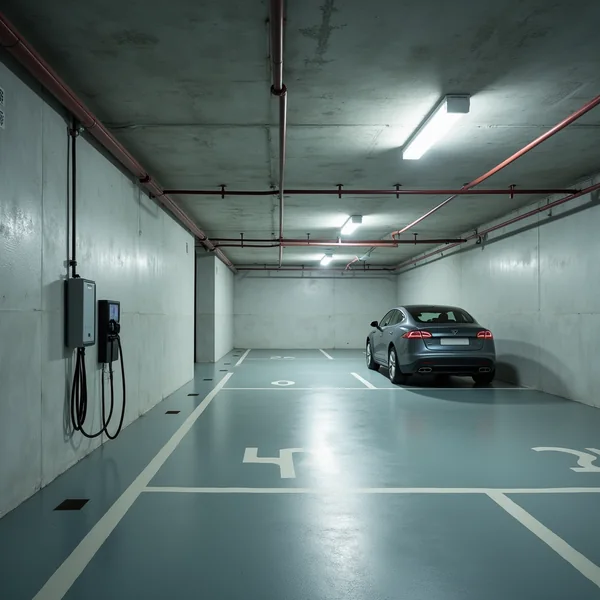
How approvals, metering and electrical capacity actually decide whether a charger can go into a garage you share with other residents.
A private driveway makes the electric-vehicle question simple: pick a spot on the wall, run a circuit, plug in. A shared garage turns the same job into a negotiation. The wall belongs to somebody else, the panel that would feed the circuit may belong to a third party, and the electricity is almost certainly billed to a meter with other people’s names on it.
None of that makes the project impossible. It changes the order of operations: in a shared garage the electrical work is the straightforward part, and the governance and the metering are what take the months.
What it takes to put a charger in a shared garage
Start with who owns the wire, not who owns the parking space
Your space and the electricity that would reach it are two separate property questions with two different answers. You may hold a deeded space, one assigned by house rule, or a license the building can move at will. Independently, the nearest usable power might be your own apartment panel, a house panel serving common areas, or a separate service kept for the garage. Three facts are worth writing down before any conversation begins:
- Your legal interest in the space — deeded, assigned by rule, or month to month.
- The nearest panel with spare capacity, and whose meter sits upstream of it.
- The route a conduit would follow from that panel to your space, and whose ceiling, wall or slab it crosses.
A licensed electrician answers the second and third in one site visit. The first lives in your lease, your proprietary lease, or the condominium declaration and bylaws — and it is the one people skip.
Four ownership shapes, and what changes in each
A rental building
The landlord owns the wiring, the panel, the wall and the conduit route, and the equipment you pay for becomes part of the building the moment it is bolted to it. That asymmetry is the whole negotiation. Tenants who get a yes usually get it by proposing something the owner can reuse: a mounted unit on a common circuit with access control, rather than a private circuit fed from one apartment. Who benefits from an owner-funded energy upgrade is the same question raised by a landlord installing solar on a rented building.
A condominium
Garage areas are normally common elements, or limited common elements assigned to particular units. Either way the board controls alterations to them, so the route is an alteration application rather than a request: stamped drawings, a licensed and insured contractor, an agreement that you carry the maintenance obligation, and language about what happens if you sell. The decision structure is the one in how a condo building decides on a rooftop energy project.
A co-op
You hold shares and a proprietary lease rather than real property, so board discretion is wider. Co-op boards ask a different question from condo boards: not whether the work is safe, but what precedent it sets and what it does to the building’s electrical headroom. An alteration agreement, an engineer’s letter and a certificate of insurance naming the corporation are the usual package. The co-op board approval process runs the same way for any equipment on shared infrastructure.
A two-family house or a shared driveway
The smallest arrangement is often the most awkward, because there is no written process to follow. Two households sharing a bay and one service have to settle where the energy is billed before anything is installed, and a handshake is a poor instrument for an appliance that runs nightly for a decade.
Where the electricity comes from, and who pays for it
This single question decides most of the rest. Four arrangements come up repeatedly, differing in what has to be installed and, more importantly, in how a disagreement gets settled two years later.
| Arrangement | How the energy is billed | What it needs | Where it tends to break down |
|---|---|---|---|
| Circuit from your own apartment panel | Lands on your account automatically | A long conduit run, plus spare capacity in your panel | The run is impossible, or crosses too much common area |
| Networked charger on the house meter | The unit records each session and bills the driver | Connectivity in the garage, a subscription, a billing arrangement | Coverage below grade; the subscription nobody budgeted for |
| Submeter on a common circuit | The building reads it and rebills you | A submeter, and somebody willing to read and invoice it | Administrative fatigue — the reading stops after a few months |
| Flat monthly amount to the building | Estimated, never measured | Nothing but an agreement | Right for one driving pattern, wrong for every other |
Buildings expecting a second driver usually skip straight to the networked option, because it is the only one of the four that scales without somebody doing arithmetic every month.
Whether the building actually has the capacity
A shared garage is fed from a service sized for lighting, a door operator, maybe a sump pump and a fan. Adding continuous loads is not automatically fine, and the answer comes from a load calculation rather than from anyone’s judgment about how the panel looks.
Three things get checked: whether the panel has space for a two-pole breaker, whether the feeder and service can carry the new continuous load on top of the existing one, and whether the supply is single-phase or three-phase. Larger New York multi-family buildings are commonly three-phase, and equipment selection follows from that rather than the other way round.
When the calculation comes back short, the choice is between upgrading the service and managing the load. Load management is usually cheaper and faster: the equipment is told the maximum current available and throttles itself, or several units share a circuit and coordinate so only one draws full current at a time. A car parked overnight does not care whether it charged at full rate, only whether it is full by morning. When an upgrade is unavoidable it looks like the panel upgrade other electrification projects trigger.
Permits, inspection and the fire-code side
Charging equipment is a permanent electrical installation, so it needs a permit pulled by a licensed electrician and an inspection afterwards. In New York City that means a licensed master or special electrician and a filing with the buildings department; elsewhere in the state it runs through the local code enforcement office and an electrical inspection agency. The certificate is what your board or landlord wants in the file, and what an insurer asks for after any incident. Enclosed parking attracts extra scrutiny too — mounting height, protection from vehicle impact, cable management, clearances. Having those answers ready shortens the approval.
Mounting, cable and the winter question
The work itself is a conduit run, a breaker, a mounted unit and a cable. Wall-mounting is simpler where a wall exists at the head of the space; a pedestal is the fallback and costs more. Cold matters less than people expect: a garage keeps equipment out of ice and snow, and it is the vehicle’s battery conditioning that changes with temperature, not the hardware — the pattern behind cold weather and home battery performance.
Programs that may pay for part of the work
New York utilities operate make-ready programs covering part of the infrastructure cost at multi-unit sites, and state programs sit alongside them. Structurally these address the wiring up to the equipment rather than the equipment itself, and they are applied for by the building or its contractor rather than by a resident — an argument for routing your request through the building. Do not rely on any figure you read for what such a program pays; amounts, eligibility and funding windows change on their own schedule. Ask your utility and get the answer in writing.
If the answer is no, at least for now
A refusal is often about precedent rather than about you, so it is worth revisiting once the building has a written policy. Meanwhile a standard outlet in the garage, where one exists and its use is permitted, covers a surprising amount of ordinary overnight driving. If the building also has roof access and an interest in generation, the two conversations combine usefully — the relationship is set out in EV charging and solar panels in New York.
The pattern that gets approvals is consistent: a load calculation, a licensed electrician, a metering arrangement that creates no work for the managing agent, and a proposal that anticipates the next resident who will ask. Buildings say no to vague requests and yes to specific ones.
Frequently Asked Questions
Can a condo or co-op board refuse an EV charger outright?
A board controls alterations to common elements and to shared electrical infrastructure, so it can decline a specific proposal. What moves the decision is usually a complete application: a load calculation, a licensed electrician, a metering method that creates no ongoing work for the managing agent, and an alteration agreement that keeps maintenance and liability with the resident.
Who pays for the electricity if the charger is on a common circuit?
Whoever the meter belongs to pays the utility, so the arrangement has to send that cost back to the driver. The three workable methods are a networked charger that bills each session, a submeter the building reads and rebills, or a flat monthly amount. The flat amount is the simplest and ages the worst as more residents plug in.
Can I run a circuit from my own apartment panel down to the garage?
Electrically it is the cleanest answer, because the energy lands on your own account with no rebilling at all. Practically it depends on whether a conduit route exists and how much common area it crosses. In a small building it is often feasible; in a large one the run is usually too long or crosses too many other units’ space to be approved.
Does a shared garage need a service upgrade for charging?
Not necessarily. A load calculation decides it, and where capacity is tight the usual answer is load management rather than a bigger service: the equipment is configured to a maximum available current, or several units share a circuit and coordinate. A vehicle parked overnight does not care whether it charged at full rate.
What permits does a garage charger need in New York?
It is a permanent electrical installation, so a licensed electrician pulls an electrical permit and the work is inspected afterwards. In New York City that means a licensed master or special electrician and a filing with the buildings department. Elsewhere in the state it runs through the local code enforcement office and an electrical inspection agency.
Are there programs that help pay for charging infrastructure in a multi-unit building?
New York utilities run make-ready programs for multi-unit and commercial sites, and state programs sit alongside them. They generally address the wiring up to the equipment rather than the equipment itself, and they are typically applied for by the building or its contractor. Confirm current terms and funding status with your utility before budgeting anything.
Is a wall-mounted unit better than a pedestal in a shared garage?
Where a wall exists at the head of the space, wall-mounting is simpler, cheaper and easier to protect from vehicle impact. A pedestal is the fallback for spaces with no adjacent wall and costs more because it needs a base and a longer conduit run. Either way, cable management matters more than people expect in a shared drive aisle.
NY Solar Incentives
Independent New York solar research. We summarise NYSERDA, NY-Sun and federal programme rules from published sources and state plainly when a figure is an estimate. We are not a government agency and do not sell equipment.
Run the arithmetic on your own system
Check the dated program table and your arrangement before counting an incentive. Standard residential NY-Sun blocks are closed; Long Island Affordable Solar has a conditional income-verification route. The NY credit depends on qualified costs and tax liability, while the NYC abatement reduces future property-tax bills. The estimator keeps those timings separate.