Can My Landlord Install Solar and Raise the Rent?
Panels on the roof of a building you rent do not decide your rent. Your lease and your regulatory status do — and the first question worth asking is which meter the array is actually wired to.
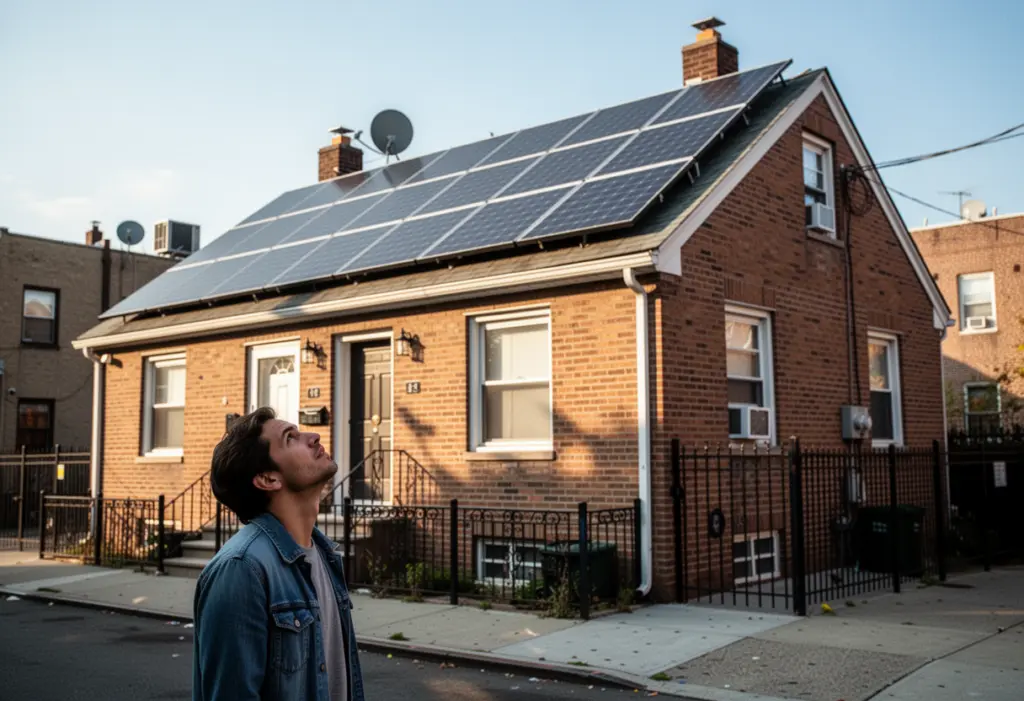
A building owner can install solar on a building they own. Whether your rent can change because of it is a separate question, and the panels are not what answers it — your lease and your regulatory status are. Before worrying about either, though, there is a more basic question that most tenants never ask, and it changes the whole conversation.
First: which meter does the array feed?
An array is wired to an account. In a building where every apartment has its own meter, a rooftop system is very often connected to the house account — hallway lighting, the boiler controls, the elevator, the laundry room. If that is your building, the solar reduces the owner common area electricity cost and it does not touch your bill at all, because your meter is a different customer of the utility.
In a master metered building, where the owner buys all the electricity and recovers it through the rent, the saving lands on the owner side of the ledger for the same reason.
So ask the owner or the managing agent directly: which account is the system connected to, and does any of the generation reach individual apartment meters. That answer, in writing, tells you whether there is anything here for you at all.
What decides whether the rent can move
Two documents, in this order.
Your lease. What does it say about increases, about pass through charges, and about improvements to the building. A charge that is not provided for in the lease is not a charge because somebody installed equipment.
Your regulatory status. If your apartment is rent regulated, increases are governed by state rules and by the agency that administers them, not by the owner judgement about what an improvement was worth. If you are unsure whether your unit is regulated, that is the first thing to establish, and it is a question for the state agency and for a tenant advice service rather than for the owner alone. Do not accept a rent increase framed as a consequence of a solar installation without checking what your status permits.
None of that is solar law. It is landlord and tenant law, and solar is simply the improvement that raised the question this time.
What is worth asking for
- Whether anything about your occupancy changes — roof access, storage areas, laundry, or scaffolding and noise during installation.
- Whether any charge is proposed, under which clause of your lease, and starting when.
- Whether the building is applying for a shared arrangement that allocates credits to tenant accounts, which some multifamily projects are structured around. If it is, ask what your allocation would be and what it would cost you.
- Whether the owner is claiming an incentive that assumes tenant benefit, and if so, what form that benefit takes on your bill.
What you can do that does not depend on the owner
If the account is in your name, community solar is available to you independently. It needs no roof, no equipment at the property and no permission from the owner, because nothing is installed and nothing is attached to the building. The credits are allocated to your utility account and you pay a project sponsor for them at a discount. If the electricity is included in your rent, that route is closed too, for the same reason the rooftop one is: there is no account of yours for credits to land on.
The owner economics, which explain the behaviour
It is worth knowing what the owner is and is not getting, because it explains why an array appears on a building at all.
The New York State credit on Form IT-255 — 25% capped at $5,000 — requires the equipment to be installed and used at the taxpayer principal residence in New York. A rental property is not that, and neither is a second or seasonal home. An owner who does not live in the building is not claiming it.
What an owner can look at instead is the state sales tax exemption on equipment and RPTL 487, which exempts the added assessed value from real property tax for 15 years where the municipality, the county and the school district have each not opted out and where construction happens before 1 January 2030. NY-Sun, applied by the contractor as a reduction on the price, counts only where NYSERDA has a block open for that kind of building: as of September 2026 NYSERDA has no open NY-Sun block for homes in any utility territory, and only non-residential blocks are open, so check NYSERDA’s NY-Sun dashboard. Business and rental property tax treatment is a different provision entirely from the residential credit, and it belongs with an accountant rather than with a rule of thumb.
Running against all of that is the Customer Benefit Contribution, charged monthly on the DC size of a system interconnected on or after 1 January 2022, regardless of what it produces. At the NYSEG residential rate a 12 kW array is 12 × $1.19, about $14.28 a month or $171 a year — but the house account of a multifamily building is often a commercial account, where a separate small commercial rate applies, and a commercial account carrying a demand charge is outside the contribution altogether. Ask which rate the utility is applying to the account the array actually feeds. And the federal residential credit is not part of anybody arithmetic in 2026: section 25D was terminated for expenditures made after 31 December 2025, on the test of when the original installation is completed. Confirm current programme terms with NYSERDA, and confirm your own utility from your own bill.
Frequently Asked Questions
Can my landlord raise my rent because of solar panels?
That is answered by your lease and by whether your apartment is rent regulated, not by the panels. A charge not provided for in the lease is not created by an improvement, and regulated units are governed by state rules.
Will rooftop solar lower my electricity bill as a tenant?
Often not. In individually metered buildings the array is frequently wired to the house account for common area loads, which is a different utility customer from you. Ask which account the system feeds, in writing.
Can I get solar benefits without my landlord?
Yes, through community solar, provided the electricity account is in your own name. Nothing is installed at the property and no permission is needed. If electricity is included in your rent, that route is closed too.
Does my landlord get the New York State solar credit?
Not for a building they do not live in. The Form IT-255 credit requires equipment at the taxpayer principal residence in New York. Owners look instead at the sales tax exemption and the RPTL 487 exemption; NY-Sun has no open block for homes as of September 2026.
This article is general information, not tax, legal or financial advice. Incentive amounts, eligibility rules and deadlines change and depend on your utility, your tax situation and your property. Confirm current terms with NYSERDA, your utility and a qualified tax professional before making a decision.
NY Solar Incentives
Independent New York solar research. We summarise NYSERDA, NY-Sun and federal programme rules from published sources and state plainly when a figure is an estimate. We are not a government agency and do not sell equipment.
Run the arithmetic on your own system
Check the dated program table and your arrangement before counting an incentive. Standard residential NY-Sun blocks are closed; Long Island Affordable Solar has a conditional income-verification route. The NY credit depends on qualified costs and tax liability, while the NYC abatement reduces future property-tax bills. The estimator keeps those timings separate.