Cold Weather and Home Battery Performance in New York
A battery in an unheated Watertown garage and one in a heated Brooklyn basement are not the same product decision. Here is why.
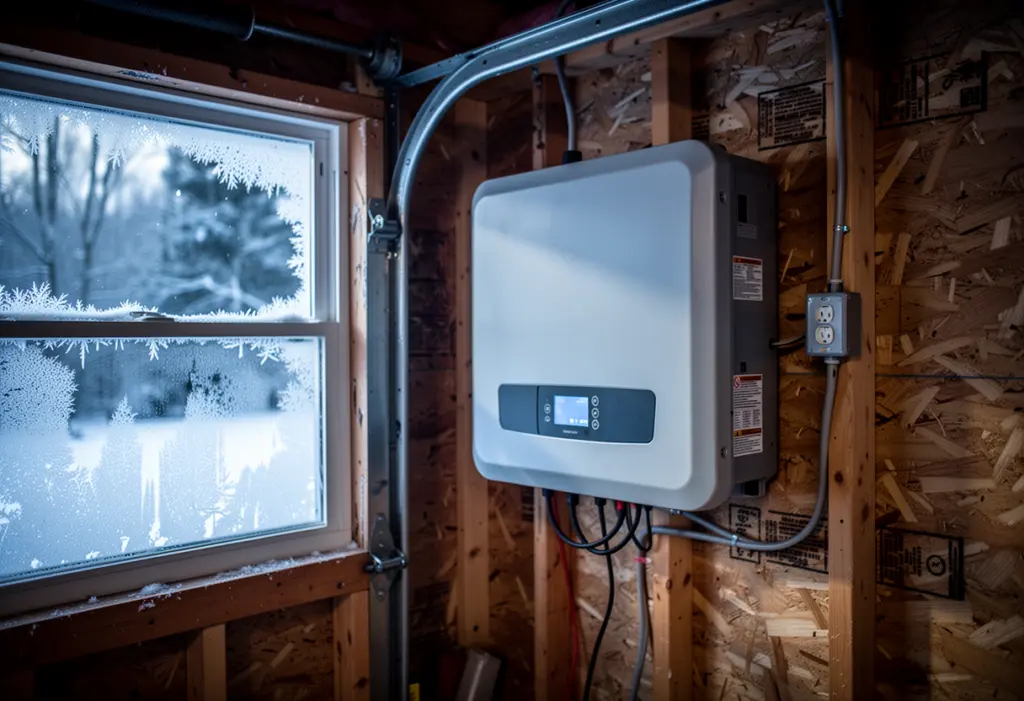
Home batteries lose usable capacity in the cold, and New York gets cold. It is not a reason to avoid storage — it is a reason to be specific about where the unit goes and what it is rated for, because the answer differs enormously between a heated basement in Brooklyn and an unheated garage in Watertown.
What cold actually does
Two separate effects, and they are worth separating because they have different consequences.
Reduced usable capacity. Lithium chemistry delivers less of its rated energy at low temperatures. A battery that runs your critical loads for a comfortable stretch in October will run them for less in January — which is precisely when you are most likely to need it.
Charging limits. Many lithium batteries must not be charged below a certain temperature at all. A unit that gets too cold may accept no charge until it warms, which matters if solar is meant to refill it during a multi-day winter outage.
Thermal management is the specification that matters
Batteries designed for outdoor or unheated installation generally include heating, so the cells stay within their working range using a small amount of stored energy. Units intended for conditioned indoor space frequently do not.
So the two questions to ask, and to get answered in writing, are:
- What is the rated operating temperature range, for discharge and separately for charge?
- Does the unit heat itself, and where does that energy come from?
A battery that heats itself uses some of its own capacity to do so, which is a real and reasonable trade — but it means a cold-weather runtime figure is lower than the datasheet headline, and you should be given the cold figure rather than the laboratory one.
Where it goes decides the answer
- Heated basement or utility room. The kindest environment, and cold performance is largely a non-issue. Subject to the fire code requirements on separation from habitable space, which your municipality applies.
- Attached garage. The commonest New York location. Cold but not extreme, and usually well within a modern unit’s range.
- Detached garage or outbuilding. Colder, and often the least constrained by code — but the temperature rating genuinely matters.
- Exterior wall. Fully exposed to a New York winter. Only for units rated for it, with thermal management.
Note that location is not purely your preference: fire code requirements govern where a battery may be installed, clearances around it and separation from living space, and New York City is stricter than the rest of the state.
The interaction people miss
Winter is when a battery is most likely to be needed and least likely to be refilled. Solar production in a New York January is a fraction of July’s, and a snow-covered array produces nothing at all — the outage that follows an ice storm is exactly the outage during which your panels are under ice.
So a battery sized on the assumption that solar tops it up daily is being sized on a summer assumption. Ask for the winter case explicitly: how long does this run my critical loads in January, with no solar contribution and at the cold-weather capacity?
That is the number that matters, and it is not the number on the brochure.
Practical points
- Get the rated temperature range for charge and discharge separately.
- Ask whether the unit heats itself and what that costs in capacity.
- Ask for a runtime estimate in January conditions with no solar input.
- Confirm the proposed location is both code-compliant and within the unit’s rating — those are two different tests.
- If storm pre-charging from the grid is available, learn how to trigger it before winter.
Frequently Asked Questions
Do home batteries work in cold weather?
Yes, but with less usable capacity, and many lithium batteries must not be charged below a certain temperature at all. Units designed for outdoor or unheated installation generally include heating to keep the cells in range.
Where should a battery be installed in a cold climate?
A heated basement or utility room is kindest, an attached garage is the commonest New York location and usually fine, and an exterior wall requires a unit rated for full exposure with thermal management. Fire code also governs location, and New York City is stricter.
How long will a battery last in a January outage?
Less than the datasheet figure, because cold reduces usable capacity and a snow-covered array contributes nothing. Ask specifically for a runtime estimate in January conditions with no solar input — that is the number that matters.
Does a self-heating battery use its own stored energy?
Yes, and that is a reasonable trade for staying in the working range. It does mean the cold-weather runtime is lower than the headline capacity suggests, so ask for the cold figure rather than the laboratory one.
This article is general information, not tax, legal or financial advice. Incentive amounts, eligibility rules and deadlines change and depend on your utility, your tax situation and your property. Confirm current terms with NYSERDA, your utility and a qualified tax professional before making a decision.
NY Solar Incentives
Independent New York solar research. We summarise NYSERDA, NY-Sun and federal programme rules from published sources and state plainly when a figure is an estimate. We are not a government agency and do not sell equipment.
Run the arithmetic on your own system
Check the dated program table and your arrangement before counting an incentive. Standard residential NY-Sun blocks are closed; Long Island Affordable Solar has a conditional income-verification route. The NY credit depends on qualified costs and tax liability, while the NYC abatement reduces future property-tax bills. The estimator keeps those timings separate.