Geothermal on a rocky lot: what bedrock changes about the loop
Bedrock conducts heat better than dry soil, so a rocky New York lot is rarely a thermal problem for a ground-source heat pump. It is a drilling, access and loop-design problem, and each one has an answer.
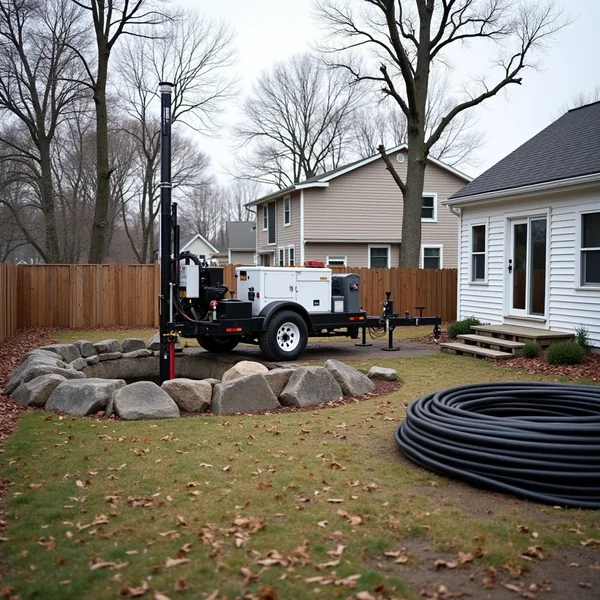
Why rock is usually a drilling problem rather than a thermal one, and which loop designs survive a New York lot with ledge in it.
The first thing a homeowner with ledge in the yard assumes is that geothermal is off the table. It is a reasonable assumption and it is usually wrong. Rock is not the obstacle people expect it to be for a ground-source heat pump — in thermal terms it is frequently better than the alternative. What rock changes is the drilling, the site access and the shape of the loop. That is a construction problem, not a physics problem.
What a rocky lot actually changes about a ground-source heat pump
A ground-source system does not burn anything and does not make heat. It moves heat between the house and the ground through a buried loop of fluid, using the ground as a reservoir that stays close to the local annual average temperature all year. How well the loop works depends on how readily the material around it conducts heat, and on how much of that material the loop can reach.
Rock conducts heat better than dry soil
This is the fact that reverses the intuition. Dry sand and loose fill are poor conductors: they are full of air, and air insulates. Saturated clay is better. Competent bedrock — including the dense metamorphic rock under much of New York City, Westchester, the Hudson Valley and the Highlands — conducts heat better still, and fractured rock carrying groundwater better again, because moving water carries heat away from the borehole rather than letting it pile up.
Higher conductivity means each foot of borehole exchanges more heat, so a loop field in rock can need less total drilled depth for the same capacity than the same field in dry sand. That does not make a rocky lot inexpensive, because drilling rock costs more per foot than drilling soil. It does mean the two effects push against each other, and it is why hitting rock is not the verdict on the project that homeowners fear.
The loop type is the decision rock actually forces
| Loop type | What a rocky lot does to it | What it needs on site | When it fits |
|---|---|---|---|
| Horizontal trench | Ruled out by shallow ledge | A large open yard and diggable soil | Deep soil, room to excavate |
| Compact horizontal (coiled) | Same problem, smaller footprint | Moderate yard, diggable soil | Deep soil, limited area |
| Vertical closed loop | More per foot, fewer feet needed | Rig access, modest surface area | Most rocky New York lots |
| Standing column well | Wants the rock, and water in it | One deep well plus a bleed route | Hard, water-bearing bedrock |
| Open loop, well to discharge | Depends on yield, not on hardness | Supply and discharge, plus permits | Good aquifer, lawful discharge |
| Pond or lake loop | Rock is irrelevant | A deep enough water body on site | Water that does not freeze through |
Horizontal loops are what rock really rules out
A horizontal loop is trenched a few feet down across a wide area. Where it fits it is the least expensive configuration, and shallow ledge ends it outright: you cannot trench rock at sensible cost, and if bedrock sits near the surface there is nowhere to lay pipe. This is the configuration a rocky lot most often eliminates, and it is a large part of why so many New York installations go vertical regardless of how much yard the owner has.
Vertical boreholes are the usual answer
A vertical closed loop is one or more boreholes with a pipe loop dropped down each and grouted in place. Drilling rock is slower per foot than drilling soil, but it is more stable: a competent rock bore generally holds its own walls, whereas soft overburden has to be cased off before the rig reaches rock at all. The equipment is normally an air-rotary or down-the-hole hammer rig rather than the auger used in soft ground, and that difference is where much of the cost sits.
Standing column wells suit New York bedrock
Where the rock is hard, deep and water-bearing, a standing column well can do the work of several closed boreholes. It is an open well drilled into bedrock: water is drawn from the bottom, passed through the heat exchanger and returned to the top of the same column, with a small bleed to a discharge point during extreme loads. Because the water itself moves heat, the required depth is far less than an equivalent closed field — exactly what you want when every foot is expensive. It also needs suitable water chemistry, a lawful discharge route and compliance with state well construction rules, so it is a design decision made with a driller and an engineer rather than a default.
What actually drives cost on a rocky site
- Rig time. Drilling is priced by the day and by the foot. Hard rock is slower, and slow is the expensive part.
- Overburden casing. Where soil sits on top of rock, steel casing has to be driven through it to keep the hole open and to protect groundwater. More overburden means more casing.
- Access. A drill rig is a truck. It needs a route wide enough and firm enough to reach the bore locations, clearance under trees and overhead lines, and somewhere to put cuttings and water. On a narrow lot this constraint decides the design.
- Grouting. The annulus around the pipe is filled with thermally enhanced grout, both to bond the loop to the rock and because state rules require the hole to be sealed against cross-contamination between water-bearing zones.
- Cuttings and water handling. Hammer drilling in rock produces wet rock flour that has to go somewhere, which on a small site is a real logistical line item.
Ledge at the surface is a different problem from rock at depth
These two situations look alike on a site visit and lead to different designs. Exposed ledge, or rock within a few feet of grade, removes horizontal loops and complicates the header trench — the pipework running from the boreholes back to the house still needs a trench below frost depth, and on a rocky lot that header is often the fussiest part of the job even when the boreholes themselves go smoothly.
Rock at depth under ordinary soil is closer to the ideal case: straightforward trenching for the header, and stable bore walls once the rig is through the overburden. Knowing which one you have changes the estimate more than almost anything else on the site.
When a rocky lot really does say no
- No access route a rig can use, and no way to create one without removing what the owner is trying to protect.
- Too little open ground to place boreholes with the separation they need — bores set too close thermally interfere with each other over a season.
- Ground conditions a driller will not work in, such as an unstable slope, known voids or contaminated groundwater.
- A local water-supply or aquifer protection rule that forbids the well type the design depends on.
In those cases the honest answer is an air-source heat pump instead. Cold-climate air-source equipment covers New York winters far better than its reputation suggests, and it removes the loop field from the budget and the schedule entirely.
How to find out before you commit money
Two inexpensive steps come before an expensive one. First, the state’s geological mapping and public well-log records will tell you roughly what is underneath the neighbourhood: depth to bedrock and rock type are mapped across New York, and nearby well completion reports are often available. Second, a driller who works your county has already drilled near you and knows what the rig will meet. On larger systems a formal thermal conductivity test on a pilot bore is worth paying for, because designing a loop field off an assumed conductivity is how a field ends up undersized and the house ends up on backup heat in February.
The rest of the project does not disappear
Ground-source heat pumps sit inside New York’s Clean Heat framework, and the incentive amounts, eligibility rules and stacking restrictions are revised over time — check the current figures on the program’s own pages and with your utility rather than trusting a number in an article. What that framework covers is set out in the NYS Clean Heat Program.
Whatever the loop ends up looking like, the indoor side still needs the electrical capacity to run compressors and circulating pumps, which is the same question solar raises: see when a project triggers an electrical panel upgrade in New York. If you are pairing the system with panels, sizing an array around a heat pump’s winter load is its own exercise, covered in heat pumps and solar in New York. And if the same rock makes a roof mount awkward, the trade-offs are laid out in ground mount or roof mount solar.
Frequently Asked Questions
Can you install geothermal on a lot with bedrock?
In most cases yes, using vertical boreholes rather than horizontal trenches. Bedrock is drilled routinely for water wells across New York, and the same rigs drill geothermal bores. The rock itself is not the obstacle; the obstacles are getting a rig onto the site and having enough open ground to space the bores properly.
Is rock better or worse than soil for a ground loop?
Thermally, competent rock is generally better than dry soil because it conducts heat more readily, and fractured rock carrying groundwater is better still. That means each foot of borehole does more work, so a field in rock can need less total depth. The offset is that drilling rock costs more per foot than drilling soil.
What is a standing column well?
An open well drilled into bedrock, where water is drawn from the bottom of the column, passed through the heat pump’s heat exchanger and returned to the top of the same well. Because the water moves heat itself, it needs far less drilled depth than a closed loop of the same capacity. It requires suitable water chemistry, a lawful bleed discharge and compliance with state well rules.
Does shallow ledge rule geothermal out completely?
It rules out horizontal trench loops, which are the configuration that needs diggable soil across a wide area. It does not rule out vertical boreholes or a standing column well. What shallow ledge does complicate is the header trench running from the bores back to the house, which still has to sit below frost depth.
How do I find out what is under my yard before paying for a design?
Start with New York’s geological mapping and public well completion records, which show depth to bedrock and rock type by area, and with neighbours’ well logs where they are available. Then ask a driller who works in your county what they typically encounter. On larger systems a thermal conductivity test on a pilot bore removes the remaining guesswork.
What happens if a driller cannot reach part of the yard?
The design changes rather than the project ending. Bores can be angled, relocated or concentrated into fewer deeper holes, and a standing column well can replace several closed bores where the geology allows. If no rig can reach the site at all, a cold-climate air-source heat pump is normally the alternative that gets recommended.
NY Solar Incentives
Independent New York solar research. We summarise NYSERDA, NY-Sun and federal programme rules from published sources and state plainly when a figure is an estimate. We are not a government agency and do not sell equipment.
Run the arithmetic on your own system
Check the dated program table and your arrangement before counting an incentive. Standard residential NY-Sun blocks are closed; Long Island Affordable Solar has a conditional income-verification route. The NY credit depends on qualified costs and tax liability, while the NYC abatement reduces future property-tax bills. The estimator keeps those timings separate.