The Utility Make Ready Program in New York, Explained
Make-ready pays for the wiring path, not the charger. Here is how New York organises that policy, which sites it is aimed at, and the step that really sets the schedule.
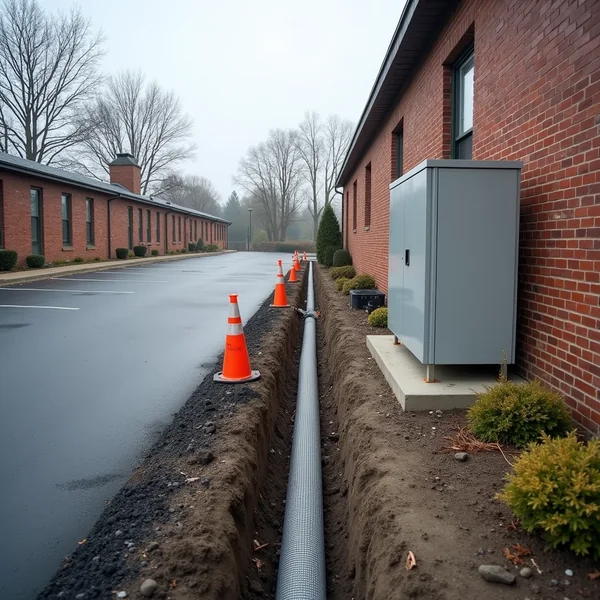
What make-ready money covers, where the utility side ends and yours begins, and why the capacity check – not the charger – sets your schedule.
What a utility make ready program actually pays for
The phrase sounds like jargon, and it is, but it names something concrete. A
utility make ready program pays for the electrical infrastructure
that has to exist before a charger can be bolted to a wall or a pedestal:
the transformer, the service, the conduit, the wire and the panel work that carry
power from the grid to a stub the charger will later connect to. It does not buy
the charger. That distinction is the whole design of the policy, and it is where
most misunderstandings about it begin.
The reasoning is that the expensive, slow, disruptive part of adding charging to
a parking lot or an apartment garage is rarely the equipment. It is the trenching,
the utility work at the property line and the capacity that may or may not be
available on the local circuit. Chargers are a product with a price you can look
up. Make-ready work is a construction project whose cost nobody can predict from a
catalogue, and that uncertainty is what stops sites from starting.
The two halves: utility side and customer side
Every make-ready scope divides at the meter. The utility side is
everything the utility owns and builds: capacity on the distribution circuit, a
new or upgraded transformer, the service run to the property, and the metering
arrangement. The customer side is everything past that point on private
property: the panel or switchgear, the conduit and conductors across the parking
area, the concrete bases and the stubs where chargers land.
Programs of this kind typically cover the utility side in full, because it is
the utility’s own asset, and cover a share of the customer side, because the
property owner keeps that asset and gets the benefit. The share is not fixed
forever, and it is exactly the kind of figure that changes between program years,
so treat any percentage you read anywhere — here included — as
something to confirm against your utility’s current program documents rather than
as a fact you can budget from.
Who pays for what
| Element | Whose side it sits on | How make-ready programs generally treat it |
|---|---|---|
| Distribution circuit capacity, transformer | Utility | Built and owned by the utility; the usual reason a program covers it fully |
| Service run to the property, metering | Utility | Utility scope, on the utility’s own construction standard |
| Switchgear, panel, protection on site | Customer | Cost-shared, with the owner contributing |
| Trenching, conduit, conductors across the lot | Customer | Cost-shared; usually the largest line on the customer side |
| Charger pedestals, bases, bollards | Customer | Sometimes eligible, sometimes not — check the current scope |
| The chargers themselves | Customer | Outside make-ready. Funded by other incentives, if at all |
| Networking fees, electricity, maintenance | Customer | Ongoing operating cost, never make-ready |
How New York’s version is organised
New York runs make-ready for electric vehicle charging as a regulated utility
program rather than as a grant fund. It was established through a proceeding at
the New York State Public Service Commission, which means the terms live in an
order and in tariff filings, the utilities administer it, and changes happen
through further orders rather than through a press release.
The investor-owned utilities each run their own version under that framework
— Con Edison, National Grid, NYSEG, RG&E, Central Hudson and Orange &
Rockland — and Long Island is administered separately through PSEG Long
Island. The practical consequence is that the application form, the queue, the
engineering review and the paperwork differ by territory even though the policy
behind them is common. If you have read your neighbour’s experience in a different
utility’s service area, treat it as background rather than as instructions.
Two structural features are worth knowing. First, programs of this design carry
an enhanced level of support for sites in disadvantaged communities, defined by
the state’s own criteria rather than by the utility’s judgement, so the same
project can qualify differently depending on where it sits. Second, the funding is
allocated in blocks per territory and per charger type, which means availability is
a queue, not an entitlement — a point covered in more detail in our piece on
EV charging alongside solar in New York.
Who can actually apply
Make-ready is aimed at sites with multiple charging positions: workplaces,
retail and municipal parking, fleet depots, multifamily buildings and public
fast-charging locations. A single-family house is not the audience, and this is the
most common disappointment. If you are wiring one charger in your own garage, the
route is a licensed electrician, a permit and whatever residential incentives your
utility currently offers — not this program.
Multifamily is the interesting middle case. A co-op board or a landlord with a
shared garage is exactly the kind of applicant the policy was designed for, and the
economics change completely when the trenching is cost-shared. The hard part there
is rarely eligibility; it is governance and metering, which is the same knot
described in our coverage of
battery storage in an apartment building and of
master-metered buildings.
How a project moves through it
The sequence is fairly consistent across territories, and understanding it is
what prevents the two expensive mistakes: buying chargers before capacity is
confirmed, and starting construction before the funding is reserved.
- Site assessment. How many positions, what power level, where
the electrical service already is and how far the conduit must run. - Capacity check with the utility. Whether the local circuit can
carry the load, or whether utility-side work is needed first. This step sets the
schedule more than anything else. - Application and reservation. Funding is committed to the
project before construction, not reimbursed on a hope afterwards. - Design and engineering review. The utility reviews the
customer-side design because it will interconnect with its system. - Construction, in two scopes. Utility crews build their side;
your electrical contractor builds yours, on a permit, inspected locally. - Energisation and closeout. Meter set, documentation filed, and
the cost-share settled against actual invoices rather than the estimate.
The step that surprises people is the second one. Where circuit capacity is
tight, the utility-side work has its own engineering and construction lead time,
and it is not something an eager contractor can accelerate. Building the schedule
around that constraint rather than around equipment delivery is the single most
useful thing an applicant can do.
What “make ready” means when it is not a program
The same phrase gets used loosely for any preparatory electrical work, and that
is a fair use of the words — a homeowner having conduit and a subpanel
installed now so a charger can be added later is genuinely making the site ready.
It is simply not the regulated program, and no cost-share attaches to it. If that
is your situation, the sequencing advice in
the right order to electrify a New York home and the
questions in when a project needs a panel upgrade are the
relevant material.
What to confirm before you count on it
Program terms, cost-share levels, eligible equipment and available funding all
change through regulatory filings, and older summaries circulate long after they
stop being true. Before a project depends on make-ready money, confirm four things
from primary sources: that the program is currently open in your utility’s
territory; what its present scope covers on the customer side; whether your site
qualifies for the enhanced disadvantaged-community treatment; and what the current
queue looks like. The utility’s own program pages and the Public Service Commission
docket are the sources that carry authority. A contractor’s summary, however
well-meant, is a secondary account of a document that may have been amended.
Frequently Asked Questions
Does a utility make ready program pay for the chargers themselves?
Generally no. Make-ready covers the electrical infrastructure up to the point where a charger connects – transformer, service, panel, conduit, conductors and often the mounting base. The charging equipment is funded separately if at all. Read the current scope for your utility before assuming a pedestal or a bollard is included, because that boundary has moved between program years.
Can a single-family homeowner in New York use the make ready program?
Not usually. The program is built for sites with multiple charging positions – workplaces, public and retail parking, fleet depots and multifamily buildings. A house with one charger goes the ordinary route: a licensed electrician, a permit, local inspection, and whatever residential incentive your utility currently offers.
Who administers make-ready in New York?
The investor-owned utilities administer it in their own territories under a framework established at the New York State Public Service Commission, and Long Island is handled separately through PSEG Long Island. The policy is common but the application forms, queues and engineering reviews differ by territory, so use your own utility’s material rather than a neighbouring one’s.
What is the difference between the utility side and the customer side?
The split falls at the meter. The utility side is distribution capacity, transformer, service run and metering, all of which the utility builds and owns. The customer side is switchgear, trenching, conduit and conductors on private property, which the owner keeps. Programs typically cover the utility side fully and cost-share the customer side.
Why does the utility capacity check take so long?
Because it can turn into construction. If the local circuit cannot carry the added load, the utility has to engineer and build an upgrade on its own side, with its own crews and lead times. That work sets the project schedule far more than charger delivery does, which is why applying before ordering equipment is the sensible order.
How do I check whether the program is still open and what it currently covers?
Go to the primary sources: your utility’s own program pages and the Public Service Commission proceeding where the terms are filed. Cost-share levels, eligible equipment and available funding change through regulatory filings, and summaries written a year earlier keep circulating after they stop being accurate.
Does the location of the site change what a project receives?
It can. Programs of this design carry an enhanced level of support for sites in disadvantaged communities, identified by the state’s own published criteria rather than by the utility’s discretion. Two otherwise identical parking lots can therefore receive different treatment, so the eligibility screen is worth running early rather than late.
NY Solar Incentives
Independent New York solar research. We summarise NYSERDA, NY-Sun and federal programme rules from published sources and state plainly when a figure is an estimate. We are not a government agency and do not sell equipment.
Run the arithmetic on your own system
Check the dated program table and your arrangement before counting an incentive. Standard residential NY-Sun blocks are closed; Long Island Affordable Solar has a conditional income-verification route. The NY credit depends on qualified costs and tax liability, while the NYC abatement reduces future property-tax bills. The estimator keeps those timings separate.