An Annual Solar Maintenance Checklist for New York Homes
A rooftop array in New York needs very little, but the little it needs is specific. Most of the value is in noticing a fault early rather than in touching the panels.
On this page 8 sections
A pitched-roof solar array in New York is close to maintenance free, and the useful annual routine is mostly inspection and record keeping rather than work on the panels themselves. The reason to do it at all is that the expensive failure is the one nobody noticed for four months.
Every month: read the production, not the roof
Open the monitoring app and compare the month against the same month last year. A single panel or a single microinverter dropping out is invisible from the ground and obvious in the data. If the system reports at the string or system level only, a partial failure can hide inside a plausible-looking total, so ask your installer what granularity you actually have.
There is a financial edge to this. The Customer Benefit Contribution is billed on the DC size of the array, not on what it generates, for systems interconnected on or after 1 January 2022. A 9 kW array pays 9 x $0.97 = $8.73 a month on National Grid, about $104.76 a year, and that charge continues unchanged in a month when the inverter is dead and the array produces nothing. Downtime costs you the lost generation and the capacity charge at the same time.
Once a year, from the ground with binoculars
- Panel surfaces for cracks, delamination, hot spots or a visibly discoloured cell.
- Racking and clamps for anything sitting proud, lifted or misaligned after a winter of freeze and thaw.
- Conduit and wiring for sagging runs, chafing at the roof edge, and cable that has dropped below the panel line where an animal can reach it.
- Bird and squirrel activity. The gap under an array is attractive nesting space, and rodent damage to DC wiring is one of the more common real repairs in New York. Critter guard is cheap after the fact and cheaper before it.
- Roof condition around the penetrations, and the flashing where it can be seen. Also look at the ceiling below the array from inside after a heavy rain.
Once a year, at the equipment
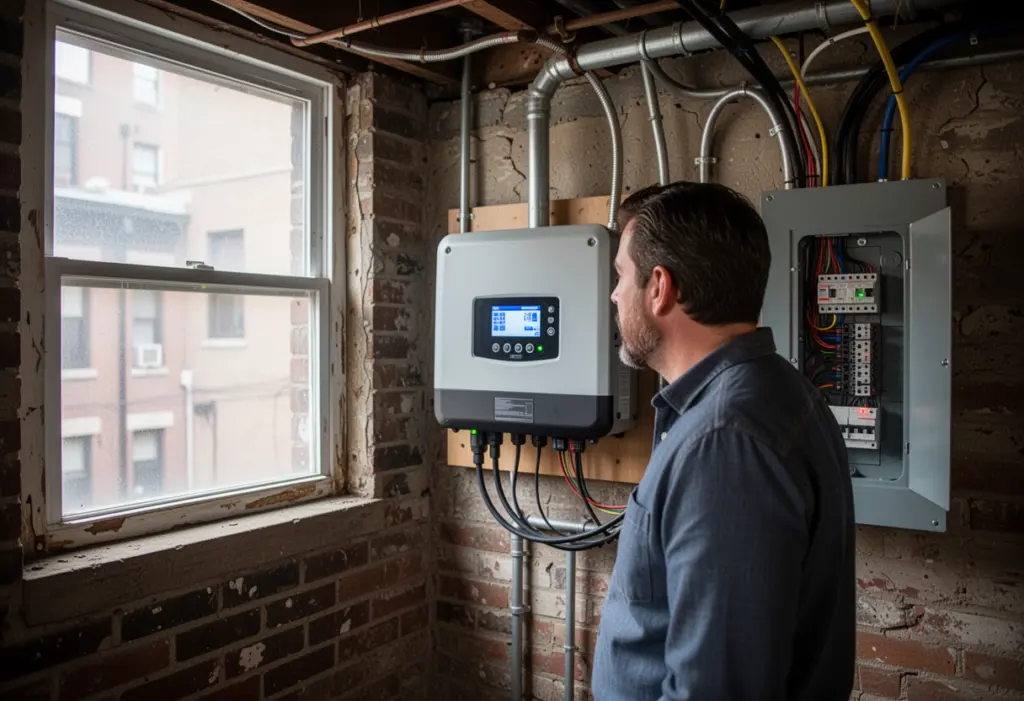
- Read the inverter fault log rather than only the green light. Recurring faults that clear themselves are a warning.
- Check that the rapid shutdown and disconnect labelling is intact and legible. This matters to a firefighter, and inspectors do look at it.
- Clear vegetation. A tree that did not shade the array at commissioning may shade it after five growing seasons, and the shade model your quote was based on assumed the tree as it was that day.
- If you have a battery, follow the manufacturer schedule and check the firmware and the reserve setting. A battery in New York under full retail-rate net metering is a resilience purchase rather than an economic one, and it needs the attention that any resilience equipment needs to be there when it is wanted.
Winter, which is where New York differs
Snow slides off a pitched array on its own as soon as the surface warms, and the loss over a season is smaller than the risk of getting it off in a hurry. Do not climb onto a snow-covered roof, do not use a roof rake across the glass, and do not attack ice with anything metal. On a low-slope roof, where snow sits rather than sheds, the honest answer is to accept the winter loss or to have discussed panel tilt at design time. Watch for ice damming at the eaves on an older house, which is a roof and insulation problem that the array did not cause but can make harder to reach.
What not to pay for
Cleaning a rain-washed pitched array is rarely worth paying for in New York. A maintenance subscription that consists of monitoring you already have and an annual visual inspection you can do with binoculars is usually a poor trade; ask what it includes that you do not already own, and ask whether it covers labour on a warranty repair, which is the part that actually costs money.
Records worth keeping in the same folder
- Panel product and performance warranties, the inverter warranty, and the installer labour warranty, which are three different documents with three different end dates.
- The interconnection approval and permission to operate notice.
- Your baseline first full year of production, which is the only fair thing to compare later years against.
- Your Form IT-255 filing. The New York credit of 25% capped at $5,000 is not refundable, and unused credit carries forward up to five years, so the paperwork matters for longer than one tax season.
The incentive that maintenance touches
Routine maintenance is not new equipment, so it does not create a fresh equipment credit, and that is a question for your tax preparer rather than for a service company selling a plan. What maintenance protects is the production behind everything else: the retail-rate credits under Phase One net metering that run 20 years from interconnection, and the value of an array whose capacity charge you are paying either way. The 30% federal residential credit is gone for expenditures made after 31 December 2025, so nothing about a repair or an upgrade brings it back. Check the current state position with NYSERDA and the Tax Department, because programme terms change from year to year.
Frequently Asked Questions
How often should a New York solar array be serviced?
A monthly look at the production data and one annual visual inspection covers most of it. The value is in catching a dead inverter or a dropped panel early, because the monthly capacity charge continues whether the array produces or not.
Should I clear snow off my panels?
On a pitched roof, no. Snow sheds on its own once the surface warms, and roof rakes and metal tools damage glass, coatings and flashing. Climbing a snow-covered roof is the real hazard here.
Is a paid maintenance plan worth it?
Ask what it includes beyond the monitoring you already have. The part with real value is labour coverage on a warranty repair, since a manufacturer warranty often covers the part only and leaves you the labour and the site visit.
What should I watch for that is specific to New York?
Freeze and thaw movement at the racking, ice damming at the eaves on older houses, rodents nesting under the array, and tree growth that has changed the shading since the system was designed.
This article is general information, not tax, legal or financial advice. Incentive amounts, eligibility rules and deadlines change and depend on your utility, your tax situation and your property. Confirm current terms with NYSERDA, your utility and a qualified tax professional before making a decision.
NY Solar Incentives
Independent New York solar research. We summarise NYSERDA, NY-Sun and federal programme rules from published sources and state plainly when a figure is an estimate. We are not a government agency and do not sell equipment.
Run the arithmetic on your own system
Check the dated program table and your arrangement before counting an incentive. Standard residential NY-Sun blocks are closed; Long Island Affordable Solar has a conditional income-verification route. The NY credit depends on qualified costs and tax liability, while the NYC abatement reduces future property-tax bills. The estimator keeps those timings separate.