Selling a New York House With Leased Solar Panels
The sale hinges on a document most sellers have not read since signing. Pull five numbers out of it before you list, not after you go to contract.
On this page 9 sections
- 01The five numbers to pull out first
- 02What the title search will find
- 03The buyer mortgage question
- 04The New York credit does not reset
- 05What the buyer inherits on the utility side
- 06Three ways the sale can go
- 07Disclosure, and the folder to have ready
- 08The 2026 position on incentives
- 09Frequently Asked Questions
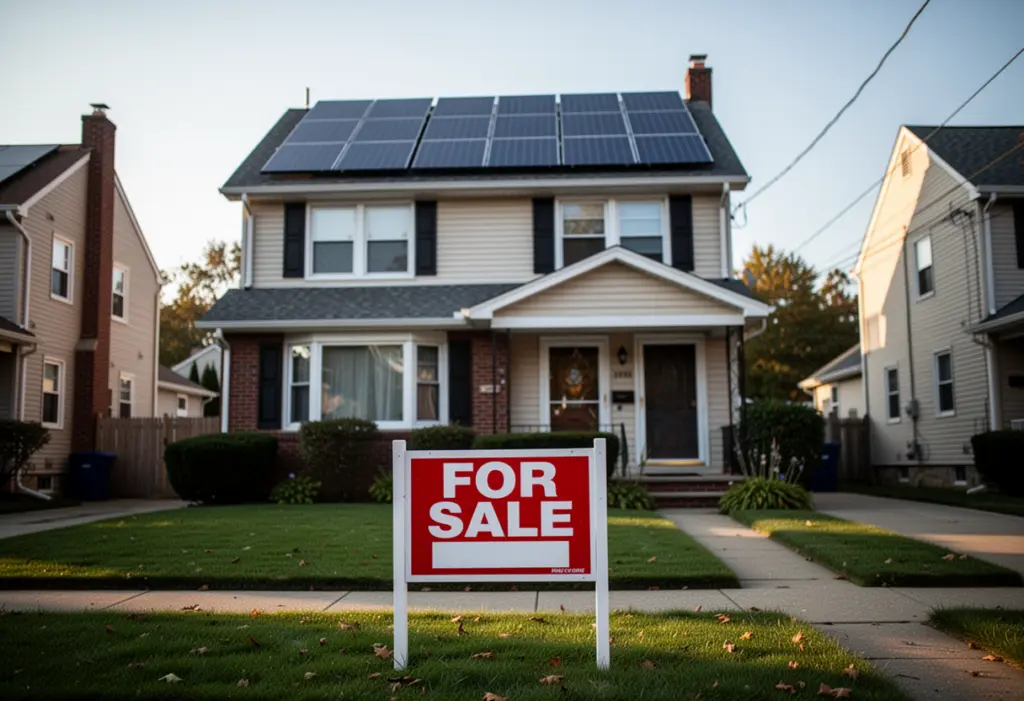
The sale turns on one document you probably have not read since you signed it. Find the lease or power purchase agreement now, not at contract, because the remaining term, the escalator, the transfer conditions and the buyout figure decide how the deal is priced and how long the closing takes. Everything else follows from what that agreement says.
The five numbers to pull out first
- Remaining term. Years left, and the exact end date.
- Current monthly payment and the escalator, the annual percentage by which it rises.
- Transfer conditions. Whether the buyer must qualify on credit, and the fee.
- Buyout figure. What it costs to end the agreement, quoted in writing and dated.
- End-of-term options. Purchase, renewal, or removal, and at whose expense.
The escalator is the number that surprises people. A payment rising by a fixed percentage every year compounds against a utility rate that may not move the same way, so the later years of a long agreement can be markedly worse value than the early ones. A buyer who works that out mid-negotiation will reprice the house, and it is better that you have done the arithmetic first.
What the title search will find
Third-party owned systems are commonly secured by a fixture filing recorded in the office where a mortgage on the property would be recorded. Your closing attorney will surface it and the title company will want it addressed. That is routine, but it is only routine when it is handled early: a filing discovered a week before closing becomes a delay, because releasing or subordinating it runs on the finance company timetable rather than on yours.
Ask the servicer, in writing, for the estoppel or consent letter, the payoff quote and confirmation of what will be filed at closing. Hand all of it to your attorney at listing.
The buyer mortgage question
Your buyer is not only deciding whether they like the array. Their lender is underwriting it. Expect the lease payment to be considered in the buyer debt-to-income calculation, and expect the lender or the title insurer to ask about the equipment filing. Neither is unusual, and neither is fast if it starts at contract. Give the buyer agent the agreement and the servicer transfer pack up front, so the lender can look at it while the appraisal is being ordered.
The New York credit does not reset
This is the point most sale conversations get wrong, and it is worth stating precisely. The New York State solar credit does reach leases and power purchase agreements, unlike the dead federal one, but only agreements running ten years or more, and that ten-year minimum applies to the lease as well as to the PPA. A five or seven year agreement does not qualify at all.
Where it does apply, the $5,000 cap is a lifetime ceiling for that agreement rather than an annual allowance. Form IT-255 requires subtracting what has already been claimed under the same agreement in earlier years, so a buyer inheriting your seventh year inherits the remainder of one ceiling, not a fresh one. And on an agreement running more than 15 years, no credit is allowed after the fifteenth year even if the ceiling has not been used up. Tell the buyer that plainly. Letting them assume a full $5,000 is a dispute waiting to happen after closing.
What the buyer inherits on the utility side
Phase One net metering credits exports at the full retail rate and holds for 20 years from interconnection, so the buyer inherits the remaining years of that clock rather than starting a new one. If the system was interconnected on or after 1 January 2022 it also carries the Customer Benefit Contribution, billed monthly on DC system size regardless of what the array produces. On a 7.6 kW system under PSEG Long Island that is 7.6 multiplied by $1.13, about $8.59 a month, or a little over $100 a year. The rates are recalculated annually.
That charge is separate from the lease payment and the lease does not reduce it. A buyer comparing the lease payment against their old bill needs both numbers in front of them.
Three ways the sale can go
- Transfer the agreement. The usual path. The servicer runs its own process and the buyer normally has to qualify.
- Buy it out and sell an owned array. Cleaner for the buyer and often for the appraisal, but get the buyout in writing and compare it against the remaining payments before deciding it is worth it.
- Fund a partial buydown. A seller credit that reduces or clears the balance can be simpler than renegotiating the price, particularly where the buyer lender is uneasy.
Relocating the array to your next house is the option that sounds appealing and almost never is. You do not own the equipment, and the finance company has no reason whatsoever to agree to it.
Disclosure, and the folder to have ready
Keep the agreement, the transfer pack, the production history from the monitoring portal, the interconnection approval and the utility account details together before the first showing. A leased array is not a problem in a New York sale. An unexplained leased array discovered a fortnight before closing is.
The 2026 position on incentives
The federal residential credit is no longer part of this conversation: section 25D ended for expenditures made after 31 December 2025, measured from when the original installation is completed. The business-side credit claimed by the company that owns your leased system is a different provision entirely and is not yours to sell or transfer. What is genuinely transferable value is the electricity, the remaining net metering term and, on a qualifying agreement of ten years or more, whatever remains of the $5,000 New York ceiling. Rates and programmes change annually, so tell the buyer to confirm the current position with the Department of Taxation and Finance rather than relying on the listing.
Frequently Asked Questions
Can I sell a New York house with leased solar panels?
Yes, and it is common. The sale runs through the finance company transfer process, so request the transfer pack, the estoppel letter and a dated buyout quote when you list rather than when you go to contract.
Does the buyer get the New York solar tax credit on my lease?
Only if the agreement runs ten years or more, and only up to what is left of the $5,000 lifetime ceiling for that agreement. Amounts claimed in earlier years are subtracted on Form IT-255, and nothing is allowed after the fifteenth year.
Will a UCC filing on the panels stop my closing?
Not if it is handled early. A fixture filing on third-party owned equipment is routine, but releasing or subordinating it runs on the finance company timetable, so give it to your attorney at listing rather than at contract.
Should I buy out the lease before selling?
Get the buyout quote in writing and compare it with the remaining payments and with what a buyer will actually pay for an owned array. Sometimes it is worth it; sometimes a seller credit at closing achieves the same thing for less.
This article is general information, not tax, legal or financial advice. Incentive amounts, eligibility rules and deadlines change and depend on your utility, your tax situation and your property. Confirm current terms with NYSERDA, your utility and a qualified tax professional before making a decision.
NY Solar Incentives
Independent New York solar research. We summarise NYSERDA, NY-Sun and federal programme rules from published sources and state plainly when a figure is an estimate. We are not a government agency and do not sell equipment.
Run the arithmetic on your own system
Check the dated program table and your arrangement before counting an incentive. Standard residential NY-Sun blocks are closed; Long Island Affordable Solar has a conditional income-verification route. The NY credit depends on qualified costs and tax liability, while the NYC abatement reduces future property-tax bills. The estimator keeps those timings separate.