What Happens to Solar Panels in a Blackout in New York?
A standard grid-tied array stops within seconds of losing utility power and stays off until it returns, even at noon in June. That is a requirement rather than a fault.
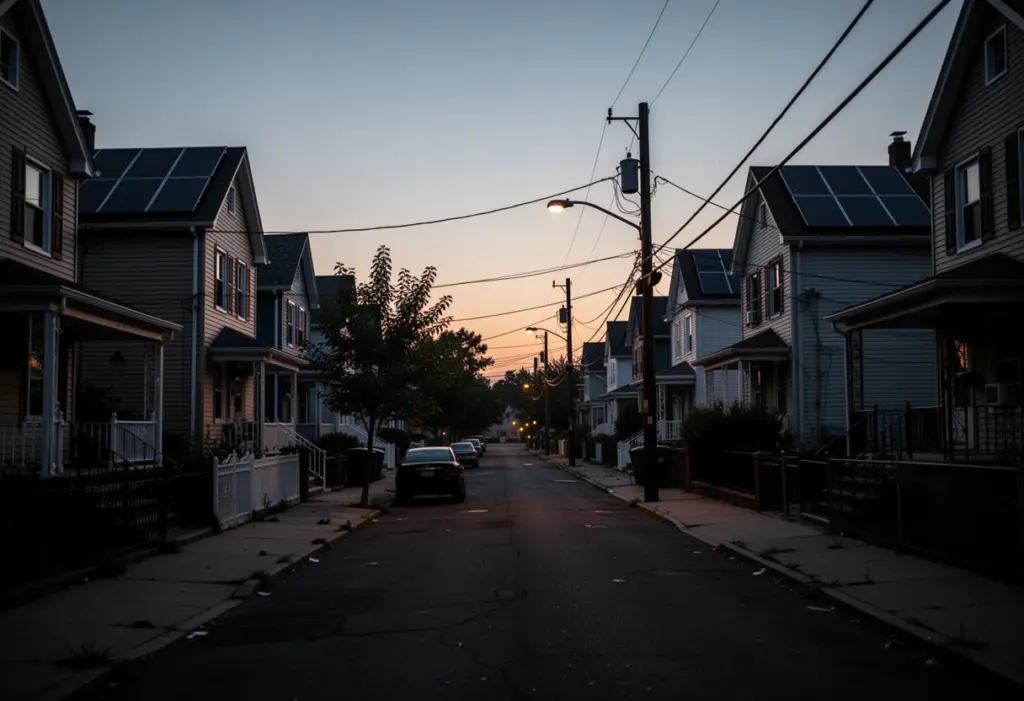
They stop. A standard grid-tied solar system shuts down within seconds of losing the utility supply and stays off until it comes back, even at noon in June with the roof in full sun. That is a requirement rather than a fault, and it catches out a great many people who bought panels partly so that this would not happen. Getting power from your own roof during an outage takes additional equipment, and there are three ways to do it.
Why it shuts down
Two reasons sit behind the rule. The first is that utility crews restore lines on the assumption that a de-energised line is de-energised, and an array quietly back-feeding into the neighbourhood would make that assumption false. The second is technical: an ordinary grid-following inverter needs a stable voltage and frequency reference to work against, and with the grid gone there is nothing to follow.
So the inverter disconnects, waits, and reconnects on its own once supply has returned and held steady for a set period. That delay is normal, and it is why production sometimes resumes several minutes after the lights do rather than instantly.
What you will actually see
- The inverter goes dark or shows a grid-related status rather than an error.
- Your monitoring shows a flat line for the duration, and probably nothing at all if the monitoring itself runs over your home internet.
- Production restarts by itself. If it has not restarted well after the neighbourhood is back and stable, that is now worth reporting.
A blackout is not something to report to your installer. A system that fails to come back afterwards is.
The three ways to have power anyway
A battery with a protected loads panel. Selected circuits are moved onto a separate subpanel that the battery feeds when the grid drops. It is automatic, silent and needs no fuel, and it is limited by the size of the battery and by whether the sun is out to refill it. This is the option people usually mean when they say they want backup.
A limited daytime backup output on the inverter. Some inverters can provide a modest amount of power from a dedicated outlet while the sun is shining, without a battery. It runs a fridge or charges phones and it stops when a cloud passes. It is better than nothing and it is not a house.
A generator with a transfer switch. The most capacity for the money and the only one that keeps going for days, at the cost of fuel, servicing, noise and a machine that has to start when you need it.
Size it against your actual outages
Before pricing any of them, write down what you genuinely need to keep running and for how long. A well pump, a sump pump, a freezer, heating controls, medical equipment and a router are a very different specification from an air conditioner and an electric range. Then look at how often and how long your power actually goes out, which for many New York households is a handful of hours a year and for some rural ones is a serious annual event.
Be clear-eyed about the economics too. Under Phase One net metering an exported kilowatt-hour already earns the full retail rate, and it holds that way for 20 years from interconnection, so putting that same kilowatt-hour through a battery instead does not add to what it was worth. Storage in New York buys availability, not savings. That is a perfectly good reason to buy it, but it is the reason.
Three things worth doing before the next outage
- Find the AC disconnect and the solar breaker now, and learn what normal looks like on the inverter display.
- Keep the installer’s number and your system details somewhere that does not require power or internet to read.
- If you have backup, test it deliberately once rather than discovering its limits during an ice storm.
Where 2026 incentives stand
Storage is where people most often assume an incentive that no longer exists. The federal residential credit that used to reach batteries is gone: section 25D was terminated for expenditures made after 31 December 2025, with an expenditure treated as made when the original installation is completed, so any 2026 proposal pricing storage against a 30% federal credit is materially wrong. New York’s own credit is a solar energy system equipment credit of 25% capped at $5,000 on Form IT-255 for a principal residence, and what portion of a combined solar and storage job counts as qualified expenditure is a question for your accountant rather than for the company quoting it. Ask NYSERDA and your utility directly what, if anything, applies to storage, rather than assuming the solar incentive stretches to cover it.
The solar side is unchanged: the state sales tax exemption and RPTL 487’s 15-year property tax exemption on added value where the municipality, the county and the school district have each not opted out, which requires the system to be constructed before 1 January 2030. NY-Sun is not part of it: as of September 2026 NYSERDA has no open NY-Sun block for homes in any utility territory; check NYSERDA’s NY-Sun dashboard for a new one. And the running cost follows the array regardless of any of this. The Customer Benefit Contribution is charged per kilowatt of DC size every month, whatever the system produces, on residential systems interconnected on or after 1 January 2022: a 6 kW system on Central Hudson pays 6 multiplied by $1.67, or $10.02 a month and $120.24 a year, in the month of the blackout exactly as in every other. Confirm current programme terms with NYSERDA before you commit to equipment.
Frequently Asked Questions
Do solar panels work during a power outage?
Not on their own. A standard grid-tied system disconnects within seconds of losing utility supply and stays off until it returns, even in full sun, so that crews restoring lines are not working on a live circuit.
Will my system restart by itself after the power comes back?
Yes. The inverter reconnects once supply has returned and held steady for a set waiting period, which is why production sometimes resumes minutes after the lights do. If it has not restarted, report it.
What equipment lets me use solar during a blackout?
A battery feeding a protected loads subpanel, a limited daytime backup outlet available on some inverters, or a generator with a transfer switch. They differ in capacity, cost, noise and whether they need fuel.
Does a battery save me money in New York?
Not really. Under full retail net metering an exported kilowatt-hour already earns retail rate for 20 years, so storing it adds nothing to its value. A battery buys availability during outages rather than savings.
This article is general information, not tax, legal or financial advice. Incentive amounts, eligibility rules and deadlines change and depend on your utility, your tax situation and your property. Confirm current terms with NYSERDA, your utility and a qualified tax professional before making a decision.
NY Solar Incentives
Independent New York solar research. We summarise NYSERDA, NY-Sun and federal programme rules from published sources and state plainly when a figure is an estimate. We are not a government agency and do not sell equipment.
Run the arithmetic on your own system
Check the dated program table and your arrangement before counting an incentive. Standard residential NY-Sun blocks are closed; Long Island Affordable Solar has a conditional income-verification route. The NY credit depends on qualified costs and tax liability, while the NYC abatement reduces future property-tax bills. The estimator keeps those timings separate.