Squirrels Under Solar Panels: A New York Problem
The warm, dry, sheltered gap under your panels is exactly what a squirrel is looking for. Preventing it costs a fraction of fixing it.
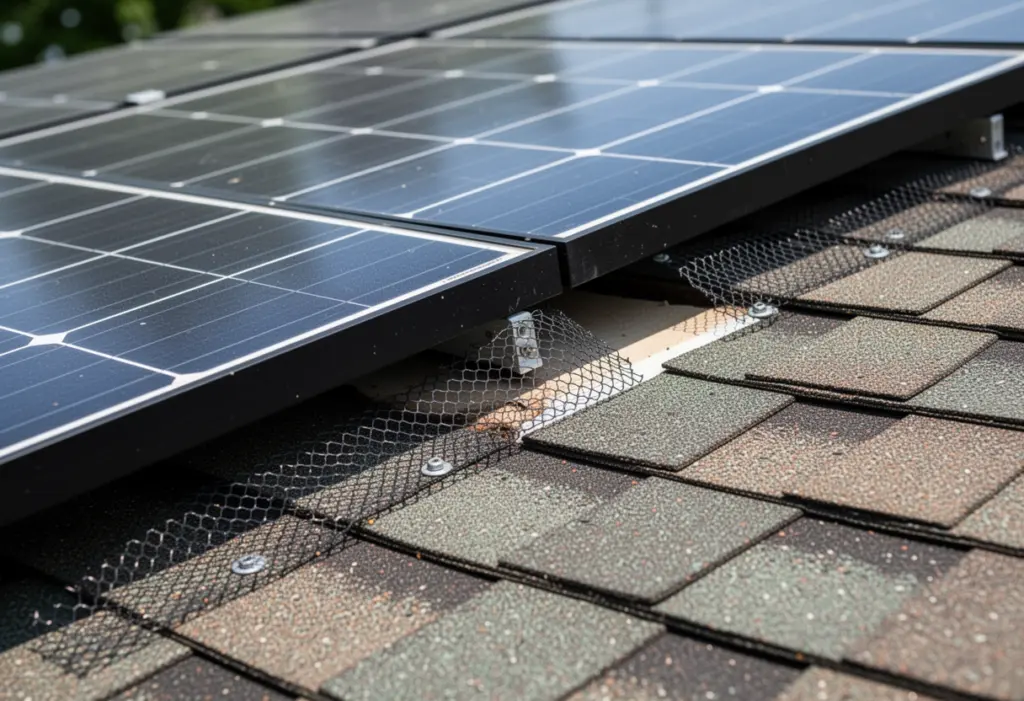
The gap between your panels and your roof is a few inches of dry, sheltered, slightly warm space with a roof over it and a clear view of the neighbourhood. From a squirrel’s point of view it is close to ideal, and in New York — where grey squirrels are abundant in every suburb and every city with trees — they find it.
Why it matters beyond the nuisance
They chew wiring. This is the real problem. Rodents gnaw to manage their teeth, and DC cabling running under an array is exactly the right diameter. A chewed conductor can take out a string, and damaged insulation on a live DC circuit is a genuine hazard rather than an inconvenience.
Nesting material blocks airflow. Panels run cooler with air moving beneath them, and cooler panels produce more. Packed nesting material also holds moisture against the roof.
Debris and droppings accumulate, and where an array sits above a valley or a gutter, that ends up in the drainage.
They also get into the attic from the same area, which is a bigger problem than the solar.
The fix is a mesh, and it is cheap at the right moment
Critter guard is a mesh — typically galvanised or stainless steel — clipped around the perimeter of the array, closing the gap between the panel edge and the roof. It does not touch the panels or affect production, and it is essentially invisible from the ground.
Fitted during installation it is a modest line item. Fitted afterwards it means a second visit, and if wiring is already damaged it means diagnosis and repair on top.
It is one of the few genuinely worthwhile options to add to a New York quote. Ask for it explicitly — plenty of installers do not include it by default, and it is not usually offered.
What to do if they are already there
- Do not seal them in. Trapping animals under an array is inhumane and produces a worse problem when they die there. Removal first, then exclusion.
- Get the wiring inspected. This is the part that matters. Ask your installer to check for damage — visually and, where the monitoring supports it, at string level.
- Then fit the guard, once the array is clear.
- Check the attic and soffits, because the same animals frequently use both.
Wildlife removal is its own trade and New York has rules about how it may be done. A solar installer is the right call for the wiring and the mesh; a licensed wildlife control operator is the right call for the animals.
Birds are the same problem, gently
Pigeons and starlings nest under arrays for the same reasons. Less chewing, more debris and blocked airflow, and the same mesh solves it. In dense parts of New York City and older suburbs, birds are the more likely occupant.
Prevention that does not involve the array
- Trim branches back from the roof. Squirrels reach a roof by jumping, and a metre of clearance removes most of the routes. This helps your shading too.
- Keep bird feeders away from the house.
- Check the soffits and fascia for existing entry points.
Is it covered?
Usually not. Rodent damage is commonly excluded from homeowners insurance, and it is not a manufacturing defect so the product warranty does not apply either. Whether an installer’s workmanship warranty covers the repair depends on the wording — and if critter guard was offered and declined, expect that to be raised.
Which is the argument for the mesh: it is a small, one-off cost against a repair that nobody else is going to pay for.
Frequently Asked Questions
Why do squirrels get under solar panels?
The gap between the panels and the roof is dry, sheltered and slightly warm, with cover overhead — close to an ideal nesting site. In New York, where grey squirrels are abundant in almost every suburb, arrays without a perimeter guard are found quickly.
What damage do squirrels do to solar panels?
They chew wiring, which can take out a string and leaves damaged insulation on a live DC circuit — a genuine hazard. Nesting material also blocks the airflow that keeps panels cool and holds moisture against the roof.
What is critter guard and should I add it?
A galvanised or stainless mesh clipped around the array perimeter, closing the gap to the roof. It does not affect production and is essentially invisible from the ground. Ask for it explicitly — many installers do not include it by default, and fitting it later means a second visit.
Is squirrel damage to solar panels covered by insurance?
Usually not. Rodent damage is commonly excluded from homeowners policies, and it is not a manufacturing defect so the product warranty does not apply. Whether the workmanship warranty covers it depends on the wording.
This article is general information, not tax, legal or financial advice. Incentive amounts, eligibility rules and deadlines change and depend on your utility, your tax situation and your property. Confirm current terms with NYSERDA, your utility and a qualified tax professional before making a decision.
NY Solar Incentives
Independent New York solar research. We summarise NYSERDA, NY-Sun and federal programme rules from published sources and state plainly when a figure is an estimate. We are not a government agency and do not sell equipment.
Run the arithmetic on your own system
Check the dated program table and your arrangement before counting an incentive. Standard residential NY-Sun blocks are closed; Long Island Affordable Solar has a conditional income-verification route. The NY credit depends on qualified costs and tax liability, while the NYC abatement reduces future property-tax bills. The estimator keeps those timings separate.