What a Heat Pump Costs in Westchester
Westchester heat pump quotes vary because of ductwork, electrical service and removals, not the equipment. Here is every line on the quote, what moves it, and the 2026 rebate route.
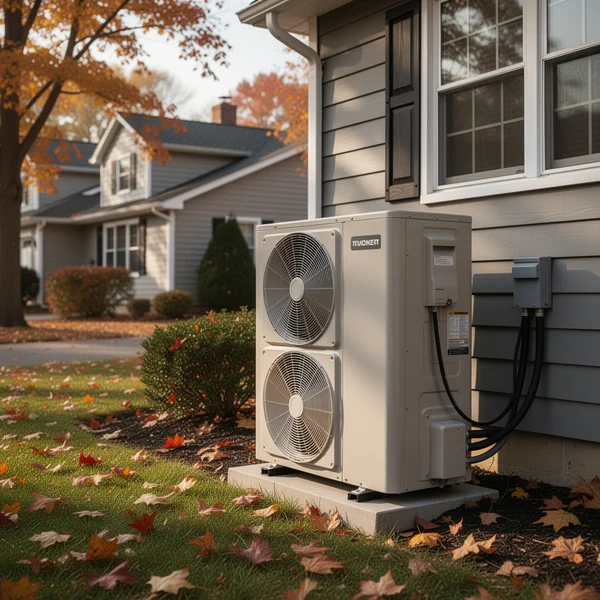
There is no single heat pump cost for Westchester, and any page that gives you one is quoting a national average with a county name pasted on top. Two houses on the same street in Ossining can receive quotes far apart because heat pump pricing is dominated by three line items that have nothing to do with the heat pump: how heat gets distributed through the house, what the electrical service can take, and what has to be removed before the new equipment goes in.
So instead of a number we will not stand behind, here is the anatomy of a Westchester quote — every line that appears on one, which lines move, and what makes them move in this county specifically.
The line items in a Westchester heat pump quote
| Line | What it covers | How much it varies |
|---|---|---|
| Equipment | Outdoor condensing unit, indoor air handler or heads, controls | Least variable line. It is a catalogue item with a model number. |
| Distribution | New ductwork, modifications to existing ducts, refrigerant line sets, line-hide covers, condensate handling | Highly variable. Usually the biggest swing on the page. |
| Electrical | Dedicated 240 V circuit, outdoor disconnect, receptacle, possible panel or service upgrade | Modest, unless the load calculation fails — then it is a project of its own. |
| Removal | Old furnace or boiler out, oil tank closure, chimney work | Highly variable in north-county houses. |
| Permits and inspection | Municipal building and electrical permits, third-party electrical inspection | Set by your village, town or city, not by the contractor. |
| Design and commissioning | Manual J load calculation, refrigerant charge verification, controls set-up, aux-heat lockout | Small line, disproportionate effect on your running cost. |
When you receive three quotes, put them side by side against this table before you compare bottom lines. Quotes that look wildly different usually turn out to be pricing different scopes — one bidder assumed the existing ducts were reusable and another did not.
What actually drives the spread here
The distribution system you already have. Westchester’s housing stock skews old, and a great deal of it is heated hydronically — cast-iron radiators or baseboard fed by a boiler, with no ducts anywhere. That is not a barrier, but it changes the machine: ducted air handlers become ductless heads, or an air-to-water heat pump feeding the existing loop, and each carries its own price and its own design constraints. Homes with a 1960s ducted system in the basement are usually the cheapest conversions in the county; a 1910 colonial in Bronxville with radiators and no chases is usually the dearest.
Where the outdoor unit is allowed to sit. Village side-yard setbacks and local noise ordinances genuinely constrain placement in Westchester, and a unit that has to move to the rear of the property or onto a stand brings a longer line set with it. In Scarsdale, Bronxville, Larchmont and the historic districts of Ossining and Croton, architectural or historic review can also have a view on a condenser visible from the street — worth raising with the building department early rather than after the equipment is on site.
Oil, and what is under the lawn. A meaningful share of northern Westchester still heats with oil, and removing the boiler means dealing with the tank. Proper closure — cleaned, certified, and documented, whether the tank is in the basement or buried — is a separate trade with its own regulatory requirements, and discovering it mid-project is how a schedule slips. Get it priced up front and get the closure paperwork; a buyer’s attorney will ask for it.
The orphaned water heater. If you pull a gas boiler off a masonry chimney but leave a gas water heater vented into it, the flue is now oversized for the remaining appliance and can fail to draft properly. The fix — relining, or converting the water heater at the same time — belongs in the quote. A contractor who does not mention it has not thought about your chimney.
The panel. Plenty of Westchester houses are on a 100-amp service that was sized for a gas furnace and one air conditioner. Adding a heat pump, and later an EV charger, can exhaust it. The same ceiling shows up whenever people electrify in stages, and it is worth planning the sequence in one go rather than paying for two electrician visits.
Permits: forty-odd building departments, not one
Westchester’s cities, towns and villages each run their own building department with their own fee schedule and their own queue. The permit path in Yonkers is not the permit path in Pound Ridge, and turnaround times differ enough to matter to your install date. Outside New York City the pattern is consistent in structure: the municipality issues the permit, and a third-party electrical inspection agency the municipality recognises inspects the electrical work and issues a certificate of compliance. Keep that certificate — it is the document an appraiser or a buyer’s attorney asks for later.
Contractor licensing is a county-level matter here: home improvement contractors working in Westchester are licensed through the county’s consumer protection department. Checking a licence takes two minutes and is the cheapest due diligence available. Multi-family and high-rise owners in White Plains, New Rochelle and Yonkers have an extra layer — board approval, an alteration agreement, and a real question about riser capacity and where a condenser may be mounted.
The 2026 money picture, plainly
A Westchester household installing a heat pump in 2026 receives nothing federal. Section 25C — the Energy Efficient Home Improvement Credit, which had allowed up to $2,000 a year toward a qualifying heat pump — applied to property placed in service through 31 December 2025, as the IRS states. Section 25D, the residential clean energy credit, terminated for expenditures after the same date. If a salesperson’s spreadsheet still shows 30% coming back from the federal government, the payback on that page is fiction. The same cliff hit the solar side, and we cover it in The Federal Solar Tax Credit and New York: What Changed.
What remains is NYS Clean Heat, administered by NYSERDA with seven sponsoring utilities. Most of Westchester takes electric service from Con Edison, which is one of them — so for most of the county the rebate route runs through Con Edison’s Clean Heat programme and a participating contractor. Two mechanics to understand:
- The rebate is claimed by the contractor, not by you, and typically appears as a discount on the invoice. That means a quote showing a low “net” price may simply be the same gross price with the rebate already subtracted. Ask every bidder to show gross price and rebate as two separate lines so you can compare like with like.
- There is no single statewide rebate table. Amounts vary by utility and equipment type, and the honest answer to “how much will I get” is the address-based finder at cleanheat.ny.gov. Anyone quoting a fixed per-ton figure from memory is guessing.
One more clarification worth having before April: New York’s Form IT-255 credit — 25% of system cost capped at $5,000, carried forward up to five years — is a solar equipment credit. It does not cover heat pumps. If you are pairing the two projects, that credit applies to the solar half only. The county-level incentive picture for the solar side is set out in Solar Incentives in Westchester County, NY, with local pricing detail in Solar Panel Cost in White Plains and Westchester and Solar Panel Installation in Yonkers, New York. What else the state still funds beyond panels is in New York State Renewable Energy Incentives Beyond Solar.
What to do next
- Get three quotes and force them onto the line-item table above before comparing totals — most of the apparent price gap will resolve into scope differences.
- Require a Manual J load calculation with the design temperature stated, plus the exact outdoor and indoor model numbers, in writing.
- Ask each bidder to show gross price and Clean Heat rebate as separate lines, and confirm they are enrolled in Con Edison’s programme.
- If you are on oil, price tank closure and chimney work as explicit lines, and keep the closure documentation.
- Call your village or town building department for the permit fee and current turnaround before committing to an install date, and verify the contractor’s Westchester County home improvement licence.
- Run your address through the Clean Heat finder yourself so you know what the rebate should be before a salesperson tells you.
NY Solar Incentives
Independent New York solar research. We summarise NYSERDA, NY-Sun and federal programme rules from published sources and state plainly when a figure is an estimate. We are not a government agency and do not sell equipment.
Run the arithmetic on your own system
Check the dated program table and your arrangement before counting an incentive. Standard residential NY-Sun blocks are closed; Long Island Affordable Solar has a conditional income-verification route. The NY credit depends on qualified costs and tax liability, while the NYC abatement reduces future property-tax bills. The estimator keeps those timings separate.