Stopping Heat Pump Condensate From Freezing in a New York Winter
Defrost meltwater has to leave the base pan and not come back as ice. Mounting height, a gravel bed, a pan heater and what is above the unit decide whether it does.
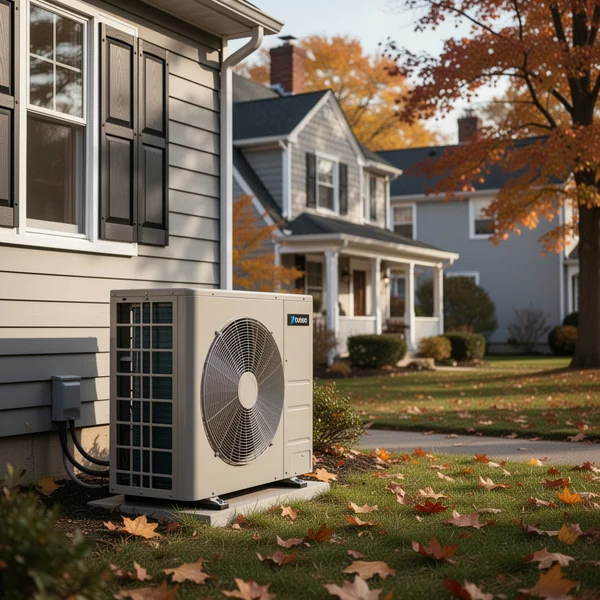
Heat pump condensate freezing in winter is normal physics being handled badly by the installation, not a broken machine. Every cold-weather heat pump periodically runs a defrost cycle that melts frost off the outdoor coil, and that meltwater has to leave the base pan, drain away from the unit, and not come back as ice.
When it does come back as ice, you get the failure New Yorkers photograph and post every January: a solid block growing up from the pad, the fan blades locked, the coil encased. By then the damage is often already done. Almost all of it is preventable with decisions made at install time.
Where the water comes from
In heating mode the outdoor coil is the cold side. Moisture in the outdoor air condenses on it and freezes. Frost insulates the coil and kills capacity, so the unit reverses briefly, sends hot refrigerant to the outdoor coil and melts the frost. That is the defrost cycle — you see steam, hear the reversing valve, and the fan stops for a few minutes.
The result is a slug of water in the base pan, at an ambient temperature well below freezing, several times a day, all winter. In Watertown, Oswego and the Tug Hill towns, or anywhere downwind of Erie and Ontario, that repeats a great many times through a lake-effect stretch. Long Island’s milder, damper winters produce fewer hard freezes but more total water.
The three ways it goes wrong
- The unit sits too low. A condenser on a slab at grade in Buffalo or Syracuse is under snow by January and its meltwater has nowhere to go but into the drift around it, where it refreezes into a shell.
- The water cannot drain away. A flat concrete pad with no fall, or a pad that has settled toward the house, holds meltwater under the unit until it freezes. Each defrost cycle adds another layer.
- Water is falling on it from above. A roof valley or a missing gutter section dumping onto a condenser is a guaranteed ice column, and it is astonishingly common because nobody looks up when they pick the location.
Stopping heat pump condensate from freezing: what actually works
Get it up off the ground
The single most effective measure in New York is height. Mount the outdoor unit on a wall bracket or an elevated stand so the base of the unit clears your local maximum snow depth with room to spare, and so meltwater falls clear rather than pooling under the coil. Snow country installers routinely mount higher than manufacturers’ minimums, and they are right to.
Wall brackets have one caveat worth knowing: they transmit compressor vibration into the structure. On a wood-framed house, use isolation pads and mount to a solid framing member, not to sheathing.
Drain the ground underneath
Set the unit over a bed of coarse gravel that lets meltwater soak away, rather than over a sealed pad that holds it. Where a pad is required, make sure it slopes away from the house and away from the unit, and that the ground beyond it does the same. Water that leaves is water that cannot become an ice pillar.
Do not pipe it, in most cases
The instinct to run a hose from the base pan to a drain is usually wrong outdoors in New York. A small-diameter hose full of near-freezing water in a January cold snap freezes solid, and then it backs up into the pan. Unless the manufacturer specifically calls for a drain kit with a heater, let the unit drain freely and manage the ground instead.
Use the base pan heater the manufacturer sells
Most cold-climate units offer an optional base pan heater — a low-wattage element that keeps the pan and the drain openings above freezing so defrost water leaves rather than accumulating. In upstate New York this is not a luxury option; treat it as part of the specification and ask the contractor explicitly whether it is included and how it is controlled. Some are thermostatically controlled and some run on a simple ambient sensor; the controlled ones use less electricity.
Keep snow away from it
Look at what is above and beside the unit before install, not after:
- No roof valley, gutter outlet or eave without a gutter discharging above it.
- Not directly under a metal roof that sheds a slab of snow at once — that has crushed more than one condenser.
- Not where the driveway plough windrows snow, and not where roof rakes will pile it.
- Clear space around all sides for airflow; a unit buried on three sides recirculates its own cold discharge air and frosts faster.
A snow-clearing habit is part of owning a heat pump in this climate, in the same way that clearing panels is part of owning solar in the snowbelt — the same seasonal reality is discussed in Snow on Solar Panels in New York: What to Do. Clear with a broom or by hand, never with a shovel edge against the coil fins and never with hot water, which refreezes.
Indoor condensate freezes too
Two indoor cases catch people out:
- Ducted air handlers in unconditioned attics. The condensate line and the pump run through a space that is at outdoor temperature all winter. That line needs insulation and, in many New York attics, self-regulating heat tape. A frozen line means water finds another way out, usually through a bedroom ceiling.
- Condensate pumps in cold basements and crawlspaces. Pumps and their discharge tubing freeze in unheated crawls. Route the discharge inside conditioned space where possible, and where the tubing exits the building, slope it so it drains rather than holding a slug of water at the exit.
In cooling season the indoor coil produces most of the condensate, and the failure mode reverses — a plugged drain in August is the common one. Cleaning the drain and pan at the end of the cooling season is what prevents a January surprise.
When it is not a drainage problem
Some icing is a mechanical fault, and no amount of gravel fixes it. Call a technician if:
- The unit ices up and never initiates a defrost cycle — a failed defrost board, sensor or thermostat.
- It defrosts constantly, far more often than the outdoor conditions justify.
- Ice forms on the refrigerant lines rather than on the coil face, which can indicate a charge or airflow problem.
- It ices heavily in mild, dry weather, when there is little moisture to explain it.
Do not chip ice off with anything metal, and do not run hot water into the unit while it is powered. Shut it off, let it thaw, and get the fault diagnosed. To find someone qualified in your area, the same approach used for solar applies — see What a NYSERDA-Qualified Contractor Actually Is.
Getting it right at purchase time
Almost everything above is a specification decision, which means it is cheapest before the contract is signed. Put these in writing in the proposal: mounting height and mounting method, base pan heater included or not, pad or gravel bed and its slope, distance from roof discharge, snow clearance plan, and condensate line insulation and heat tape for any line running through unconditioned space.
On cost: NYS Clean Heat rebates, administered by NYSERDA with seven sponsoring utilities — Central Hudson, Con Edison, National Fuel Gas, National Grid, NYSEG, Orange & Rockland and RG&E — are claimed by a participating contractor and taken off the invoice. Amounts are not published as one statewide table; check your address at cleanheat.ny.gov/find-available-rebates. And be clear about the federal side: both 25C and 25D ended for property placed in service after 31 December 2025, so a 2026 install in New York gets nothing federal. Optional cold-weather accessories are yours to pay for. The wider state incentive picture is in New York State Renewable Energy Incentives Beyond Solar.
What to do next
- Go outside and look at your unit now: is it high enough for a bad February, is water pooling under it, is anything above it discharging onto it?
- Check whether your model has a base pan heater and whether it was installed. Your contractor can tell you from the model and accessory numbers.
- Trace any condensate line running through an attic, crawlspace or unheated basement and insulate it; add self-regulating heat tape where it is exposed.
- Clear snow with a broom after each significant storm, keeping all sides open for airflow.
- If icing is happening without a defrost cycle running, stop troubleshooting drainage and book a technician.
- If you are still at quote stage, put mounting height, pan heater and drainage in the written scope before you sign.
NY Solar Incentives
Independent New York solar research. We summarise NYSERDA, NY-Sun and federal programme rules from published sources and state plainly when a figure is an estimate. We are not a government agency and do not sell equipment.
Run the arithmetic on your own system
Check the dated program table and your arrangement before counting an incentive. Standard residential NY-Sun blocks are closed; Long Island Affordable Solar has a conditional income-verification route. The NY credit depends on qualified costs and tax liability, while the NYC abatement reduces future property-tax bills. The estimator keeps those timings separate.