Solar Panel Installation in Yonkers, New York
Yonkers combines Con Edison rates with dense, hilly housing stock. Here is what that means for a solar installation and what it is worth in 2026.
On this page 8 sections
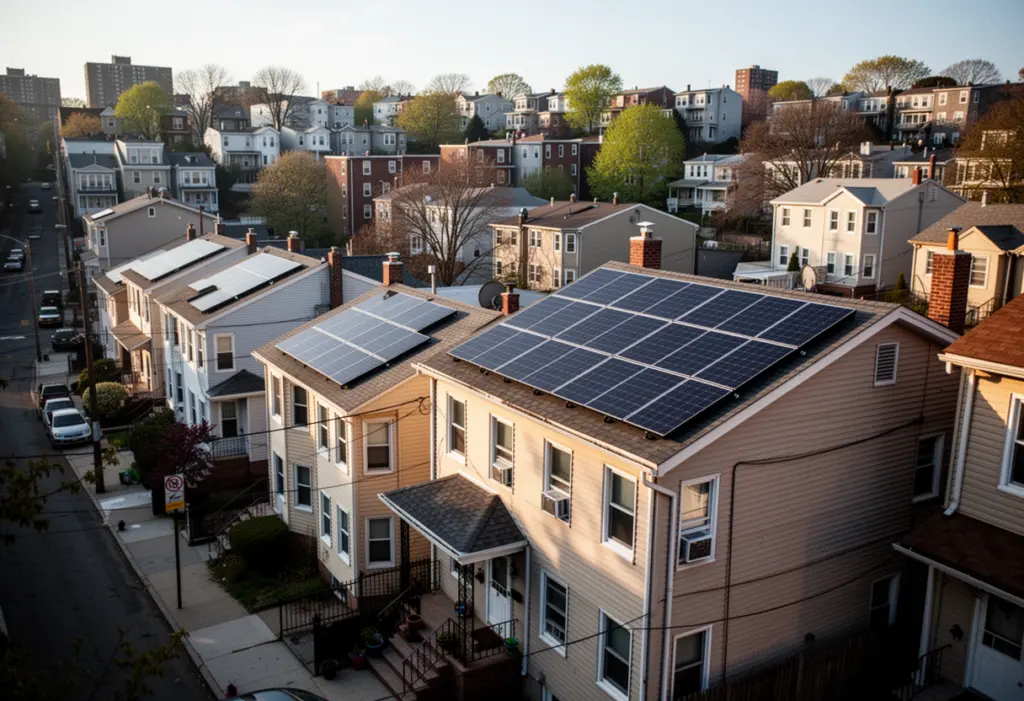
Yonkers is New York’s fourth-largest city and its solar market looks like nowhere else in Westchester: dense, hilly, mixed between one-family houses, two-families and small apartment buildings, and served by Con Edison.
Why Con Edison territory helps the arithmetic
Westchester retail electricity is expensive. Under Phase One net metering each exported kilowatt-hour earns a credit at the full retail rate, so the higher the retail rate, the more each unit your roof exports is worth. That is the single largest reason solar economics in Yonkers are stronger than in much of upstate New York, where power is cheaper.
A system interconnected today holds that net-metering treatment for 20 years.
The Con Edison charge to put in your arithmetic
Residential customers who interconnected on or after 1 January 2022 pay a monthly Customer Benefit Contribution based on the DC size of the system rather than its output. Con Edison’s final 2026 residential rate is $1.29 per kW-month.
An 8 kW system pays 8 × $1.29 = $10.32 a month, about $124 a year. It is recalculated annually rather than locked in, and it will not appear in most sales proposals.
What is different about a Yonkers roof
- Slope and access. Yonkers is built on hills. Staging equipment on a steep, narrow lot takes longer than on a flat suburban plot, and labour reflects that.
- Density and shading. Houses sit close together and many streets carry mature trees. A shading assessment is not optional here — it is the difference between a real production estimate and a template.
- Mixed housing types. A great deal of Yonkers housing is two-family or small multi-family. Who owns the roof, who pays the electric bill, and which meter the system offsets are questions that must be settled before design, not after.
- Roof stock. Older housing means more roofs near the end of their life. If the shingles have under about ten years left, do the roof first.
Permits and the sequence
- Twelve months of Con Edison usage, a shading assessment, and a roof condition and structural check.
- Interconnection application filed with Con Edison, ideally before installation.
- City of Yonkers building permit and electrical filing.
- Installation, then electrical inspection.
- Certificate to Con Edison, meter exchange, and permission to operate. The system may not run before PTO.
Most delay in Westchester is municipal rather than utility. Ask your installer what the City of Yonkers is currently running at for solar permits, based on their own recent projects.
If you own a two-family or small multi-family
This is common in Yonkers and it changes the project. A system connected behind one meter offsets that meter only. If tenants pay their own electricity, an owner-side system offsets the owner’s usage — hallways, boiler, common areas — and not theirs. Whether that is worth doing depends on how large the owner’s own load is, and it is worth modelling honestly before signing.
Where the building is master-metered, the calculation is entirely different and usually better.
Property tax in Westchester
RPTL 487 exempts the added value of a solar system from property tax for 15 years, but municipalities may opt out and Westchester’s cities, towns, villages and school districts have each made that choice for their own levy. Yonkers is one of New York’s Big Five city school districts, which are fiscally dependent and levy no separate school property tax — so here you check the city and the county, and there is no separate school levy to check. This is genuinely local and no statewide page can answer it for your address.
2026 incentives
The 30% federal residential credit ended for expenditures made after 31 December 2025 — the expenditure being treated as made when the original installation is completed. New York’s 25% credit capped at $5,000 on Form IT-255 remains and, importantly for a market with many lease and PPA offers, reaches leases and PPAs of ten years or more as well as purchases too. The state sales tax exemption and RPTL 487 also remain. As of September 2026 NYSERDA has no open NY-Sun block for homes in any utility territory; check NYSERDA’s NY-Sun dashboard for a new one.
Frequently Asked Questions
Is solar worth it in Yonkers?
Westchester retail electricity is expensive and net metering credits exports at the full retail rate, so each exported kilowatt-hour is worth more here than in cheaper upstate territories. The main constraints are shading, roof age and lot access rather than the economics.
Which utility connects solar in Yonkers?
Con Edison, which serves most of New York City and most of Westchester. The Rockaway Peninsula in Queens is the exception — it is PSEG Long Island territory. Con Edison’s 2026 residential Customer Benefit Contribution rate is $1.29 per kW-month, about $124 a year for an 8 kW system.
Can I put solar on a two-family house in Yonkers?
Yes, but a system behind one meter offsets only that meter. If tenants pay their own electricity, an owner-side system offsets the owner's usage only. Settle which meter the system serves before the design stage.
Does solar raise property taxes in Yonkers?
RPTL 487 exempts the added value for 15 years, but municipalities may opt out: in Yonkers the city and Westchester County each decide for their own levy, and the Yonkers city school district is one of the five that cannot opt out. File form RP-487 with the assessor by the taxable status date the city charter sets, and check both for your address.
This article is general information, not tax, legal or financial advice. Incentive amounts, eligibility rules and deadlines change and depend on your utility, your tax situation and your property. Confirm current terms with NYSERDA, your utility and a qualified tax professional before making a decision.
NY Solar Incentives
Independent New York solar research. We summarise NYSERDA, NY-Sun and federal programme rules from published sources and state plainly when a figure is an estimate. We are not a government agency and do not sell equipment.
Run the arithmetic on your own system
Check the dated program table and your arrangement before counting an incentive. Standard residential NY-Sun blocks are closed; Long Island Affordable Solar has a conditional income-verification route. The NY credit depends on qualified costs and tax liability, while the NYC abatement reduces future property-tax bills. The estimator keeps those timings separate.